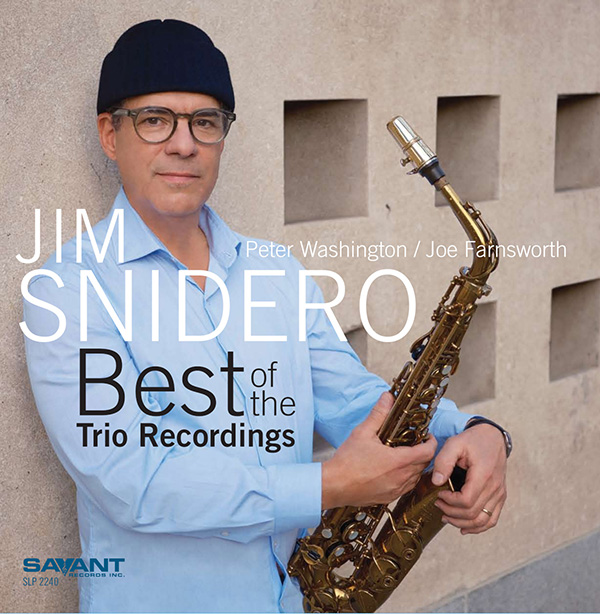
Jim Snidero: Best of the Trio Recordings
Snidero, alto saxophone; Peter Washington, bass; Joe Farnsworth, drums
Savant Records SLP 2240 (LP). 2026. Snidero, Barney Fields, prods.; Ken Heckman, Dave Darlington, engs.
Performance ****
Sonics **** This LP, which compiles material from two earlier Savant Records CDs, arrived the day before Sonny Rollins died. Even though Snidero plays alto, it reminded me of the great tenor player. Why did it remind me of Sonny? I wasn't sure myself. I thought about it. The first reason, I think, is the ensemble sound. This is a saxophone trio, like the group (Rollins, Ray Brown, Shelly Manne) that plays so memorably on Rollins's Way Out West. That sound is stuck in my head forever—a good thing.
Another reason is the repertoire. No, Snidero and crew do not play "Wagon Wheels" or "I'm an Old Cowhand," but they do play familiar melodies ("Ornithology"; "For All We Know"; "Parker's Mood"; "Love for Sale"), and the tunes are recognizable.
But to me, the main thing that links Snidero and Rollins—and it's related to the first reason—is his mastery of a difficult format, the horn trio. In contrast to ensembles that feature a "chordal instrument" like a piano, or even multiple horns, the horn in a horn trio must carry the load of almost every moment of every song. Snidero alludes to this in a quote in the liner notes: "It wasn't until recently that I felt I could basically maintain interest and intensity throughout an entire sax trio recording. But when we began recording the For All We Know session"—one of the two CDs this material is drawn from—"it was all so natural and clear." That's the link with Sonny. Snidero's sidemen support him well, but what stands out is Snidero's ease, command, and fluency. Every line is fresh, and every measure offers pleasure, including the cadenzas, if I may use that word to describe Snidero's unaccompanied improvisations.
Best of the Trio Recordings reminds me very much of Sonny Rollins. May he rest in peace.—Jim Austin
 Nils Petter Molvær: Be Quiet
Molvær, trumpet; nine others
Edition EDN 1305 (auditioned in WAV; available as CD, LP). 2026. Molvær, prod.; nine engs.
Performance ****½
Sonics ****½ Even those of us who are big fans of Norwegian trumpet savant Nils Petter Molvær understand why he has doubters. There is a continuity to his work that can be perceived as sameness. His use of electronics creates sustained ambient atmospheres that can challenge impatient listeners. But Molvær has just done something extraordinary that should win over many of those doubters. Be Quiet is a duo album with nine tracks and nine collaborators, recorded in nine locations in Europe and Asia. Some of the collaborators are well known. Many specialize in electronics. Others play non-Western instruments. The tracks are named for the cities where the music was created.
A documentary film by Per Maning will provide the backstory for this unique project. In the meantime, we have the music itself. The various settings and partners inspire Molvær to epiphanies of trumpet lyricism. On "Rome," with Martux_m, an innovator in experimental electronics, Molvær gradually emerges from softly cycling synthesized patterns. When his intermittent calls coalesce, it sounds like someone coming into being. On "Düsseldorf," Molvær's gestures, transient as breath, animate a mysterious soundscape conjured by the electronics and "field recordings" of Miki Yui. On "Berlin-orbit 4," the electronics of Alva Noto provide a minimal tonal carpet over which Molvær invents long, dramatic, ceremonial melodies.
There are also pieces with Western acoustic instruments. "München" has the great cellist Anja Lechner. All of Lechner's responses to Molvær's emotional ideas deepen their yearning. On "London—Finsbury Park," pianist John Paul Jones (of Led Zeppelin fame) plays solemn chords behind Molvær, who floats free. Like everything on Be Quiet, the piece never settles and never finds home. Its fulfillment lies in the search.—Thomas Conrad
 Adam O'Farrill: Elephant
O'Farrill, trumpet; Yvonne Rogers, piano/synth; Walter Stinson, double bass; Russell Holzman, drums
Out of Your Head Records OOYH 042 (LP). 2026. Spencer Murphy, prod.; Patrick Dillett, eng.; Peter Jensen, asst. eng.
Performance ****
Sonics ****
Still in his early 30s, Adam O'Farrill has quickly established himself as a leading light, as a nimble trumpeter and innovative composer. His first noted appearance on record was on tenor saxophonist Rudresh Mahanthappa's 2015 Charlie Parker homage, Bird Calls. O'Farrill has now tracked five albums as leader, the latest with a new quartet he calls Elephant.
At the center of this sonically aggressive album, which the trumpeter calls an exploration of the "gray spaces between minimalism and maximalism," is the moody, three-part "Sea Triptych." Opening with his lone horn looped and then echoing as background, the ambitious 10-minute-plus piece is led by pianist Yvonne Rogers. In the opening chapter "Along the Malecon," O'Farrill uses an echo and delay to send his clarion trumpet soaring. Moodier and more exploratory than the opening, this piece's second movement features more sonic experiments from the trumpeter as Rogers keeps up a rhythm of steady single notes.
The finale shifts to a fast, spidery rhythm on Walter Stinson's double bass, over which O'Farrill solos stridently. Opening with just bass and piano, "Eleanor's Dance," the collection's most accessible and joyous track, shifts into a rolling, danceable rhythm, complete with four-on-the-floor high hat. Its groove signals an intriguing new direction in O'Farrill's work.
Rhythms supplied by drummer Russell Holzman stay in the forefront of "Herkimer Diamond," named for quartz found at a site in upstate New York. The finale is a solemn cover of Ryuichi Sakamoto's "Bibo No Aozora," where O'Farrill again textures his horn's exultant tones and breathy moments with echo effects. A skittering solo and more nimble scampering from Rogers precede a quiet, graceful close.—Robert Baird
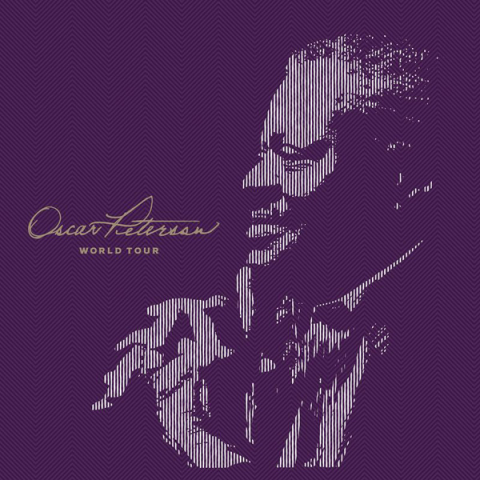
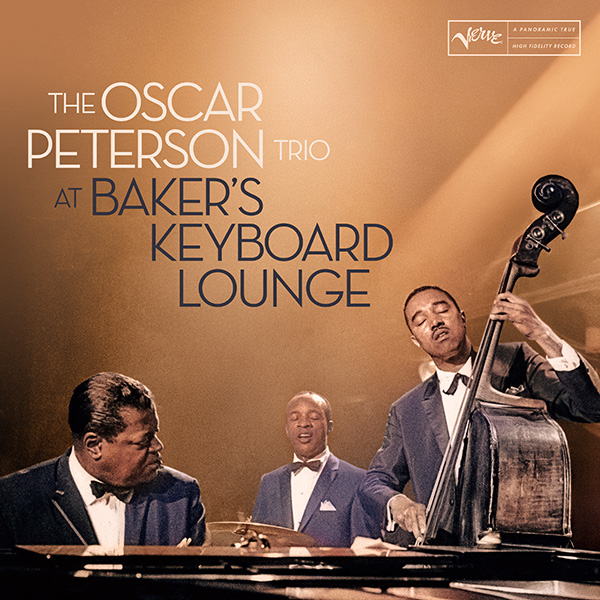 The Oscar Peterson Trio: At Baker's Keyboard Lounge
Peterson, piano; Ray Brown, bass; Ed Thigpen, drums
Verve 199957190886 (CD; expanded version available on 3 LPs). 1960/2026. Ken Druker, prod.; Val Valentin, likely eng.
Performance *****
Sonics **** Here's the backstory: Oscar Peterson brought his trio to Detroit for a two-week engagement at Baker's Keyboard Lounge in August 1960. He had just turned 35. Bassist Ray Brown had been with him since 1953. Drummer Ed Thigpen had been with him 20 months. A case can be made that they were one of the three greatest piano trios in the history of jazz, with trios led by Bill Evans and Keith Jarrett.
A year after the gig in Detroit, this same trio made a series of recordings at the London House in Chicago that many critics believe constitute Peterson's masterwork. There were also live recordings made at Baker's (on August 19, 1960), but they went unreleased. Until now. They were recently discovered in a mismarked box in the Verve label's vaults.
In his excellent liner notes, Mark Stryker makes the point that there are two schools of thought on Peterson. One cohort (the largest) believes he was a towering artist with otherworldly chops. The other believes he was all technique, lacked emotional depth, and played silly songs like "S'posin'."
The first group will find validation in this album. No one should be able to play a piano this fast. Performances here like "Politics and Poker" and "Liza" and, yes, "S'posin'" possess ridiculous levels of virtuosity. But Peterson was way more than fast. At insane tempos, he created precise, elegant, complete forms.
Peterson doubters might point out that this album contains no ballads. It is true. Apparently, August 19, 1960, was not a night for ballads. Even candidates like "Django" and "The Touch of Your Lips" can't stay slow. Peterson has too much juice. As for the issue of emotional depth: One emotion permeates these nine tracks. It is the ecstasy that happens in the moment when consummate creative acts occur.—Thomas Conrad
 Joe Syrian Motor City Jazz Octet: A Blue Time
Syrian, drums; 11 others
Circle 9 C90016 (CD). 2026. Doug Beavers, prod.; Chris Sullit, Kostadin Kamcev, engs.
Performance ****
Sonics ****½ We need more octets. Octets are big enough to be dangerous but small enough to be agile. We especially need more octets like Joe Syrian's. He is based in Detroit and has led bands named after the Motor City for years. His current octet ranges far beyond Detroit for its players. Many are in New York. None are exactly famous. All bring the goods.
Current jazz musicians, even those who are not good composers, often seem to feel a moral obligation to write their own material. Syrian realizes that interpretation requires as much creativity as original composition. He gathers a set of tunes he loves and gives them to some of his favorite arrangers and tells them to knock themselves out. The result is an album of great songs bathed in fresh light, performed by eight skilled ensemble players who are also strong soloists.
"Norwegian Wood," as done by the Beatles, was a gentle, lilting, somewhat mysterious waltz. In the chart by Adam Birnbaum, it is still in 3/4 and still mysterious, but it is no longer gentle. Birnbaum gives it new internal riffs, gives Boris Kozlov an insidious bass ostinato, and gives himself a soaring piano solo. "Black Magic Woman" is another tune embedded in pop cultural history. Brian Stark's arrangement turns it into hard-edged jazz. Paul Bollenback's wild, nasty, rasping guitar solo one-ups the original by Carlos Santana, no mean trick. "Nature Boy," normally an immersion in minor-key eeriness, is reimagined with an Afro-Cuban throb by arranger John Fedchock. There are some unearthed gems like the title track, a piece by Tadd Dameron, which has been mostly forgotten despite its harmonic richness and melodic grace.
Other players who have fine moments are tenor saxophonist Tim Ries, trombonist Doug Beavers, and Syrian himself, whose authoritative drumming gives his octet many ways to swing.—Thomas Conrad
Snidero, alto saxophone; Peter Washington, bass; Joe Farnsworth, drums
Savant Records SLP 2240 (LP). 2026. Snidero, Barney Fields, prods.; Ken Heckman, Dave Darlington, engs.
Performance ****
Sonics **** This LP, which compiles material from two earlier Savant Records CDs, arrived the day before Sonny Rollins died. Even though Snidero plays alto, it reminded me of the great tenor player. Why did it remind me of Sonny? I wasn't sure myself. I thought about it. The first reason, I think, is the ensemble sound. This is a saxophone trio, like the group (Rollins, Ray Brown, Shelly Manne) that plays so memorably on Rollins's Way Out West. That sound is stuck in my head forever—a good thing.
Nils Petter Molvær: Be QuietMolvær, trumpet; nine others
Edition EDN 1305 (auditioned in WAV; available as CD, LP). 2026. Molvær, prod.; nine engs.
Performance ****½
Sonics ****½ Even those of us who are big fans of Norwegian trumpet savant Nils Petter Molvær understand why he has doubters. There is a continuity to his work that can be perceived as sameness. His use of electronics creates sustained ambient atmospheres that can challenge impatient listeners. But Molvær has just done something extraordinary that should win over many of those doubters. Be Quiet is a duo album with nine tracks and nine collaborators, recorded in nine locations in Europe and Asia. Some of the collaborators are well known. Many specialize in electronics. Others play non-Western instruments. The tracks are named for the cities where the music was created.
Adam O'Farrill: ElephantO'Farrill, trumpet; Yvonne Rogers, piano/synth; Walter Stinson, double bass; Russell Holzman, drums
Out of Your Head Records OOYH 042 (LP). 2026. Spencer Murphy, prod.; Patrick Dillett, eng.; Peter Jensen, asst. eng.
Performance ****
Sonics ****
The Oscar Peterson Trio: At Baker's Keyboard LoungePeterson, piano; Ray Brown, bass; Ed Thigpen, drums
Verve 199957190886 (CD; expanded version available on 3 LPs). 1960/2026. Ken Druker, prod.; Val Valentin, likely eng.
Performance *****
Sonics **** Here's the backstory: Oscar Peterson brought his trio to Detroit for a two-week engagement at Baker's Keyboard Lounge in August 1960. He had just turned 35. Bassist Ray Brown had been with him since 1953. Drummer Ed Thigpen had been with him 20 months. A case can be made that they were one of the three greatest piano trios in the history of jazz, with trios led by Bill Evans and Keith Jarrett.
Joe Syrian Motor City Jazz Octet: A Blue TimeSyrian, drums; 11 others
Circle 9 C90016 (CD). 2026. Doug Beavers, prod.; Chris Sullit, Kostadin Kamcev, engs.
Performance ****
Sonics ****½ We need more octets. Octets are big enough to be dangerous but small enough to be agile. We especially need more octets like Joe Syrian's. He is based in Detroit and has led bands named after the Motor City for years. His current octet ranges far beyond Detroit for its players. Many are in New York. None are exactly famous. All bring the goods.