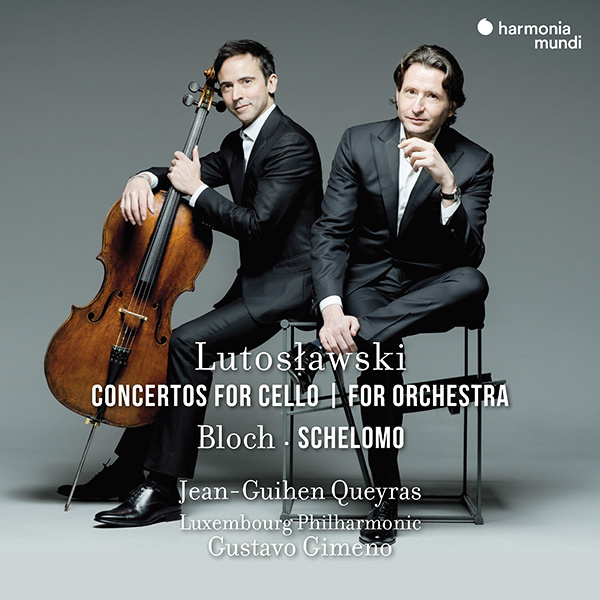
Lutosławski: Concertos for Cello and Orchestra
Bloch: Schelomo
Jean-Guihen Queyras, cello; Luxembourg Philharmonic, Gustavo Gimeno, cond.
Harmonia Mundi HMM 902714 (reviewed as 24/96 WAV; available on CD). 2026. Polyhymnia International B.V., prod.; Karel Bruggeman, Marko Schneider, engs.
Performance ****½
Sonics **** This fine recording, distinguished by copious color, excellent bass, and a deep if edgeless soundstage, showcases two phases of Lutosławski's compositional career. The Concerto for Orchestra was composed when he was in his early 40s; the far more "modernist" Cello Concerto around age 60. Even if the musical struggles they present do not reflect actual events or emotional states—Lutosławski insisted they didn't—it's impossible to separate these works from his story as a survivor of Bolshevik and Stalinist repression. His father was executed by the Bolsheviks. His statement that the cello/orchestra relationship in the Cello Concerto was one of "conflict" seems to presage the emigration from the Soviet Union by its outspoken dedicatee and champion, Mstislav Rostropovich. After starting with a startling boom, the Concerto for Orchestra's first movement is tuneful, lyrical, and lovely. In the two subsequent movements, Lutosławski seems to be testing how far he can deviate from traditional harmonies. The final movement begins with notes of alarm and so much frenetic energy that it is hard not to visualize a series of explosions that at first seem to stop the orchestra dead in its tracks before rebounding. The conclusion is mesmerizing.
The Cello Concerto presents a far more tortured journey, which I find both musically irresistible and an excellent test of a high-end system. Queyras's smooth, warm playing stands out for its beauty and eloquence. Common themes of suffering and struggle unite these works. While Nicholas Reyland, in his liner notes, hears "the possibility of acceptance," this Jew hears resignation. What do you feel?—Jason Victor Serinus
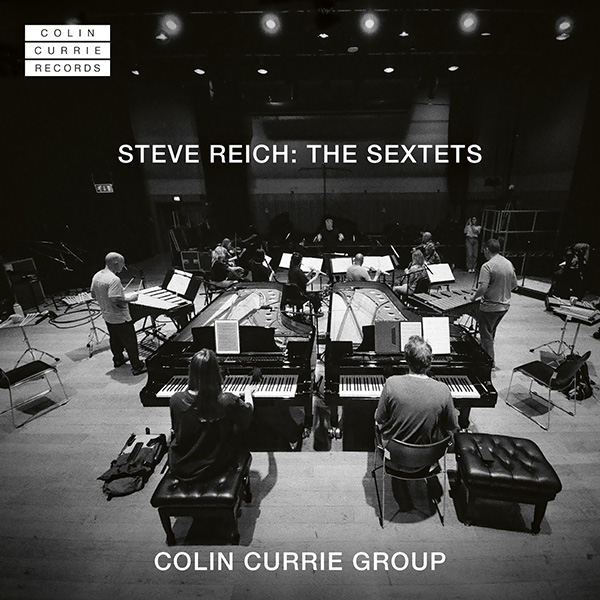 Steve Reich: The Sextets
The Colin Currie Group
Colin Currie Records CCR0009 (SACD; reviewed as 24/96). 2026. Ian Dearden, prod.; Phil Jones, eng.
Performance *****
Sonics ****½ Maximal color. Maximal exuberance. Maximal joy. A maximal trance-out experience. Recorded in celebration of Steve Reich's 90th birthday, which arrives in October, this recording presents all four of Steve Reich's Sextets: the five-movement Sextet, whose movements are designated by their metronome speed; the three-movement Double Sextet, commissioned by Eighth Blackbird, whose three movements are designated, with admirable transparency, as Fast, Slow, and Fast; Six Marimbas, a rescoring of Reich's Six Pianos; and Dance Patterns (2002), one of several short works written by different composers for filmmaker Thierry de Mey's film of choreographer Anne Teresa de Keersmaeker's Counter Phrases.
Reich, who may have finished his third commission for the Colin Currie Group by the time you read this, has given this recording his imprimatur. "The Colin Currie Group continues to give outstanding performances and make great recordings of more and more of my music," he states in the foreword to the liner notes. "This recording of 'The Sextets' presents four pieces that are all for different combinations of instruments that create different kinds of music. ... What is common here is an absolutely top level of performance."
In all truth, this is one recording where I found it impossible to take notes. Rather, I zoned out on the colors, patterns, and shifts. Sometimes Reich plays the Mahler game, where a theme—in his case a pattern and/or instrumental grouping—metamorphoses so slowly that suddenly, you wonder how you've ended up where you are. Most of the time, however, if you pay attention, you can hear one instrument substituting for another, or one pattern shifting into another. None of that accounts for the maximal magic that Reich and the Colin Currie Group conjure.—Jason Victor Serinus
 Mahler: Symphony No.5
Grand Teton Music Festival Orchestra; Sir Donald Runnicles, cond.
Reference Recordings FR-763 (24/96 WAV download). 2026. Vic Muenzer, prod.; Kevin Harbison, Vic Muenzer, engs.
Performance ****½
Sonics *****
The opening trumpet fanfare is precisely placed, with a pillowy depth; from Reference Recordings, we'd expect no less. The surprise comes with the following tutti: the dotted chords present a unified, satisfying sonority, yet you can sense the numerous instruments almost tangibly in the sonic frame. That's the sonic achievement here: a seemingly unmediated immediacy that acknowledges every detail.
The sonics clothe a first-rate performance. Runnicles serves up details of accent, articulation, and dynamics—note the nuanced gradations of in-between levels in the first movement—more than anyone else save perhaps Boulez while projecting the music's longer expressive line and purpose. The woodwinds' major-key chorale has a hymnlike solemnity. In the reprises of the funeral march, the counterpoints are impeccably balanced: You hear them, but they never distract from the main event. Throughout the score, motivic details that don't usually register enrich the textures.
The oft-abused Adagietto stands out. Runnicles's tempo is flowing yet patient. He finds places to project three-note groupings, varying the scansion, amid the standard duple rhythm, generating a forward impulse while maintaining the needed breadth. The previously lean, tapered string tone—handy for all those stabbing accents—blossoms at the climaxes into vibrant refulgence. Nicely done.
Where this Fifth falters, like so many others, is in the second movement, Stürmisch bewegt. It begins strongly and chugs along energetically, but the extended, spacious cello episode simply goes becalmed; despite expressive phrasing, the movement never recovers. So it's not perfect. But it's close. And you may never again hear it sound as good.—Stephen Francis Vasta
 Schubert: Octet
Scharoun Ensemble Berlin
Pentatone PTC 5187520 (CD). 2026. Jean-Marie Geijsen, prod.; Geijsen, Holger Urbach, engs.
Performance ****½
Sonics ***** Schubert filled his six-movement Octet with Viennese lyric touches, and it can settle into an easy, pleasing Gemütlichkeit. The Scharoun Ensemble—formed in 1983 by members of the Berlin Philharmonic specifically to play this piece—has other ideas.
After a stark call to attention, the Allegro goes with a fleet, unbuttoned exuberance. The pulse, however, isn't rigid: The players take time to expand expressively. The development moves ominously into the minor, though a quieter interlude is tentatively attacked. Pizzicato afterbeats bring uplift to parts of the recap, capped by a bracing coda. The Adagio, led by the clarinet, sings with a dignified, unsentimental demeanor; the Scherzo rolls along conventionally and buoyantly, slowing down for a Trio in a distant key.
The Andante begins with an almost Biedermeier squareness that belies the diverse ensuing variations, now taut and bristling, now lively and energetic; the cantabile horn answered by dashing violin figurations resonates most in my memory. The fifth movement, a tripartite Menuetto, is lovely and legato though not particularly dancey.
In the finale, I sense the composer—or the players—reaching for a more "symphonic" scale. Schubert's cheerful theme, with its three-bar grouping, keeps us off balance; the harmonic shift for the development recalls that in the Sixth Symphony. The final recap closes things with triumphant swagger.
The playing is fine. The strings' straight-ish tone had me wondering whether this was a period-practice ensemble (it isn't); the double bass supplies a resonant foundation. The clarinet, as the sole treble wind, gets much of the expressive lifting, and Alexander Bader handles it graciously. Andrej Žust's horn solos are full-toned and focused.
The sonics are vivid, with an unobtrusive ambience.—Stephen Francis Vasta
Bloch: Schelomo
Jean-Guihen Queyras, cello; Luxembourg Philharmonic, Gustavo Gimeno, cond.
Harmonia Mundi HMM 902714 (reviewed as 24/96 WAV; available on CD). 2026. Polyhymnia International B.V., prod.; Karel Bruggeman, Marko Schneider, engs.
Performance ****½
Sonics **** This fine recording, distinguished by copious color, excellent bass, and a deep if edgeless soundstage, showcases two phases of Lutosławski's compositional career. The Concerto for Orchestra was composed when he was in his early 40s; the far more "modernist" Cello Concerto around age 60. Even if the musical struggles they present do not reflect actual events or emotional states—Lutosławski insisted they didn't—it's impossible to separate these works from his story as a survivor of Bolshevik and Stalinist repression. His father was executed by the Bolsheviks. His statement that the cello/orchestra relationship in the Cello Concerto was one of "conflict" seems to presage the emigration from the Soviet Union by its outspoken dedicatee and champion, Mstislav Rostropovich. After starting with a startling boom, the Concerto for Orchestra's first movement is tuneful, lyrical, and lovely. In the two subsequent movements, Lutosławski seems to be testing how far he can deviate from traditional harmonies. The final movement begins with notes of alarm and so much frenetic energy that it is hard not to visualize a series of explosions that at first seem to stop the orchestra dead in its tracks before rebounding. The conclusion is mesmerizing.
Steve Reich: The SextetsThe Colin Currie Group
Colin Currie Records CCR0009 (SACD; reviewed as 24/96). 2026. Ian Dearden, prod.; Phil Jones, eng.
Performance *****
Sonics ****½ Maximal color. Maximal exuberance. Maximal joy. A maximal trance-out experience. Recorded in celebration of Steve Reich's 90th birthday, which arrives in October, this recording presents all four of Steve Reich's Sextets: the five-movement Sextet, whose movements are designated by their metronome speed; the three-movement Double Sextet, commissioned by Eighth Blackbird, whose three movements are designated, with admirable transparency, as Fast, Slow, and Fast; Six Marimbas, a rescoring of Reich's Six Pianos; and Dance Patterns (2002), one of several short works written by different composers for filmmaker Thierry de Mey's film of choreographer Anne Teresa de Keersmaeker's Counter Phrases.
Mahler: Symphony No.5Grand Teton Music Festival Orchestra; Sir Donald Runnicles, cond.
Reference Recordings FR-763 (24/96 WAV download). 2026. Vic Muenzer, prod.; Kevin Harbison, Vic Muenzer, engs.
Performance ****½
Sonics *****
Schubert: OctetScharoun Ensemble Berlin
Pentatone PTC 5187520 (CD). 2026. Jean-Marie Geijsen, prod.; Geijsen, Holger Urbach, engs.
Performance ****½
Sonics ***** Schubert filled his six-movement Octet with Viennese lyric touches, and it can settle into an easy, pleasing Gemütlichkeit. The Scharoun Ensemble—formed in 1983 by members of the Berlin Philharmonic specifically to play this piece—has other ideas.