
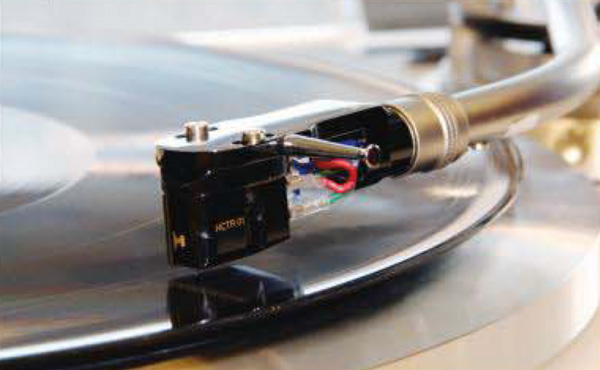
Haniwa Audio System HCTR01 Super Low Impedance MC cartridge and HEQA01 Phono Equalizer
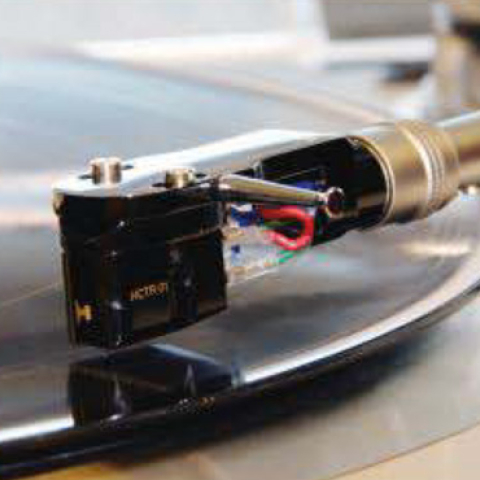
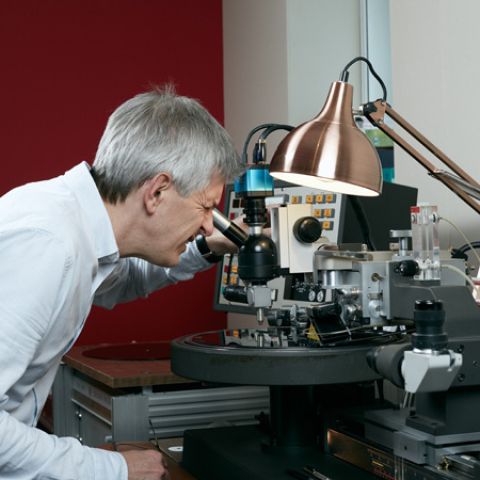
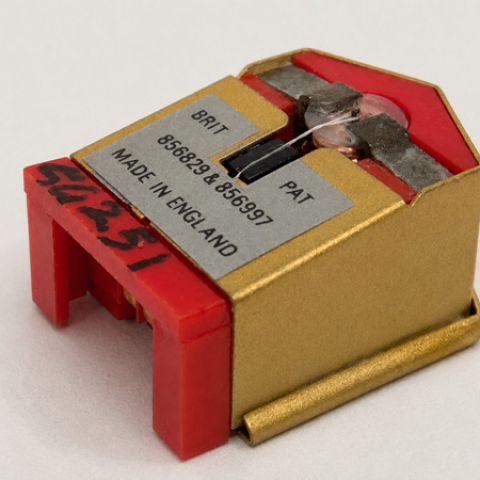
Here's something unique: a moving-coil phono cartridge ($5000, above) with a super-low internal impedance of just 0.8 ohm and an inductance of 1.3µH, yet that outputs a generous 0.35mV. What's more, it's designed to track at 1.0–1.5gm in your choice of phono preamp, and at a head-scratchingly low 0.6–1.0gm using Haniwa's HEQA01 MC/MM Phono Equalizer ($5000). Haniwa Audio System is a subsidiary of Kubotek, the Japanese company that has exhibited at Consumer Electronics Shows and regional audio shows over the past few years. I encountered the American representative, Robert Bean, of Haniwa Audio, a division of Kubotek USA, at T.H.E. Show at Newport Beach last June; he gave me a sample of the cartridge, and later delivered a Phono Equalizer. The HCTR01 cartridge was designed by Tetsuo Kubo and built by Y. Matsudaira; the latter owns My Sonic Lab and builds cartridges to spec for Air Tight. It features a boron cantilever and a line-contact stylus assembly that looks like the one used in My Sonic Lab cartridges. The design goals for the HCTR01 were lower mass, fewer coil windings, higher compliance, lower impedance, and reasonably high output. That last has been achieved, thanks to a high-power magnetic circuit. Thus, the HCTR01 promises moving-magnet–like tracking, a linear frequency response, and coherent phase response.
The cartridge itself is beautifully made and superbly finished, from the machining and painting to the cartridge pins. It comes nicely packaged and includes useful accessories—it's the least you should expect for $5000, though you don't always get it.
 My first concern was how the high-compliance HCTR01 would interface with the Continuum Audio Labs Cobra tonearm. No problem. The Hi-Fi News & Record Review Test Record (LP, Hi-Fi News HFN 001) revealed that the cartridge's lateral and vertical resonance frequencies were both at a comfortable 10Hz.
The second issue was the HCTR01's recommended loading of 4 ohms. Yes, 4 ohms! Since the cartridge's internal impedance is but 0.8 ohm, I would have figured 8 ohms (10× internal impedance), but 4 ohms it is. Can your phono preamp do 4 ohms? Most can't. With the Ypsilon MC-10 step-up transformer's parallel-resistor loading jacks, that would require wiring two 10 ohm resistors in parallel in a phono plug, to yield about 4.9 ohms. However, also on hand was the latest, 2010 version of the ASR Basis Exclusive phono preamp (see review below), and with that I was more easily able to get to 10 ohms.
The third issue was to make sure that the phono-cable resistance was less than 0.5 ohm, since the HCTR01's impedance is 0.8 ohm. I measured the wiring in the Cobra arm at 1.3 ohms, so ideal conditions could not be met.
I set the Haniwa's vertical tracking force (VTF) at 1.3gm because, in my experience, too light a VTF does more damage to the grooves than does tracking on the high side of the recommended force. The HCTR01 tracked cleanly at 1.3gm, and was an exceptionally quiet tracker, producing silent backdrops and minimizing noise on records with pressing problems.
During the months I had the Haniwa in my system, it put on a spectacular sonic display. However, if you prefer a warmer sound, you might not like what you hear. Unlike the My Sonic Lab cartridges, the HCTR01 didn't burnish the top end. Instead, it produced a fully extended, ultraclean, remarkably transparent sound that some might describe as "crystalline." But if it wasn't properly loaded, it sounded bright.
The Haniwa didn't sound lush through the Ypsilon MC-10/VPS-100 combination, but produced enough midband warmth and powerful, well-controlled bass to create a full-range, coherent picture with solid, three-dimensional images, full dynamics, and fast, ultraclean transients.
 The 45rpm edition of Falla's The Three-Cornered Hat, in the recording by Ernest Ansermet and L'Orchestre de la Suisse Romande (LP, London CS 6224/ORG 102), produced a deep, transparent soundstage that let me see into the confines of the narrow, deep concert hall in which it was recorded.
Even with the HCTR01 loaded at 10 ohms, I thought its sound through the ASR Basis Exclusive 2010 was a bit bright—which leads me to believe that unless you can load it at 4 or 5 ohms, or buy it with the HEQA01 Phono Equalizer, which has only 4 ohm loading, you shouldn't get this cartridge.
And, indeed, I did get the best tonal balance with the HEQA01, another nicely made Haniwa component. It has MM and MC inputs, and for the latter, a built-in degausser. The design pays particular attention to minimizing phase shift while obtaining accurate RIAA frequency response. It also includes electromagnetic damping, which is supposed to let you track as low as 0.6–1gm.
The sound lost some of the Ypsilon's midband magic, but it was clear that the two Haniwa components formed a synergistic system, much as the Soundsmith Strain Gauge SG-200 cartridge did with its dedicated preamp and power supply (see my review in the March 2011 issue). In fact, the best way to describe this combo is "Strain Gauge–like," so fast, clean, quiet, and pristine was the sound, no doubt due in part to the cartridge's low mass and high compliance. Transient performance, too, was similar to that of a Strain Gauge: incredibly fast and clean.
Through the HEQA01, The Three-Cornered Hat lost a bit of room size but gained warmth in the strings, better timpani textures, and more burnish to the brass.
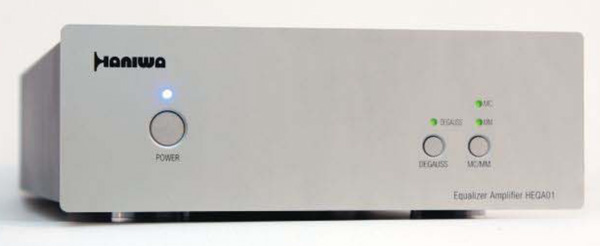 Haniwa claims that you can drop the HCTR01's VTF to 0.6gm when the HEQA01 is used, so after listening to side 1 of a reissue of Frank Sinatra's The Concert Sinatra (LP, Reprise/Mobile Fidelity Sound Lab MSFL 1-345) and feeling as if I were hearing Frank from the other side of the microphone, I dropped the VTF from 1.3gm to 1gm and listened again.
No problems there—transients got faster and three-dimensionality increased—but, as happens when any cartridge's VTF is set at the lighter end of its scale, the sound got a bit brighter. The HCTR01 still tracked perfectly at 0.8gm, vocal sibilants and orchestral crescendos alike, but I preferred the balance at 1gm, where Sinatra's voice had more body and depth.
 I don't have the space here to further describe the sound of Haniwa's HCTR01 Super Low Impedance MC cartridge paired with their HEQA01 Phono Equalizer, but considering that I got exceptional transparency, spaciousness, three-dimensionality, and subjective top-to-bottom tonal neutrality, and that the Haniwa cartridge could track at less than 1gm, this combination represents quite a technological and aesthetic achievement. At $10,000 it doesn't come cheap, but you can spend that much on a cartridge alone, and most serious combinations of cartridge and phono preamp cost at least that much.
Best of all, Kubotek USA sells these products directly, with a money-back "try and buy" guarantee. So I've told you—now you tell me! Just do me a favor: They're really nice people, so don't jerk their chain unless you're serious about buying it if you like it.
Miyajima Labs Kansui MC cartridge
In the analog realm, there really is something for every taste. You can easily go from the Haniwa HCTR01 to something meatier-sounding, like the Miyajima Labs Kansui moving-coil cartridge ($3600), and be equally enthralled by what you hear—and it doesn't mean you're not discerning. I suspect Art Dudley would respect but not much cotton to the Haniwa's sound, but he'd be all over the Miyajima. They sound very different, and I love them both. Judging by the e-mails I get, Miyajima's Shilabe ($2995) has become a favorite of many vinyl fanatics, and Artie loved it as much as if not more than I did. In his Follow-Up in the October 2010 Stereophile you can read not only about the general Miyajima Labs sound, but also about the unique motor technology that no doubt contributes to the Shilabe's "direct" sound.
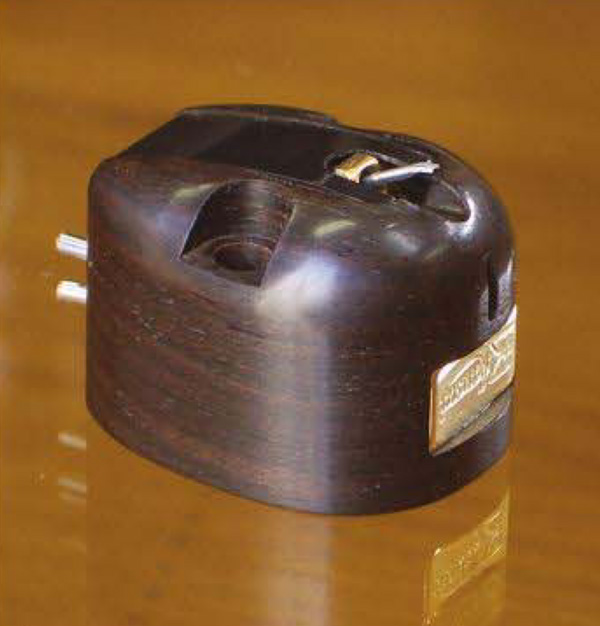 The Kansui should attract an even bigger crowd: It takes the Shilabe steps further in terms of resolution and tracking, without losing any of the magic. The cartridges are similar in many ways: Both use the same cross-ring motor design, which centers the fulcrum within the coil former, and both have bodies of curvaceous African Blackwood that, to be secured to the headshell, require the insertion of long screws fastened with nuts. Each cartridge weighs 10.4gm, has an internal impedance of 16 ohms and a lowish output of 0.23mV, and is fitted with a Shibata stylus. And both come with hilariously translated instruction manuals: "Please talk without adding a hand when a trouble happened." My sentiment exactly! "A transformer and the amplifier for MC please use the thing that it is possible for reproduction of the broadband if possible to make use of a good point of Cartridge enough." I assumed that meant "Use a step-up transformer" and happily complied.
So what's the difference between the Shilabe and the Kansui, other than the price? Mainly, it appears to be the compliance. It's been upped from 5 × 10⁻⁶ to 7 × 10⁻⁶, which allows the Kansui to track at 2.0–2.5gm vs the Shilabe's 2.5–3.2gm. The optimal recommended VTF drops from 3 to 2.25gm, a number that should make the cartridge more attractive to more buyers, particularly those concerned about record wear caused by too heavy a VTF.
If there are other differences, they're not divulged in the instruction sheet, or anywhere online I could find. However, an increase in compliance usually results in a bit more speed and information retrieval. That's what it sounded like, too, though I didn't have a Shilabe here to make a direct comparison.
Because a Shibata stylus has a long contact patch, setting the Kansui's stylus rake angle (SRA) is critical; consider a Shilabe or Kansui only if your tonearm permits adjustment of SRA and vertical tracking angle (VTA). I set SRA to 92° and used no loading resistors in the Ypsilon MC-10 step-up transformer, which produces the equivalent of a 200 ohm loading—about ideal for a cartridge with an internal impedance of 16 ohms.
Compared to the Haniwa HCTR01, the Kansui's sound was more direct, forceful, and immediate. It definitely gave up some context to get the immediacy, but it's a tradeoff many will prefer, and at a considerably lower price.
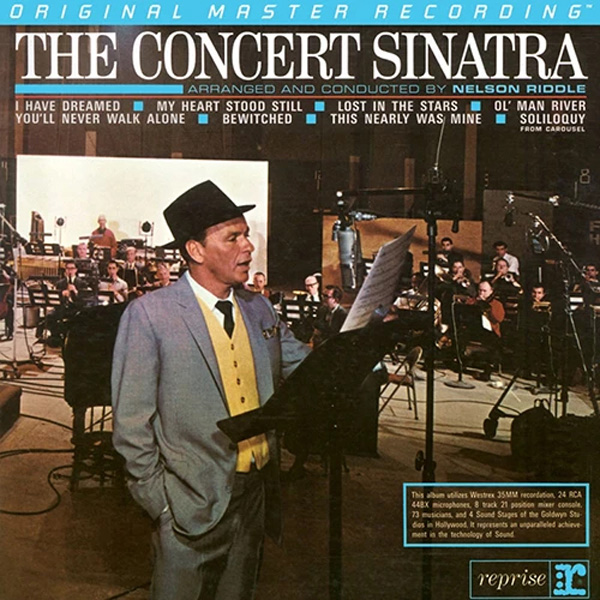 There was considerably more chest and physical presence in Sinatra's voice on The Concert Sinatra, but at the expense of context. Through the Haniwa, Sinatra stood before a microphone in front of a large studio orchestra, somewhat overwhelmed by the cavernous acoustic of the Samuel Goldwyn Soundstage 7. Through the Kansui, his voice sounded bigger, richer, and in some ways more natural.
The vocal picture lost some of the spatial context, but certainly not the physical or emotional context, and while the Haniwa's greater resolution of spatial information provided its own thrills in terms of re-creating the event, the Kansui's more intimate and meatier sound produced a more visceral, communicative, and emotional impact.
The Kansui did seem to resolve more spatial information than I remember hearing from the Shilabe, which was somewhat drier in terms of its decay structure, but like the Shilabe, the Kansui was more about a direct connection to the music making than to the spatial context. And while there was some warmth to the sound, nothing on top was covered up. If a recording was bright, the Kansui presented it as such; if there was ultradeep bass, the Kansui delivered it; and what was in between sounded linear, with perhaps a touch of lower-midbass warmth.
Whether it was because of the cross-ring construction or something else, the Kansui, like the Shilabe, had tremendous immediacy and forcefulness, particularly in how it delivered bass lines. It didn't produce the widest or deepest stage, but that was more than made up for in the physicality and solidity of the images it produced. It didn't sound polite, that's for sure—not tonally, dynamically, or, especially, texturally. Its transient cleanness and its reproduction of textures were among its greatest strengths. It was, as Artie so aptly said of the Shilabe, "downright chunky."
I'll repeat what I said about the Shilabe in this column in September 2009, because it's even more true of the Kansui: "the Shilabe had among the fastest, cleanest transient response of any cartridge I've heard at any price. Metal sounds like metal, yet there was nothing intrinsically bright about the Shilabe's sound, which was full-bodied, deep, extremely well defined, and as fast on bottom as on top. The midrange was full but not excessively so, resulting in superbly coherent transient and harmonic performance from top to bottom. The Shilabe had the slam and fullness preferred by moving-magnet devotees, but with the resolution and speed of a good moving-coil."
I really liked the Miyajima Labs Shilabe, but I loved the Kansui. It's a fine performer, it's well built, and it sells at a reasonable price. (Note: Miyajima Labs advertises on my website.)
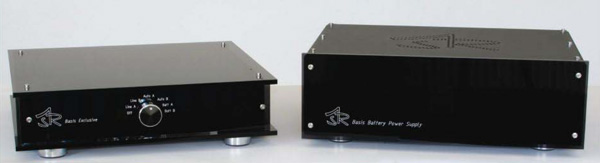 ASR Basis Exclusive 2010 phono preamplifier
In February 2007 I reviewed the ASR Basis Exclusive Revised, an earlier version of this high-performance, battery-powered phono preamplifier, designed by Friedrich Schäfer and made in Germany. That model, with two independently adjustable inputs, cost $6200. The Basis Exclusive 2010 costs $9100. The review sample I received included some extra-cost options: a mono switch ($300), three pairs of silver WBT RCA jacks ($550), and three pairs of pure-silver-contact XLR connectors ($1650), for a total cost of $11,600.
The basic design remains unchanged: A large, heavy, outboard battery pack connects to the main unit via a thick umbilical. An optical digital logic circuit controls charging and can automatically switch from battery to line voltage, in the unlikely event that you run out of battery power (a full charge lasts about 60 hours).
The amplifier section is housed in an acrylic chassis, while the power supply is housed in a steel chassis with an acrylic faceplate. The main chassis contains two complete, independently configurable phono preamps. Because cartridges do not have a common ground, they are "balanced" (but not dual-differential). If your tonearm wire floats the shield, the cartridge is essentially "balanced," even with RCA plugs. So both the positive and negative legs of each channel have a full set of DIP switches (times two if you opt for the two-input version).
Multiple gain choices from 32dB (MM) to 70dB, and among the most complete loading options found on any phono preamp, make the Basis Exclusive 2010 one of the most adjustable you can buy. So if you like to play with and optimize capacitive and resistive loading, you'll be kept busy here—there are a lot of DIP switches.
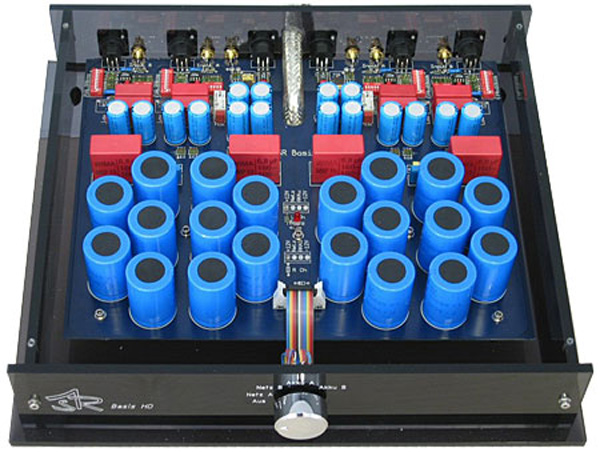 Schäfer's design centers around the purity of the electricity (hence the batteries), and linear gain provided by high-quality, low-noise microphone op-amps followed by RIAA equalization. The low-impedance unbalanced signal is output directly; an additional driver stage is used for the balanced output. Only high-quality components are used in the signal path. Unchanged since 2007 are the instructions: still confusing and poorly laid out, but once you grasp what's going on, it's not difficult to use the Basis.
As I remember from my last encounter with it, the Basis's sound is extremely quiet—it's among the quietest phono preamps I've heard—with wide dynamics, thanks in part to the "black" backdrops, and extremely fast, you-are-there clarity and presence. Image definition and focus, transient precision and three-dimensionality, were as remarkable this time as last, when I wrote that some listeners might prefer "a bit more midband 'plushness'" and find the ASR Basis's sound "too literal and a tad mechanical."
Comparing the new Basis to my reference phono preamps—then the Manley Labs Steelhead, now the Ypsilon VPS-100—I still feel that way, which is why the combination of the Haniwa HCTR01 loaded at 10 ohms and the ASR was less than satisfying, while the Kansui-ASR combo was spectacular! The Kansui's visceral impact, immediacy, subtle warmth, and sheer physicality mated perfectly with the ASR's uncolored precision and transient clarity. You want the Kansui's sound to survive intact from a phono preamp's input to its output, and that's what the ASR Basis Exclusive 2010 managed.
I'm sticking with something else I wrote then: "Its transparency, speed, and noticeable lack of midbass warmth mean that the ASR Basis Exclusive will not appeal to everyone or be appropriate for every system. [But it had] rhythmic snap; among the deepest, cleanest, most dynamic bass I've heard; and midrange and high-frequency transparency and clarity without etch, grain, or brightness."
Still, I'm sorry the Basis's price has risen so much since then. At $6200, it was a great value; even at $9100, without the extras that were fitted to the review sample, it makes me think the EAR 324 offers similar performance for $5895.
Sidebar: In Heavy Rotation 1) Robert Johnson, The Complete Original Masters Centennial Edition, Columbia/Legacy 10" 45rpm singles (12), CDs (2), DVD (1) 2) Cluster & Eno, Cluster & Eno, Sky/4 Men With Beards 180gm LP 3) Various Artists, Rave On Buddy Holly, Fantasy/MPL 45rpm 180gm LPs (2) 4) Adele, 21, XL/Columbia 180gm LP 5) Bon Iver, Bon Iver, Jagjaguwar 180gm LP 6) June Christy, The Cool School, Capitol/Pure Pleasure 180gm mono LP 7) Works by Albéniz, Falla, Granados; Rafael Frühbeck de Burgos, New Philharmonia Orchestra; London/ORG 45rpm 180gm LPs (2)
8) Fountains of Wayne, Sky Full of Holes, Yep Roc 180gm LP
9) Oren Ambarchi & Jim O'Rourke, Indeed, Editions Mego LP
10) Horace Silver, The Stylings of Silver, Blue Note/Music Matters 45rpm 180gm mono LPs (2)
Footnote 1: Haniwa Audio System, Kubotek Corporation, 1-3-13 Kanda Izumicho, Chiyoda-Ku, Tokyo 101-0024, Japan. Web: www.kubotek.com/haniwaaudio/index.html. US distributor: Kubotek USA, Inc., 2 Mount Royal Avenue, Suite 500, Marlborough, MA 01752. Email: haniwa@kubotek.co.jp. Footnote 2: Miyajima Laboratory/Otono-Edison, 1-45-111, Katae 5-chome, Jounan-ku, Fufuoka 814-0142, Japan. Web: www.miyajima-lab.com. US distributor: Robyatt Audio. Web: www.robyattaudio.com. Footnote 3: ASR Audiosysteme Friedrich Schäfer, Hohe Strasse 700 / Haus 5a, D-35 745 Herborn, Herbornseelbach, Germany. Tel: (49) (0-27-72) 4-29-05. Fax: (49) (0-27-72) 4-04-88. Web: asraudio.de/. US distributor: Musical Sounds (2011).
Here's something unique: a moving-coil phono cartridge ($5000, above) with a super-low internal impedance of just 0.8 ohm and an inductance of 1.3µH, yet that outputs a generous 0.35mV. What's more, it's designed to track at 1.0–1.5gm in your choice of phono preamp, and at a head-scratchingly low 0.6–1.0gm using Haniwa's HEQA01 MC/MM Phono Equalizer ($5000). Haniwa Audio System is a subsidiary of Kubotek, the Japanese company that has exhibited at Consumer Electronics Shows and regional audio shows over the past few years. I encountered the American representative, Robert Bean, of Haniwa Audio, a division of Kubotek USA, at T.H.E. Show at Newport Beach last June; he gave me a sample of the cartridge, and later delivered a Phono Equalizer. The HCTR01 cartridge was designed by Tetsuo Kubo and built by Y. Matsudaira; the latter owns My Sonic Lab and builds cartridges to spec for Air Tight. It features a boron cantilever and a line-contact stylus assembly that looks like the one used in My Sonic Lab cartridges. The design goals for the HCTR01 were lower mass, fewer coil windings, higher compliance, lower impedance, and reasonably high output. That last has been achieved, thanks to a high-power magnetic circuit. Thus, the HCTR01 promises moving-magnet–like tracking, a linear frequency response, and coherent phase response.
My first concern was how the high-compliance HCTR01 would interface with the Continuum Audio Labs Cobra tonearm. No problem. The Hi-Fi News & Record Review Test Record (LP, Hi-Fi News HFN 001) revealed that the cartridge's lateral and vertical resonance frequencies were both at a comfortable 10Hz.
The second issue was the HCTR01's recommended loading of 4 ohms. Yes, 4 ohms! Since the cartridge's internal impedance is but 0.8 ohm, I would have figured 8 ohms (10× internal impedance), but 4 ohms it is. Can your phono preamp do 4 ohms? Most can't. With the Ypsilon MC-10 step-up transformer's parallel-resistor loading jacks, that would require wiring two 10 ohm resistors in parallel in a phono plug, to yield about 4.9 ohms. However, also on hand was the latest, 2010 version of the ASR Basis Exclusive phono preamp (see review below), and with that I was more easily able to get to 10 ohms.
The 45rpm edition of Falla's The Three-Cornered Hat, in the recording by Ernest Ansermet and L'Orchestre de la Suisse Romande (LP, London CS 6224/ORG 102), produced a deep, transparent soundstage that let me see into the confines of the narrow, deep concert hall in which it was recorded.
Even with the HCTR01 loaded at 10 ohms, I thought its sound through the ASR Basis Exclusive 2010 was a bit bright—which leads me to believe that unless you can load it at 4 or 5 ohms, or buy it with the HEQA01 Phono Equalizer, which has only 4 ohm loading, you shouldn't get this cartridge.
Haniwa claims that you can drop the HCTR01's VTF to 0.6gm when the HEQA01 is used, so after listening to side 1 of a reissue of Frank Sinatra's The Concert Sinatra (LP, Reprise/Mobile Fidelity Sound Lab MSFL 1-345) and feeling as if I were hearing Frank from the other side of the microphone, I dropped the VTF from 1.3gm to 1gm and listened again.
No problems there—transients got faster and three-dimensionality increased—but, as happens when any cartridge's VTF is set at the lighter end of its scale, the sound got a bit brighter. The HCTR01 still tracked perfectly at 0.8gm, vocal sibilants and orchestral crescendos alike, but I preferred the balance at 1gm, where Sinatra's voice had more body and depth.
I don't have the space here to further describe the sound of Haniwa's HCTR01 Super Low Impedance MC cartridge paired with their HEQA01 Phono Equalizer, but considering that I got exceptional transparency, spaciousness, three-dimensionality, and subjective top-to-bottom tonal neutrality, and that the Haniwa cartridge could track at less than 1gm, this combination represents quite a technological and aesthetic achievement. At $10,000 it doesn't come cheap, but you can spend that much on a cartridge alone, and most serious combinations of cartridge and phono preamp cost at least that much.
In the analog realm, there really is something for every taste. You can easily go from the Haniwa HCTR01 to something meatier-sounding, like the Miyajima Labs Kansui moving-coil cartridge ($3600), and be equally enthralled by what you hear—and it doesn't mean you're not discerning. I suspect Art Dudley would respect but not much cotton to the Haniwa's sound, but he'd be all over the Miyajima. They sound very different, and I love them both. Judging by the e-mails I get, Miyajima's Shilabe ($2995) has become a favorite of many vinyl fanatics, and Artie loved it as much as if not more than I did. In his Follow-Up in the October 2010 Stereophile you can read not only about the general Miyajima Labs sound, but also about the unique motor technology that no doubt contributes to the Shilabe's "direct" sound.
The Kansui should attract an even bigger crowd: It takes the Shilabe steps further in terms of resolution and tracking, without losing any of the magic. The cartridges are similar in many ways: Both use the same cross-ring motor design, which centers the fulcrum within the coil former, and both have bodies of curvaceous African Blackwood that, to be secured to the headshell, require the insertion of long screws fastened with nuts. Each cartridge weighs 10.4gm, has an internal impedance of 16 ohms and a lowish output of 0.23mV, and is fitted with a Shibata stylus. And both come with hilariously translated instruction manuals: "Please talk without adding a hand when a trouble happened." My sentiment exactly! "A transformer and the amplifier for MC please use the thing that it is possible for reproduction of the broadband if possible to make use of a good point of Cartridge enough." I assumed that meant "Use a step-up transformer" and happily complied.
So what's the difference between the Shilabe and the Kansui, other than the price? Mainly, it appears to be the compliance. It's been upped from 5 × 10⁻⁶ to 7 × 10⁻⁶, which allows the Kansui to track at 2.0–2.5gm vs the Shilabe's 2.5–3.2gm. The optimal recommended VTF drops from 3 to 2.25gm, a number that should make the cartridge more attractive to more buyers, particularly those concerned about record wear caused by too heavy a VTF.
If there are other differences, they're not divulged in the instruction sheet, or anywhere online I could find. However, an increase in compliance usually results in a bit more speed and information retrieval. That's what it sounded like, too, though I didn't have a Shilabe here to make a direct comparison.
There was considerably more chest and physical presence in Sinatra's voice on The Concert Sinatra, but at the expense of context. Through the Haniwa, Sinatra stood before a microphone in front of a large studio orchestra, somewhat overwhelmed by the cavernous acoustic of the Samuel Goldwyn Soundstage 7. Through the Kansui, his voice sounded bigger, richer, and in some ways more natural.
ASR Basis Exclusive 2010 phono preamplifierIn February 2007 I reviewed the ASR Basis Exclusive Revised, an earlier version of this high-performance, battery-powered phono preamplifier, designed by Friedrich Schäfer and made in Germany. That model, with two independently adjustable inputs, cost $6200. The Basis Exclusive 2010 costs $9100. The review sample I received included some extra-cost options: a mono switch ($300), three pairs of silver WBT RCA jacks ($550), and three pairs of pure-silver-contact XLR connectors ($1650), for a total cost of $11,600.
Schäfer's design centers around the purity of the electricity (hence the batteries), and linear gain provided by high-quality, low-noise microphone op-amps followed by RIAA equalization. The low-impedance unbalanced signal is output directly; an additional driver stage is used for the balanced output. Only high-quality components are used in the signal path. Unchanged since 2007 are the instructions: still confusing and poorly laid out, but once you grasp what's going on, it's not difficult to use the Basis.
As I remember from my last encounter with it, the Basis's sound is extremely quiet—it's among the quietest phono preamps I've heard—with wide dynamics, thanks in part to the "black" backdrops, and extremely fast, you-are-there clarity and presence. Image definition and focus, transient precision and three-dimensionality, were as remarkable this time as last, when I wrote that some listeners might prefer "a bit more midband 'plushness'" and find the ASR Basis's sound "too literal and a tad mechanical."
Comparing the new Basis to my reference phono preamps—then the Manley Labs Steelhead, now the Ypsilon VPS-100—I still feel that way, which is why the combination of the Haniwa HCTR01 loaded at 10 ohms and the ASR was less than satisfying, while the Kansui-ASR combo was spectacular! The Kansui's visceral impact, immediacy, subtle warmth, and sheer physicality mated perfectly with the ASR's uncolored precision and transient clarity. You want the Kansui's sound to survive intact from a phono preamp's input to its output, and that's what the ASR Basis Exclusive 2010 managed.
Sidebar: In Heavy Rotation 1) Robert Johnson, The Complete Original Masters Centennial Edition, Columbia/Legacy 10" 45rpm singles (12), CDs (2), DVD (1) 2) Cluster & Eno, Cluster & Eno, Sky/4 Men With Beards 180gm LP 3) Various Artists, Rave On Buddy Holly, Fantasy/MPL 45rpm 180gm LPs (2) 4) Adele, 21, XL/Columbia 180gm LP 5) Bon Iver, Bon Iver, Jagjaguwar 180gm LP 6) June Christy, The Cool School, Capitol/Pure Pleasure 180gm mono LP 7) Works by Albéniz, Falla, Granados; Rafael Frühbeck de Burgos, New Philharmonia Orchestra; London/ORG 45rpm 180gm LPs (2)
Footnote 1: Haniwa Audio System, Kubotek Corporation, 1-3-13 Kanda Izumicho, Chiyoda-Ku, Tokyo 101-0024, Japan. Web: www.kubotek.com/haniwaaudio/index.html. US distributor: Kubotek USA, Inc., 2 Mount Royal Avenue, Suite 500, Marlborough, MA 01752. Email: haniwa@kubotek.co.jp. Footnote 2: Miyajima Laboratory/Otono-Edison, 1-45-111, Katae 5-chome, Jounan-ku, Fufuoka 814-0142, Japan. Web: www.miyajima-lab.com. US distributor: Robyatt Audio. Web: www.robyattaudio.com. Footnote 3: ASR Audiosysteme Friedrich Schäfer, Hohe Strasse 700 / Haus 5a, D-35 745 Herborn, Herbornseelbach, Germany. Tel: (49) (0-27-72) 4-29-05. Fax: (49) (0-27-72) 4-04-88. Web: asraudio.de/. US distributor: Musical Sounds (2011).