DAVID R. ADLER
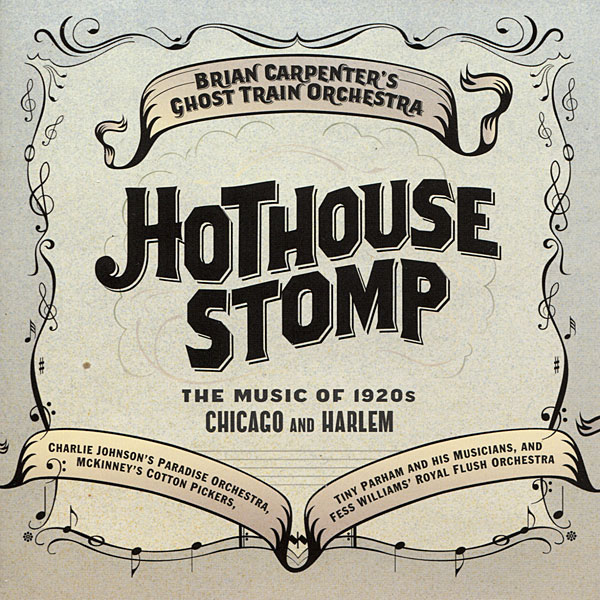
BRIAN CARPENTER'S GHOST TRAIN ORCHESTRA: Hot House Stomp: The Music of 1920s Chicago and Harlem
Brian Carpenter, trumpet, harmonica, voice; Dennis Lichtman, clarinet; Andy Laster, alto saxophone; Matt Bauder, alto & tenor saxophone, clarinet; Curtis Hasselbring, trombone; Ron Caswell, tuba; Brandon Seabrook, banjo; Mazz Swift, violin, vocals; Jordan Voelker, viola; Rob Garcia, drums
Accurate 5062 (CD). 2011. Danny Blume, eng., mix. DDD? TT: 38:46 It's great to hear pre-swing big-band charts done up in high fidelity. But Boston-based trumpeter Brian Carpenter takes liberties with music by Charlie Johnson, Fess Williams, Tiny Parham, and McKinney's Cotton Pickers, setting his Ghost Train Orchestra apart from your typical trad-jazz repertory group. Several GTO members have avant-garde pedigrees, which accounts for the freewheeling spirit (and occasional modern improv) on these tracks. Carpenter's erudite liner notes bring to life the history of the period. And his song choices—dig "Stop Kidding," by the startlingly innovative John Nesbitt—shed light on long-forgotten areas of jazz's past.
 RALPH PETERSON'S UNITY PROJECT: Outer Reaches
Ralph Peterson, drums; Jovan Alexandre, tenor saxophone; Josh Evans, trumpet; Pat Bianchi, organ; David Fiuczynski, guitar (tracks 10, 12)
Onyx Music (CD). 2011. Ralph Peterson, Pat Bianchi, engs., mix. DDD? TT: 78:47
JOHN ATKINSON
PETER GABRIEL: New Blood (Special Edition)
with Ane Brun, Melanie Gabriel, Thomas Cawley, vocals; New Blood Orchestra, Louisa Fuller (leader), Ben Foster (conductor)
Real World 00038 (2 CDs). 2011. Peter Gabriel, prod., arr.; John Metcalfe, prod., arr., orchestrations, mix; Dickie Chappell, mix, eng.; Scott Barnett, Tobias Froberg, engs. DDD. TT: 2:32:06 I finished reading Walter Isaacson's biography of Steve Jobs as I prepared to write these brief reviews, and was struck by how adeptly Jobs re-created himself. He was not an artist as such, but Jobs's life illustrates how the artist who doesn't keep evolving ultimately fails. By that measure, Peter Gabriel's career is a continuing success, even if this 2011 album comprises second examinations of his earlier songs. Gabriel's Scratch My Back, which featured empathetic arrangements by John Metcalfe of other people's songs, was one of my 2011 "R2D4" picks; in New Blood, Metcalfe applies his orchestral imagination to a selection of Gabriel's own material. And again, there is no drum kit, no rhythm section. The sound of the orchestra, recorded at Air Lyndhurst in London, is rich and large, reminiscent of that on Joni Mitchell's Both Sides Now, from 2000, which was also recorded there. Occasionally the space on the accompaniment stands too much in contrast to the closeness of Gabriel's voice, particularly in the final track, "Solsbury Hill," which, for reasons explained in the booklet, is separated from the rest of the album by almost five minutes of ambient sound. Two favorites of mine from Security, "WallFlower" and "San Jacinto," are here, along with two favorites from So, "In Your Eyes" and "Don't Give Up," though Norwegian singer Ane Brun's excessive vibrato in the latter takes some getting used to after the glory of Kate Bush in the original, and the purity of Paula Cole in 1994's Secret World Live version. The second CD mainly comprises the orchestral backing tracks, which, if musically incomplete, bear witness both to the inventiveness of Metcalfe's arrangements and the completeness of Gabriel's musical imagination.
 STEVE WINWOOD: Steve Winwood
Island 842 774-2 (CD). 1977. Steve Winwood, Chris Blackwell, Mark Miller Mundy, prods.; Phill Brown, eng.; Robert Ash, Ray Doyle, asst. engs.; Lee Hulko (Sterling Sound), CD mastering. AAD. TT: 37:25 At the fall 2011 AES Convention in New York, I was invited to take part in a workshop on "The Loudness Wars," chaired by Thomas Lund of TC Electronic. As part of the preparation of my segment, I went hunting for rock albums with respectable dynamic range. Not surprisingly, I couldn't find any from this century that weren't dynamically compromised. But among the jewels I did discover was Steve Winwood's first solo record. Overshadowed in sales by the subsequent Arc of a Diver, the LP release of Steve Winwood was in constant rotation on my Linn at the end of the 1970s, and when I ripped the CD into my iTunes library, Pure Music's meters informed me that this album had as much dynamic range as a good classical recording, its crest factor exceeding 20dB much of the time. Musically, the album wears its 35 years well. From the loping rhythm of the opener, "Hold On," to the anthemic closer, "Let Me Make Something in Your Life," both written with the late Jim Capaldi and featuring the dream team of Willie Weeks on bass and Andy Newmark on drums, you're struck by the sparseness of the soundstage created by engineer Phill Brown, despite the many instrumental flavors created by Winwood. ("Now this is an audiophile recording!" I commented in my AES presentation.) But the track that sticks in your memory is the only survivor from the original sessions, "Vacant Chair," cowritten with the late Vivian Stanshall in memory of Graham Bond. Alan Spenner's bass and John Susswell's drums underpin a hypnotic guitar riff from Julian Marvin as a multitracked Winwood chants "o-ku nsu-kun no-ko": in Yoruba dialect, "the dead are weeping for the dead."
JIM AUSTIN
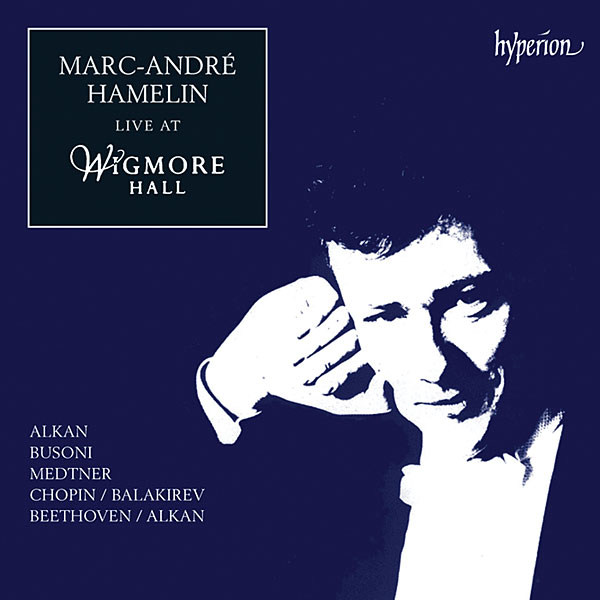
MARC-ANDRÉ HAMELIN: Live at Wigmore Hall
Works by Alkan, Beethoven-Alkan, Busoni, Chopin-Balakirev, Medtner
Hyperion CDA66765 (CD). 1995. Ates Orga, prod.; Ken Blair, eng. DDD. TT: 71:56
 CLARK TERRY: Duke with a Difference
Clark Terry, trumpet, arr.; Johnny Hodges, alto saxophone; Paul Gonsalves, tenor saxophone; Britt Woodman, Quentin Jackson, trombone; Billy Strayhorn, piano; Luther Henderson, celeste; Tyree Glenn, vibes; Jimmy Woode, bass; Sam Woodyard, drums; Marian Bruce, vocals; Mercer Ellington, arr.
Riverside/OJC RLP-1108/OJC-229 (LP). 1957/1990. Orrin Keepnews, prod.; Jack Higgins, Jack Matthews, engs. AAA. TT: 38:09 Practically a Duke Ellington record—eight Ellington tunes played by five Ellington horns, plus Duke's bassist and drummer, Strayhorn on piano, and several other musicians with connections to the orchestra—but with a twist. There's no shortage of small-group Ellington records, but here the style is a bit more modern (for 1957) and improvisational. There is, apparently, a very good-sounding mono version of this, but my OJC reissue is great-sounding stereo. The sound is woody, airy, blatty, and great. Good times.
ROBERT BAIRD
THE LOUVIN BROTHERS: Satan Is Real
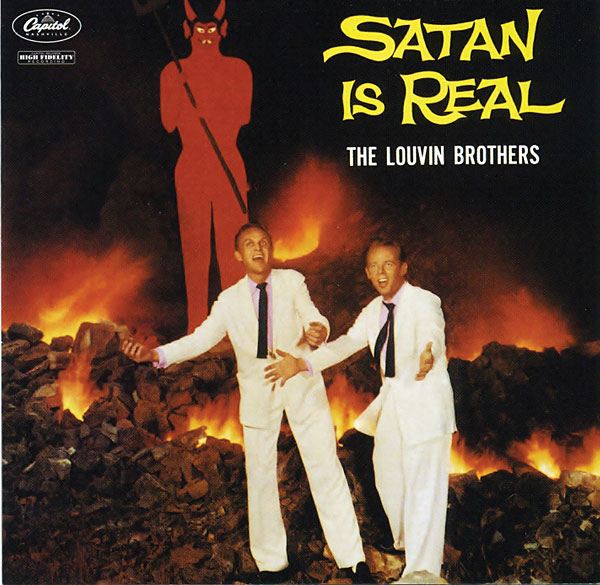
Capitol/Light in the Attic LITA 075 (2 LPs/CDs). 1959/2011. Ken Nelson, orig. prod.; orig. eng. not listed; Matt Sullivan, exec. & reissue prod.; Josh Wright, exec. reissue prod.; John Baldwin, remastering. ADA/ADD. TT: 70:36 Although much of their material had sacred connections, the glorious sounds of Charlie and Ira Louvin's singing was a profound influence on secular music—their close, high harmonies are especially reflected in the music of the Everly Brothers and the Byrds. Here, what may be their recorded masterpiece gets the deluxe reissue treatment, thanks to Seattle's superlative Light in the Attic crew. Thankfully, the album's already excellent sound has been retained, and its unforgettable original artwork—the brothers in white suits, behind them a looming red devil and roaring hellfire—is left untouched. Instead of a tribute record in which contemporary performers take stabs at their favorite Louvin tracks, disc 2 of this set collects 14 recordings from the Louvins' entire catalog, each selected by a modern admirer: Lucinda Williams, Mark Lanegan, Beck, Jim James, M. Ward, among others. Judging by the choices—which include "The Great Atomic Power," "When I Stop Dreaming," and "Knoxville Girl"—many of the decidedly secular and very noncountry alt-rock generation are big fans. Even better, the entire set is also available on two gorgeous 180gm LPs.
 OTIS REDDING: The Great Otis Redding Sings Soul Ballads
Atco/4 Men with Beards 4M105 (LP). 1965/2002. No prod. or eng. listed. ADA. TT: 33:59
LARRY BIRNBAUM
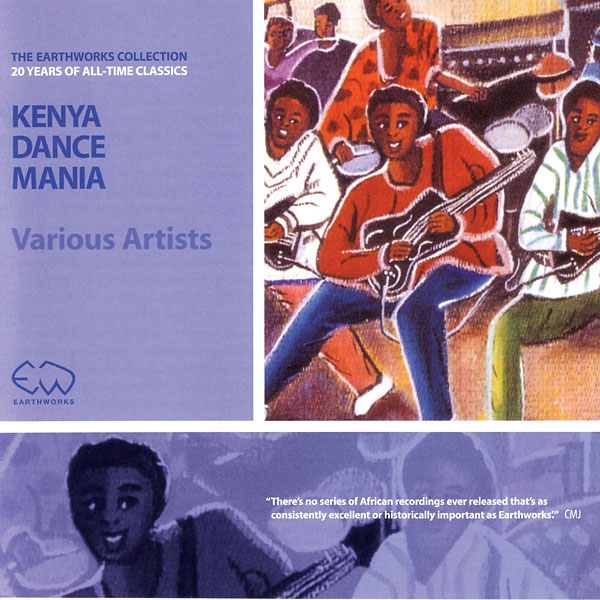
KENYA DANCE MANIA: Various Artists
Earthworks 3-1024-2 (CD). 1991. Trevor Herman, prod.; Frank Arkwright, mastering. AAD. TT: 72:05 The Kenyan benga style blends Congolese, Zimbabwean, and South African dance-pop with the music of the Luo people of southwestern Kenya. This collection includes killer benga hits of the 1970s and '80s—tightly meshed confections of sweet, slightly melancholy singing (mainly in Swahili or Luo), rhythmically twining guitars, hard-punching horns, throbbing bass lines, and clipped, thumping drums. Among the artists are Gabriel Omolo, whose "Lunch Time" went gold in 1973; H.O. Kabaselleh, whose career was interrupted by a prison term for sedition; Les Wanyika, a spin-off from the mostly Tanzanian group Simba Wanyika; and Wanyika Super Les Les, a spin-off from Les Wanyika. Most compelling, however, is the military band Maroon Commandos, whose stately 1976 smash, "Charonyi Ni Wasi," is surpassed only by their stomping 1989 hit, "Mawakaribishwa Na Maroon."
 CAL TJADER & STAN GETZ: Sextet
Stan Getz, tenor saxophone; Cal Tjader, vibraphone; Eddie Duran, guitar; Vince Guaraldi, piano; Scott LaFaro, bass; Billy Higgins, drums
OJC Remasters OJC-32690-02 (CD). 1958/2011. Sol Weiss, orig. prod.; Nick Phillips, reissue prod.; Joe Tarantino, remastering. AAD. TT: 42:47 This breezy-cool 1958 Fantasy date brought together Stan Getz with his then-unknown sidemen Billy Higgins and Scott LaFaro, and Cal Tjader with his sideman Vince Guaraldi and Guaraldi's own sideman (with his own trio), Eddie Duran. Although the group had never previously played together and didn't rehearse, they clearly clicked, and the session went down in one take. Getz is in especially good form, bopping smoothly in his best Lester-Young-meets-Charlie-Parker manner, but Tjader, in a straight-ahead setting rather than his usual Latin-jazz context, manages to keep up. The unheralded Duran and Guaraldi, belying his reputation for commercialism, are surprisingly solid, while Higgins and LaFaro are simply superb. Laid-back or up-tempo, every track is strong, but Guaraldi's briskly swinging composition "Ginza Samba," foreshadowing Getz's bossa nova collaborations with Charlie Byrd and Joao Gilberto, is irresistible.