In his July 2003 "The Fifth Element" column, John Marks enthusiastically wrote about the Benchmark Media Systems DAC1 D/A processor and headphone amplifier. Comparing its sound playing CDs with that of a three-times-more-expensive Marantz SA-14 SACD player, he concluded that the DAC 1's "Red Book" performance was at least as good as that of the Marantz, being "slightly more articulate in the musical line, and slightly more detailed in spatial nuances, particularly the localization of individual images in space, and in soundstage depth."
 I wrote a Follow-Up review of the DAC1 in May 2004 and concluded, "Whether considered as a standalone D/A converter or a versatile headphone amp, Benchmark's DAC1 is an audiophile bargain. Use it to revitalize the sound of your long-in-the-tooth CD player or the DVD player that you never thought sounded as good playing CDs as you had expected."
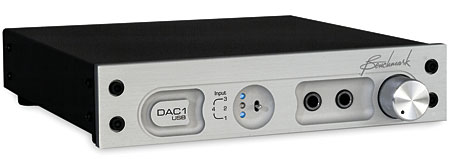
The Benchmark DAC1's price has remained at $975 since that review, even though it is now available with a handsome cast front panel in either an aluminum or black finish, as well as the original rack-mount version in utilitarian black. The DAC1 has set the standard for affordable D/A-processor performance for four years, but a second version is now available, the DAC1 USB ($1275), which is the subject of this review.
The USB
I wrote a Follow-Up review of the DAC1 in May 2004 and concluded, "Whether considered as a standalone D/A converter or a versatile headphone amp, Benchmark's DAC1 is an audiophile bargain. Use it to revitalize the sound of your long-in-the-tooth CD player or the DVD player that you never thought sounded as good playing CDs as you had expected."
The Benchmark DAC1's price has remained at $975 since that review, even though it is now available with a handsome cast front panel in either an aluminum or black finish, as well as the original rack-mount version in utilitarian black. The DAC1 has set the standard for affordable D/A-processor performance for four years, but a second version is now available, the DAC1 USB ($1275), which is the subject of this review.
The USB
As its name suggests, the new DAC1 adds a USB port to take digital audio data directly from a computer at sample rates up to 96kHz and bit depths up to 24. Benchmark chose to use a USB 1.1 port rather than the more modern and much faster USB 2.0 (which is backward-compatible with USB 1.1), because then the D/A could be used without the host computer having to run a custom driver program, and Benchmark could thus control communication to allow the transmission of bit-transparent high-resolution data. (The code to do this was developed for Benchmark by Centrance, Inc..) USB 1.1 has a maximum transmission rate of 12Mbps, which is sufficient for two channels of 24/96 data. Other improvements over the standard DAC1 are: two gain settings for the headphone amplifier, selectable with internal jumpers; a (defeatable) muting of the line outputs when a pair of headphones is plugged into the left-hand of the two headphone outputs; and high-current output drivers for the XLR and RCA outputs, to allow these outputs to drive longer cables, low-impedance loads, high-capacitance loads, and/or high-inductance loads with no increase in distortion. The lock LEDs also now flash to indicate various error conditions (such as being driven with DTS- or ADAT-format data), following which the DAC1 goes into Standby mode. While some of these improvements have found their way into the basic DAC1—such as the 30 ohm output impedance for the RCA jacks, which originally had an impedance of 1250 ohms—it is not possible to upgrade earlier DAC1s to the USB version. Other than a different input-selection switch—the USB replaces the DAC1's three-position toggle with a momentary switch that lets the user scroll up or down through the inputs—all of the DAC1's features remain: There are two headphone jacks on the front panel, in addition to the balanced and single-ended line-level outputs on the rear. The latter can be either variable or fixed in level, with multi-turn, rear-panel pots allowing the fixed outputs to be calibrated. The Variable/Fixed level switch on the rear panel has a central, muting position. Using internal jumpers, the balanced outputs can be attenuated in 10dB steps by up to 30dB, to allow the processor's maximum output to be optimally matched to the rest of the system. (These jumpers do not affect the unbalanced or headphone outputs.) And the DAC1 USB has the same detented volume control used in current DAC1 production. (The original used a continuous control.)
USB inside
The DAC1 USB's circuitry is neatly laid out on a single lead-free, multiplane printed-circuit board running from the back to the front of the aluminum chassis. With the exception of what appears to be an 8-pin IC carrying the firmware for a Xilinx gate array chip, some 3-pin voltage regulators (which use the chassis as their heatsink), and the output amplifiers for the headphone jacks, the DAC1 uses surface-mount components throughout. Great care, I was told, has been taken with layout and grounding to keep noise levels sufficiently low for 24-bit performance. Looking at the circuit, AES/EBU and S/PDIF datastreams are buffered by pulse transformers and taken to an AKM AK4114 receiver chip. This is capable of handling 24-bit data with sample rates of up to 192kHz, and converts the incoming data to the i2S format. The USB input is taken to a Texas Instruments TAS1020B chip, which extracts the audio data using a phase-locked loop and converts it to i2S. According to Benchmark's Elias Gwinn (footnote 1), the DAC1 USB runs in the USB protocol's "synchronous" mode, to allow the host PC to, at all times, send audio data at the original sample rate of the audio being played. If the PC (or, more specifically, Windows XP's kmixer DLL) is not forced to do sample-rate conversion, it can maintain bit-transparent operation. "There is a tradeoff, of course," said Gwinn: "significant amounts of jitter arrive at the DAC1. This is not a problem for the DAC1, however, because Benchmark's UltraLock clocking system makes it immune to jitter." The datastream selected by the front-panel switch is sent to an asynchronous sample-rate converter chip, an Analog Devices AD1896, which, regardless of the original sample rate of the data, converts it to a datastream sampled at 110kHz. As well as isolating the DAC stage from word-clock jitter on the incoming signal, this sample-rate conversion allows the DAC to run at its optimal sample rate. Benchmark's John Siau explains that "the trade-off of a small amount of SRC distortion far outweighs the more significant distortion and noise of the D/A chip operating at sample-rates other than its most efficient rate....[110kHz] is the highest frequency to maintain the full oversampling of the D/A chip."
The DAC itself is an Analog Devices AD1853—a two-channel, multibit, sigma-delta type with 24-bit performance—clocked by an adjacent crystal oscillator. The output of the DAC chip feeds individual circuits for the headphone, unbalanced, and balanced outputs. The headphone driver appears to be based on TI 5532 dual op-amp chips feeding Burr-Brown BUF634 unity-gain, open-loop buffers. The BBs have an output current capability of 250mA (!) and are heatsunk to the board. At the other end of the board, both the balanced and unbalanced output circuits appear to be based on a 5532 chip feeding one (unbalanced) or two (balanced) National L4562 devices. This is a high-speed dual op-amp chip specified as being capable of driving 600 ohm loads without undue stress. The chips used for the balanced output are followed by the resistor matrix for padding down the output if necessary.
USB Setup
Not much to say about using the DAC1 USB in my main rig, other than that I potted down its balanced output by 10dB, so I didn't have to use the preamp volume control near the bottom of its range. I used a Kimber Illuminations Orchid AES/EBU link from the Ayre C-5xe universal player and a 15' AudioQuest Optink-5 TosLink connection from the Slim Devices Transporter. For auditioning of the DAC1 USB using its USB connection, I initially used my 2002-vintage Apple PowerBook running OSX 10.3.9, then my G4 Mac mini running OSX 10.4.10. Both computers identified it as "Benchmark 1.0" in the CoreAudio dialog and told me that "The selected device has no output controls."
Footnote 1: There is a superb discussion—52 webpages long as of November 1, 2007—of the DAC1 USB's design and architecture on the Head-Fi website. The quoted text is taken from that discussion.
I wrote a Follow-Up review of the DAC1 in May 2004 and concluded, "Whether considered as a standalone D/A converter or a versatile headphone amp, Benchmark's DAC1 is an audiophile bargain. Use it to revitalize the sound of your long-in-the-tooth CD player or the DVD player that you never thought sounded as good playing CDs as you had expected."
The Benchmark DAC1's price has remained at $975 since that review, even though it is now available with a handsome cast front panel in either an aluminum or black finish, as well as the original rack-mount version in utilitarian black. The DAC1 has set the standard for affordable D/A-processor performance for four years, but a second version is now available, the DAC1 USB ($1275), which is the subject of this review.
As its name suggests, the new DAC1 adds a USB port to take digital audio data directly from a computer at sample rates up to 96kHz and bit depths up to 24. Benchmark chose to use a USB 1.1 port rather than the more modern and much faster USB 2.0 (which is backward-compatible with USB 1.1), because then the D/A could be used without the host computer having to run a custom driver program, and Benchmark could thus control communication to allow the transmission of bit-transparent high-resolution data. (The code to do this was developed for Benchmark by Centrance, Inc..) USB 1.1 has a maximum transmission rate of 12Mbps, which is sufficient for two channels of 24/96 data. Other improvements over the standard DAC1 are: two gain settings for the headphone amplifier, selectable with internal jumpers; a (defeatable) muting of the line outputs when a pair of headphones is plugged into the left-hand of the two headphone outputs; and high-current output drivers for the XLR and RCA outputs, to allow these outputs to drive longer cables, low-impedance loads, high-capacitance loads, and/or high-inductance loads with no increase in distortion. The lock LEDs also now flash to indicate various error conditions (such as being driven with DTS- or ADAT-format data), following which the DAC1 goes into Standby mode. While some of these improvements have found their way into the basic DAC1—such as the 30 ohm output impedance for the RCA jacks, which originally had an impedance of 1250 ohms—it is not possible to upgrade earlier DAC1s to the USB version. Other than a different input-selection switch—the USB replaces the DAC1's three-position toggle with a momentary switch that lets the user scroll up or down through the inputs—all of the DAC1's features remain: There are two headphone jacks on the front panel, in addition to the balanced and single-ended line-level outputs on the rear. The latter can be either variable or fixed in level, with multi-turn, rear-panel pots allowing the fixed outputs to be calibrated. The Variable/Fixed level switch on the rear panel has a central, muting position. Using internal jumpers, the balanced outputs can be attenuated in 10dB steps by up to 30dB, to allow the processor's maximum output to be optimally matched to the rest of the system. (These jumpers do not affect the unbalanced or headphone outputs.) And the DAC1 USB has the same detented volume control used in current DAC1 production. (The original used a continuous control.)
The DAC1 USB's circuitry is neatly laid out on a single lead-free, multiplane printed-circuit board running from the back to the front of the aluminum chassis. With the exception of what appears to be an 8-pin IC carrying the firmware for a Xilinx gate array chip, some 3-pin voltage regulators (which use the chassis as their heatsink), and the output amplifiers for the headphone jacks, the DAC1 uses surface-mount components throughout. Great care, I was told, has been taken with layout and grounding to keep noise levels sufficiently low for 24-bit performance. Looking at the circuit, AES/EBU and S/PDIF datastreams are buffered by pulse transformers and taken to an AKM AK4114 receiver chip. This is capable of handling 24-bit data with sample rates of up to 192kHz, and converts the incoming data to the i2S format. The USB input is taken to a Texas Instruments TAS1020B chip, which extracts the audio data using a phase-locked loop and converts it to i2S. According to Benchmark's Elias Gwinn (footnote 1), the DAC1 USB runs in the USB protocol's "synchronous" mode, to allow the host PC to, at all times, send audio data at the original sample rate of the audio being played. If the PC (or, more specifically, Windows XP's kmixer DLL) is not forced to do sample-rate conversion, it can maintain bit-transparent operation. "There is a tradeoff, of course," said Gwinn: "significant amounts of jitter arrive at the DAC1. This is not a problem for the DAC1, however, because Benchmark's UltraLock clocking system makes it immune to jitter." The datastream selected by the front-panel switch is sent to an asynchronous sample-rate converter chip, an Analog Devices AD1896, which, regardless of the original sample rate of the data, converts it to a datastream sampled at 110kHz. As well as isolating the DAC stage from word-clock jitter on the incoming signal, this sample-rate conversion allows the DAC to run at its optimal sample rate. Benchmark's John Siau explains that "the trade-off of a small amount of SRC distortion far outweighs the more significant distortion and noise of the D/A chip operating at sample-rates other than its most efficient rate....[110kHz] is the highest frequency to maintain the full oversampling of the D/A chip."
Not much to say about using the DAC1 USB in my main rig, other than that I potted down its balanced output by 10dB, so I didn't have to use the preamp volume control near the bottom of its range. I used a Kimber Illuminations Orchid AES/EBU link from the Ayre C-5xe universal player and a 15' AudioQuest Optink-5 TosLink connection from the Slim Devices Transporter. For auditioning of the DAC1 USB using its USB connection, I initially used my 2002-vintage Apple PowerBook running OSX 10.3.9, then my G4 Mac mini running OSX 10.4.10. Both computers identified it as "Benchmark 1.0" in the CoreAudio dialog and told me that "The selected device has no output controls."
Footnote 1: There is a superb discussion—52 webpages long as of November 1, 2007—of the DAC1 USB's design and architecture on the Head-Fi website. The quoted text is taken from that discussion.