|
Recent Additions
Budget Components Audacious Audio
Loudspeakers
Amplification
Digital Sources
Analog Sources
Accessories Listening / Art Dudley The Fifth Element / John Marks Music in the Round / Kal Rubinson Fine Tunes / Jonathan Scull Special Features Reference Interviews Think Pieces Historical Recording of the Month Records 2 Die 4 Music/Recordings Stephen Mejias Robert Baird Fred Kaplan Wes Phillips Audio News Past eNewsletters FSI 2008 CES 2008 RMAF 2007 CEDIA 2007 HE 2007 FSI 2007 CES 2007 China 2006 RMAF 2006 HFN 2006 CEDIA 2006 HE 2006 FSI 2006 CES 2006 Forums Galleries Vote Previous Votes Dealer Locator AV Links Audiophile Societies Contact Us Customer Service New Subscription Digital Subscription Renew Give a Gift Sub Services Recordings Backissues More . . . Phono Preamp Hi-Fi Phono Cartridge Amplifiers Stereo Speakers |
Revel Ultima Studio2 loudspeaker
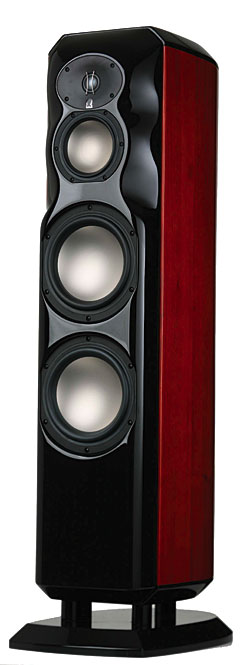
This is my fourth review of a Revel loudspeaker, and I was even more excited by the arrival of the Ultima Studio2s ($15,999/pair) than I was when their predecessors, the original Ultima Studios ($10,799/pair when first reviewed; $15,000/pair when last listed in "Recommended Components"), were delivered in 2000. (See my review in the December 2000 Stereophile, Vol.23 No.12.) After all, the Studios were my reference speakers for years and, along with the larger Ultima Salons, were statement products that were the product of the talented designer Kevin Voecks and the considerable resources of Harman International, parent of Revel as well as of JBL and Infinity. Over the years, I've also reviewed Revel's Performa F30 (May 2000, Vol.23 No.5) and Concerta F12 (July 2006, Vol.29 No.7), each outstanding at its price point. If, after all these years, Voecks and his team were ready to reconsider their statement products, they should be something special.
Things moved slowly, and they didn't arrive till late 2007. Further delay in auditioning for this report resulted from one of the original pair having no tweeter output due to shipping damage, though the driver itself was functional.
See it now!
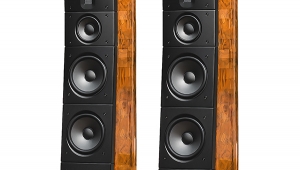
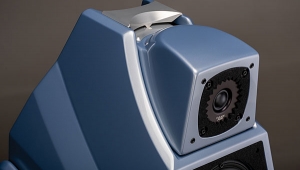
The Studio2 stands a bit taller than the original because the bass enclosure's flared port is aimed downward into a space created by incorporating a nonremovable base. The advantage of this configuration is that the port's output is more reliably predefined than if the port were on the front or rear. The Studio2 is also slimmer because great attention has been paid to creating a uniform in-room dispersion of sound. For example, the four drivers are set into a 21/2"-thick contoured front panel that virtually eliminates the edge diffractions of more rectangular boxes that make imaging unstable. The Studio2's sides curve smoothly around to the rearthere are no sharp edges anywhere except at the bottom of the enclosure. To retain the virtues resulting from the smooth contours, the front grille fabric is stretched over a rigid frame that firmly attaches to the cabinet with magnetsno fixtures protrude to affect the dispersion even minimally. The choice and implementation of each internal element continues the attention to detail seen in the cabinet. Beginning at the top, Revel uses a tweeter with a dome of pure beryllium. The tweeter is set in what looks like a shallow depression but is really a sophisticated waveguide. This ensures a uniform high-frequency dispersion that is independent of the frontal dimensions of the cabinet and more closely matches that of the midrange driver. It also permits the elimination of the original Studio's rear-firing supplementary tweeter. In addition, the tweeter's mechanical resonance has been reduced to below 600Hz, in part because of its highly compliant surround, which makes for an easier and superior crossover nearly two octaves higher. The 5.5" midrange driver and the two 8" woofers have inverted-dome titanium diaphragms and neodymium magnet assembliesa level of sophistication beyond that even of the midranges in the original Studio. The goal of using such lightweight but ultra-rigid diaphragms driven by powerful motors is to make these drivers store as little energy as possible, for excellent transient response. As in the original Studio, high-slope crossovers are used to minimize driver overlap, which in turn contributes to improved dispersionan abiding theme. Access to the connections and crossover is behind that little plastic back door, where you'll find LF and HF terminals suitable for biwiring, a low-frequency compensation control, and a tweeter-level control. The LF control has settings of Normal (for when the speaker is 3' or more from walls or large objects), Contour (to compensate for an unfortunate position with regard to room modes), and Boundary (for when the speaker is less than 2' from a room boundary or large object). The tweeter-level control adjusts the highs to complement the general room acoustics. I needed neither adjustment in my room, though they did have subtle effects that I expect would be useful in more problematic rooms.
Hear it now!
Article Continues: Page 2 »
|
|
||||||||||||||||||||||||||||||||||||||||||||||


But when I saw the prototype of the Studio2 at the