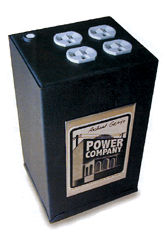
The Richard Gray's Power Company 400S arrived on the audiophile scene last year with a bang. Weighing in at a hefty 20 lbs and at $700 a pop, this four-outlet power conditioner, according to the paperwork, "effectively 'positions' audio, video, and home theater equipment 'electronically closer' to your utility company transformer, without introducing any type of series electronic 'traps' or capacitors into the circuit, which we feel degrade the performance of certain equipment, and severely limit the amount of current they can handle." 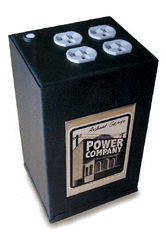 They go on: "Richard Gray's Power Company increases the dynamics and performance of audio systems by providing a short-term supply of high current on demand to satisfy power-hungry transients required of the AC line by your stereo equipment." They cite the 400S's "unique ability to 'fill in' the AC line when demand momentarily overcomes supply," and explain that it "tends to 'even out' small line anomalies. This electronic flywheel 'fill-in effect' enables Richard Gray's Power Company to suppress or quench the back EMF or 'fingerprint' of the equipment connected to it." The 400S also "quenches AC line noise caused by internal crosstalk between digital and analog electrical devices within the circuit," and is said to "greatly improve" home-theater systems. Audio Line Source lobbied hard for a review. Here it is. What is it?
Each Richard Gray's Power Company 400S comes in a powder-black rectangular housing with four gray (of course) Hubbell AC sockets on its face and an IEC mains-in fitting on the side. Whether you plug your components straight into a 400S or plug it into your system's power receptacles, the heart of the beast—the inductor—is wired in parallel, "bracketing" the AC. It offers, says RGPC, little or no resistance to the line: "Theoretically it can be placed anywhere within a circuit to provide high current on demand to all equipment within the same AC circuit. The closer your equipment is placed to the unit, the more quickly effective it becomes." I looked at a few drawings supplied (I believe) as part of the patent application, and the 400S appears to be a large, iron-core inductor or choke. I understand that there's also a metal-oxide varistor (MOV) sitting across the hot and neutral lines to provide protection against voltage spikes.
If you need more than four outlets, RGPC suggests plugging the "overflow equipment," both analog and digital, into a good-quality power extender, "one that does not contain any form of power-line conditioning," and use that into the 400S. Start with the front-end, they counsel, listening as you go, with the power amps last. One is exhorted in no uncertain terms that best use is made with "star clusters" of two or more 400Ses in multiple arrays. "While the system is playing, merely plug a second [400S] into the primary unit for almost instant delivery of twice the power-on-demand." (my italics) For the audiophile flush with the necessary cash, "additional units may be added, with the only limitation being that of how many spare plugs you have available on the unit." They recommend one on each amp in the system after the front-end is treated, "because each amplifier plugged into the combined system will benefit from a doubling (2 units) or tripling (3 units) of thousands of watts of high current-on-demand." (my italics again) "To our knowledge, [the 400S] is the only device that provides high current on demand without limiting the dynamics of any amplifier, regardless of power rating or design!"
They go on: "Richard Gray's Power Company increases the dynamics and performance of audio systems by providing a short-term supply of high current on demand to satisfy power-hungry transients required of the AC line by your stereo equipment." They cite the 400S's "unique ability to 'fill in' the AC line when demand momentarily overcomes supply," and explain that it "tends to 'even out' small line anomalies. This electronic flywheel 'fill-in effect' enables Richard Gray's Power Company to suppress or quench the back EMF or 'fingerprint' of the equipment connected to it." The 400S also "quenches AC line noise caused by internal crosstalk between digital and analog electrical devices within the circuit," and is said to "greatly improve" home-theater systems. Audio Line Source lobbied hard for a review. Here it is. What is it? Each Richard Gray's Power Company 400S comes in a powder-black rectangular housing with four gray (of course) Hubbell AC sockets on its face and an IEC mains-in fitting on the side. Whether you plug your components straight into a 400S or plug it into your system's power receptacles, the heart of the beast—the inductor—is wired in parallel, "bracketing" the AC. It offers, says RGPC, little or no resistance to the line: "Theoretically it can be placed anywhere within a circuit to provide high current on demand to all equipment within the same AC circuit. The closer your equipment is placed to the unit, the more quickly effective it becomes." I looked at a few drawings supplied (I believe) as part of the patent application, and the 400S appears to be a large, iron-core inductor or choke. I understand that there's also a metal-oxide varistor (MOV) sitting across the hot and neutral lines to provide protection against voltage spikes.