The best, most enduring audio products have in their favor more than great sound: They have some sense of history as well. Particularly good examples abound from the British companies Spendor, Rogers, and Harbeth, some of whose products were actually commissioned into being by the British Broadcasting Corporation. Better that, I suppose, than existing to fill a price point.
 Spendor is probably the best known of the three, and theirs is the typical story: In the 1960s, the BBC's engineering department declared that monitor-loudspeaker technology could not continue to improve without some alternative to the paper-cone drivers of the day. Consequently, the BBC set about developing their own plastic-cone drivers. One of the men on that project, a staff technician named Spencer Hughes, began making Bextrene (footnote 1) cones at home, more or less as a lark. But by 1969 Hughes had designed and built a complete loudspeaker that was good enough to be the standard for a whole new company. Thus was Spendor established, the firm's name derived from the Christian names of Hughes and his wife, Dorothy.
Dudley Harwood, a more senior technician in the same BBC engineering department, looked with interest at Spencer Hughes's success—and that of another supplying manufacturer, Jim Rogers—and decided he could do an even better job of making and selling high-quality monitors. So in 1977 Dudley Harwood and his wife, Beth, formed Harbeth Audio Ltd.—which, when you think about it, scarcely escaped being called Dudbeth.
Decades later, the erosion of our industry's mom-and-pop bedrock is no surprise: All of those companies have changed hands, some more than once. Fortunately, the twentysomething fellow who bought the Harbeth company in the mid-1980s had a keen interest in the company's pedigree, owing to his experience as a teenage tape-splicer for the BBC. More than 20 years after buying Harbeth, the still-youthful Alan Shaw continues to run that company, from which perspective he has, every now and then, the privilege of tweaking the company's flagship loudspeaker . . .
Technical background
Spendor is probably the best known of the three, and theirs is the typical story: In the 1960s, the BBC's engineering department declared that monitor-loudspeaker technology could not continue to improve without some alternative to the paper-cone drivers of the day. Consequently, the BBC set about developing their own plastic-cone drivers. One of the men on that project, a staff technician named Spencer Hughes, began making Bextrene (footnote 1) cones at home, more or less as a lark. But by 1969 Hughes had designed and built a complete loudspeaker that was good enough to be the standard for a whole new company. Thus was Spendor established, the firm's name derived from the Christian names of Hughes and his wife, Dorothy.
Dudley Harwood, a more senior technician in the same BBC engineering department, looked with interest at Spencer Hughes's success—and that of another supplying manufacturer, Jim Rogers—and decided he could do an even better job of making and selling high-quality monitors. So in 1977 Dudley Harwood and his wife, Beth, formed Harbeth Audio Ltd.—which, when you think about it, scarcely escaped being called Dudbeth.
Decades later, the erosion of our industry's mom-and-pop bedrock is no surprise: All of those companies have changed hands, some more than once. Fortunately, the twentysomething fellow who bought the Harbeth company in the mid-1980s had a keen interest in the company's pedigree, owing to his experience as a teenage tape-splicer for the BBC. More than 20 years after buying Harbeth, the still-youthful Alan Shaw continues to run that company, from which perspective he has, every now and then, the privilege of tweaking the company's flagship loudspeaker . . .
Technical background
The new M40.1 ($12,995/pair), which Harbeth announced at the January 2008 Consumer Electronics Show, is intended as a domestic replacement for the Harbeth M40, itself supplied to the BBC to replace their old LS5/8 studio monitor. Given the heavily damped settings for which it was intended, Alan Shaw had designed the original M40 with an elevated bass response, a quality that didn't always jell with home installations. So when driver manufacturer Vifa discontinued the M40's woofer, Harbeth had an opportunity to recast its flagship loudspeaker as an unabashedly audiophile product. Shaw decided that Harbeth should design and make a new woofer themselves, to which end he enlisted the help of a surprising ally: engineer Derek Hughes, son of Spencer and Dorothy. Hughes and Shaw came up with a 12" polypropylene cone that's sufficiently well behaved to perform all the way up to 400Hz—nearly an octave higher than its predecessor. That brought about a change to the suspension compliance of Harbeth's 6.5" midrange driver, which first saw the light of day in the early 1990s, when Shaw hired some doctoral students to research cone materials. After rejecting various materials—metal tended to ring, Kevlar was bright and hashy, paper was good but hygroscopic, etc.—the young team came up with a distinctive polymer to which Harbeth gave the trade name Radial. Harbeth's latest-generation Radial-cone midrange driver has a different resonant frequency from that of its immediate predecessor. That, in turn, required some changes to the flagship's crossover network: the most difficult thing to get right, according to one Harbeth rep with whom I spoke.
When all was said and done, Harbeth had created an altogether more consumer-friendly flagship speaker. Compared to the old M40, the M40.1 is claimed to be more sensitive (85dB/W/m into 6 ohms vs 84dB/W/m into 4 ohms), and to exhibit bass response at once more accurate and more extended: down to 38Hz, yet without the excess output at 60Hz and environs.
Description
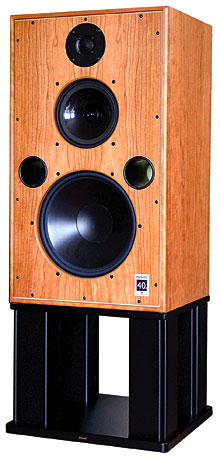
Of the M40.1's three drive-units, the only one not made by Harbeth is a SEAS Excel tweeter, whose 1" fabric dome and magnet system are designed to prevent reflected backwaves from coloring the sound. The front of the dome is protected by a metal honeycomb grille cemented in place. (Another change from the M40: This grille's openings are somewhat larger.) Early speakers from Harbeth and Spendor, et al, pioneered the use of deliberately thin-walled plywood cabinets with minimal damping of individual panels. Using that approach, the English companies were able to keep energy storage reasonably low, and the effects of cabinet resonances could be minimized by spreading them out among many low-amplitude points. Harbeth maintains that approach, but with MDF instead of plywood. The M40.1's cabinet is minimally braced (like a good mandolin, I kept thinking), veneered inside and out, and damped with thin sheets of a hard, lossy material not unlike bitumen. The review pair was finished in a semigloss cherry veneer: nice, but not quite in the same league as the exotic and altogether more luxuriant veneers seen on speakers from other high-end makers.
Alone among the three drivers, the Harbeth midrange cone has its own internal loading chamber, also made from MDF. For its part, the woofer is reflex-loaded with a pair of front-firing ports 2.75" in diameter and a little over 6" long. Blocks and sheets of two different types of acoustical foam are arranged inside the cabinet with great apparent precision. The rear panel is screwed rather than glued in place—another nod to Harbeth's pro-audio heritage—and the cabinet walls are so precisely made and fit together so well that the rear panel proved difficult to remove, even with the screws removed. (Again, I thought of a good stringed instrument, in which a neck with a carefully made dovetail joint will stay in place under full string tension, even without glue.)
The M40.1's crossover network is housed on a large (7.5" by 11.5") circuit board fastened to the cabinet's rear panel and damped on one side. Some parts appeared to have been individually tested—they were numbered and labeled by hand—and all of the copper inductors seem to have been made in-house. Unlike its triwirable predecessor, the new Harbeth has only a single pair of binding posts, a change reportedly made to prevent poor, or at least nonexemplary, performance in the field through the use of incorrect crossover points or mismatched amplifiers. Internal cabling is Van Damme Blue Series stranded-copper twin-lead, and signal connections are all made with push-on terminals: surprising in a $13,000 product, though maybe not so in light of its pro-audio origins.
The purpose-built stands, made by Skylan Manufacturing of Calgary, Alberta, Canada, were superb: computer-milled from MDF, filled with kitty litter, and finished so perfectly that they were indistinguishable from the metal sort—but cheaper and easier to ship, and quite possibly less susceptible to ringing. The threaded feet worked smoothly, and I noted that tilt, in particular, was easier to adjust than is usually the case. Nice. They cost $595/pair.
Installation and setup
Unlike its pro-audio forebear, which I'm told was designed to sit on tall stands (or else to hang from a higher bracket, its front tipped down toward the mixing seat), the Harbeth M40.1s are intended to be used on the 14"-tall Skylan stands described above, and placed as far as possible from any adjacent walls. The former requirement, when combined with a bit of backtilt, puts the on-axis tweeter dispersion almost exactly at ear level for a seated listener; the wisdom of the latter was confirmed by my AudioControl Industrial SA3050 spectrum analyzer, which I used to tweak distributor Fidelis A/V's speaker placements and to gauge the M40.1's bass extension and smoothness in my 12' by 19' listening room. Unsurprisingly, there were challenges in getting such a wide cabinet far enough from the sidewalls to avoid minor to moderate bass cancellations while still enjoying a sufficiently wide soundfield. Finding the right distance between the cabinets and me was also tricky: Even the best-case placement, with the fronts of the speakers just over 6' from the wall behind them, didn't give perfectly smooth response throughout the bottom octaves (footnote 2). Still, the M40.1's bottom-end response was solid to well below Harbeth's claims—only 2dB down at 31.5Hz in my small room—and with the gentle toe-in I tend to prefer, the trebles were extended and gently rolled off. I used a few different amplifiers to drive the M40.1s, hewing mostly to the distributor's suggestion that the new flagship is more suitable for use with low-power amps than the old. But despite my optimism, the 10Wpc Shindo Cortese simply couldn't drive the Harbeths well enough to hold my interest. A 23Wpc DNM PA3ΔS did a much better job, as did my rebuilt Quad II monoblocks, which can pass 20 undistorted watts across an 8-ohm load. But best of all were the amazingly rich, dynamic Shindo Corton-Charlemagnes: At 25Wpc, those push-pull (EL34) monoblocks brought the Harbeths to life better than any other amp I tried.
Listening
The Harbeth M40.1 is easy to describe, difficult to review. Individually, some of the comments that follow may seem like faint praise—the Harbeth is almost the best at this, nearly unsurpassable at that—and in taking each on its own, removed from the larger context, the casual reader might miss the most important point. The fact is, the Harbeth M40.1 delivered excellent performance in a greater number of areas than anything else I've had in my home. In the past I've referred to a few different products as great all-arounders; here, the expression took on a whole new level of meaning.
Footnote 1: A methyl-benzene–based polymer.—Ed. Footnote 2: That point was driven home when I tried the Harbeths in my much larger living room: The smoothness of the M40.1's bass response, though acceptably good in a small room, improved as the room boundaries became more distant.
Spendor is probably the best known of the three, and theirs is the typical story: In the 1960s, the BBC's engineering department declared that monitor-loudspeaker technology could not continue to improve without some alternative to the paper-cone drivers of the day. Consequently, the BBC set about developing their own plastic-cone drivers. One of the men on that project, a staff technician named Spencer Hughes, began making Bextrene (footnote 1) cones at home, more or less as a lark. But by 1969 Hughes had designed and built a complete loudspeaker that was good enough to be the standard for a whole new company. Thus was Spendor established, the firm's name derived from the Christian names of Hughes and his wife, Dorothy.
Dudley Harwood, a more senior technician in the same BBC engineering department, looked with interest at Spencer Hughes's success—and that of another supplying manufacturer, Jim Rogers—and decided he could do an even better job of making and selling high-quality monitors. So in 1977 Dudley Harwood and his wife, Beth, formed Harbeth Audio Ltd.—which, when you think about it, scarcely escaped being called Dudbeth.
Decades later, the erosion of our industry's mom-and-pop bedrock is no surprise: All of those companies have changed hands, some more than once. Fortunately, the twentysomething fellow who bought the Harbeth company in the mid-1980s had a keen interest in the company's pedigree, owing to his experience as a teenage tape-splicer for the BBC. More than 20 years after buying Harbeth, the still-youthful Alan Shaw continues to run that company, from which perspective he has, every now and then, the privilege of tweaking the company's flagship loudspeaker . . .
The new M40.1 ($12,995/pair), which Harbeth announced at the January 2008 Consumer Electronics Show, is intended as a domestic replacement for the Harbeth M40, itself supplied to the BBC to replace their old LS5/8 studio monitor. Given the heavily damped settings for which it was intended, Alan Shaw had designed the original M40 with an elevated bass response, a quality that didn't always jell with home installations. So when driver manufacturer Vifa discontinued the M40's woofer, Harbeth had an opportunity to recast its flagship loudspeaker as an unabashedly audiophile product. Shaw decided that Harbeth should design and make a new woofer themselves, to which end he enlisted the help of a surprising ally: engineer Derek Hughes, son of Spencer and Dorothy. Hughes and Shaw came up with a 12" polypropylene cone that's sufficiently well behaved to perform all the way up to 400Hz—nearly an octave higher than its predecessor. That brought about a change to the suspension compliance of Harbeth's 6.5" midrange driver, which first saw the light of day in the early 1990s, when Shaw hired some doctoral students to research cone materials. After rejecting various materials—metal tended to ring, Kevlar was bright and hashy, paper was good but hygroscopic, etc.—the young team came up with a distinctive polymer to which Harbeth gave the trade name Radial. Harbeth's latest-generation Radial-cone midrange driver has a different resonant frequency from that of its immediate predecessor. That, in turn, required some changes to the flagship's crossover network: the most difficult thing to get right, according to one Harbeth rep with whom I spoke.
Of the M40.1's three drive-units, the only one not made by Harbeth is a SEAS Excel tweeter, whose 1" fabric dome and magnet system are designed to prevent reflected backwaves from coloring the sound. The front of the dome is protected by a metal honeycomb grille cemented in place. (Another change from the M40: This grille's openings are somewhat larger.) Early speakers from Harbeth and Spendor, et al, pioneered the use of deliberately thin-walled plywood cabinets with minimal damping of individual panels. Using that approach, the English companies were able to keep energy storage reasonably low, and the effects of cabinet resonances could be minimized by spreading them out among many low-amplitude points. Harbeth maintains that approach, but with MDF instead of plywood. The M40.1's cabinet is minimally braced (like a good mandolin, I kept thinking), veneered inside and out, and damped with thin sheets of a hard, lossy material not unlike bitumen. The review pair was finished in a semigloss cherry veneer: nice, but not quite in the same league as the exotic and altogether more luxuriant veneers seen on speakers from other high-end makers.
Unlike its pro-audio forebear, which I'm told was designed to sit on tall stands (or else to hang from a higher bracket, its front tipped down toward the mixing seat), the Harbeth M40.1s are intended to be used on the 14"-tall Skylan stands described above, and placed as far as possible from any adjacent walls. The former requirement, when combined with a bit of backtilt, puts the on-axis tweeter dispersion almost exactly at ear level for a seated listener; the wisdom of the latter was confirmed by my AudioControl Industrial SA3050 spectrum analyzer, which I used to tweak distributor Fidelis A/V's speaker placements and to gauge the M40.1's bass extension and smoothness in my 12' by 19' listening room. Unsurprisingly, there were challenges in getting such a wide cabinet far enough from the sidewalls to avoid minor to moderate bass cancellations while still enjoying a sufficiently wide soundfield. Finding the right distance between the cabinets and me was also tricky: Even the best-case placement, with the fronts of the speakers just over 6' from the wall behind them, didn't give perfectly smooth response throughout the bottom octaves (footnote 2). Still, the M40.1's bottom-end response was solid to well below Harbeth's claims—only 2dB down at 31.5Hz in my small room—and with the gentle toe-in I tend to prefer, the trebles were extended and gently rolled off. I used a few different amplifiers to drive the M40.1s, hewing mostly to the distributor's suggestion that the new flagship is more suitable for use with low-power amps than the old. But despite my optimism, the 10Wpc Shindo Cortese simply couldn't drive the Harbeths well enough to hold my interest. A 23Wpc DNM PA3ΔS did a much better job, as did my rebuilt Quad II monoblocks, which can pass 20 undistorted watts across an 8-ohm load. But best of all were the amazingly rich, dynamic Shindo Corton-Charlemagnes: At 25Wpc, those push-pull (EL34) monoblocks brought the Harbeths to life better than any other amp I tried.
The Harbeth M40.1 is easy to describe, difficult to review. Individually, some of the comments that follow may seem like faint praise—the Harbeth is almost the best at this, nearly unsurpassable at that—and in taking each on its own, removed from the larger context, the casual reader might miss the most important point. The fact is, the Harbeth M40.1 delivered excellent performance in a greater number of areas than anything else I've had in my home. In the past I've referred to a few different products as great all-arounders; here, the expression took on a whole new level of meaning.
Footnote 1: A methyl-benzene–based polymer.—Ed. Footnote 2: That point was driven home when I tried the Harbeths in my much larger living room: The smoothness of the M40.1's bass response, though acceptably good in a small room, improved as the room boundaries became more distant.