In an unfortunate coincidence, a few nights before the Cabasse team arrived to install the company's unusual-looking La Sphère powered speaker system, VOOM HD Networks, Monster HD channel, which is exclusively devoted to B horror movies, broadcast The Crawling Eye (aka The Trollenberg Terror), a 1958 black-and-white howler starring Forrest Tucker. I watched.
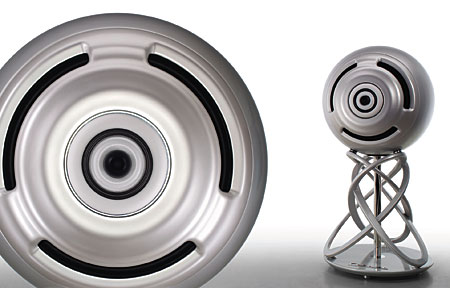 Uncrated, and minus the cold fog, the large, accurately named Sphères bore more than a passing resemblance to that flick's crawling-eye monsters. Indeed, the Cabasses' unusual presence in my listening room creeped out more than a few visitors. The ones who didn't recoil—count me among them—embraced the speaker's retro sci-fi looks.
Construction in the Round
Uncrated, and minus the cold fog, the large, accurately named Sphères bore more than a passing resemblance to that flick's crawling-eye monsters. Indeed, the Cabasses' unusual presence in my listening room creeped out more than a few visitors. The ones who didn't recoil—count me among them—embraced the speaker's retro sci-fi looks.
Construction in the Round
The Sphère's startlingly large spherical enclosure is made of dual shells of thin, rigid polymer separated by a layer of damping material that Christophe Cabasse, son of the French firm's founder, Georges Cabasse, told me is extensively used in the aeronautical industry, as well as to damp submarine interiors. It contains a acoustic-suspension woofer with a 22" cone made from ultrarigid, lightweight Nomex honeycomb. Inside, the sphere is further stiffened with curved wood braces, then covered in a thick layer of acoustical felt.
Within a highly damped composite "lens," the ball's curved front surface holds the three-way TC23 module, which covers the range of 80Hz to 22kHz and comprises the convex midbass and midrange drivers, and a dome tweeter mated to a flared horn. The TC23 is an upgrade of the TC22 coaxial driver used in many Cabasse products, including the Artis Baltic II, which I reviewed in the September 2005 Stereophile (Vol.28 No.9). As I wrote in that review, the coaxial's exploded diagram demonstrates that it's "not simply three nested drivers but a complex jigsaw puzzle of them." The TC23's updated tweeter is made of a new generation of polyether said to incorporate an ideal ratio of rigidity to weight that better matches the performance of the midrange driver. The 8"-diameter low-midrange unit, with a ring-shaped Duocell diaphragm of Rohacell foam, has been redesigned and now has a longer throw.
With this four-way composite drive-unit, Cabasse appears to have produced as close to a full-range, coincident point-source loudspeaker as is physically possible while avoiding the usual problems of reflection, diffraction, and comb filtering associated with placing a mid/high-frequency driver in front of a woofer. Still, the Sphère's drivers are arranged one in front of the other, the new woofer placed behind the low-midrange/high-frequency array.
While a single full-range driver would be ideal, it's simply not possible. This forces the designer to choose between producing frequency-limited, single-driver speakers, which almost always sound very coherent while reproducing flutes and such, but are more or less useless at the frequency and dynamic extremes—or multidriver, full-range speakers, which all suffer, to one degree or another, from tonal and spatial incoherence due to compromises that must be made in driver placement and/or crossover network, and the resultant inconsistencies in time delay. Most of us listen to examples of the latter, among which are many speakers that prove that such a system can be made to work quite effectively. Still, these problems are difficult to design around, and affect both direct and reflected off-axis energy. It's the balance a designer strikes between them that is critical to achieving timbral and spatial accuracy.
In the Sphère, Cabasse claims to have produced at least part of that ideal driver: a pulsing sphere. Even the Sphère's asymmetrical, diffraction-avoiding stand plays a part in the speaker's sound. It provides a rigid, vibration-free support for the sphere, and also gives it a sexy, "futuristic" look.
Solving the physical aspect of the composite drive-unit's design still leaves the issues of crossover phase and time delay. For that, Cabasse developed a proprietary active digital crossover combined with a powerful DSP chip. The software, jointly developed over three years by Cabasse and ENST Bretagne, a graduate engineering school and information-technology research center based in Brittany, resulted in the issuance of several patents and three AES presentations on digital sound treatment and coaxial drivers. Cabasse then worked with the American company DANVIL Signal Processing, which produced a special version of one of their soundcards to meet the needs of the Sphère.
In simple language that even I can understand: The crossover-processor corrects, in the digital domain, the time delay inherent in the horizontal stacking of the point-source array, while using four linear-phase digital filters combined with the appropriate time-aligning delay filters to carefully limit the response of each transducer's operating range. The system was further optimized by Cabasse to optimize the off-axis radiation pattern. To smooth the amplitude response, it also includes a linear-phase, digital-domain equalizer.
While digital-domain crossovers permit the implementation of steep slopes without the usual tradeoffs of analog crossovers, Cabasse's research has demonstrated that this approach is not necessarily ideal for coaxial drivers, in which lobing does not occur in the overlapping frequencies. The result, according to their literature, is a speaker whose polar pattern response is remarkably smooth, consistent, and controlled. Cabasse claims that the response will fall within 2dB of the Sphère's specified on-axis frequency response of 20Hz–25kHz, ±3dB (open space conditions) within a 60° cone centered on the tweeter.
A block diagram shows that the analog input is first digitized at 24-bit/48kHz resolution by an Analog Devices AD1938 analog-to-digital converter. The digital audio data are then equalized, after which it is fed to a digital filter bank that implements the necessary time alignment of the four acoustic centers and the crossover networks. The crossover points are 150Hz, 800Hz, and 4kHz, with variable-slope filters ranging from 24 to 70dB/octave. Digital signal processing is accomplished via an Analog Devices 32-bit floating-point SHARC chip, with D/A conversion for each of the four drive-unit channels handled by an AD1938 chip. The speaker needs to be quad-amplified.
Uncrated, and minus the cold fog, the large, accurately named Sphères bore more than a passing resemblance to that flick's crawling-eye monsters. Indeed, the Cabasses' unusual presence in my listening room creeped out more than a few visitors. The ones who didn't recoil—count me among them—embraced the speaker's retro sci-fi looks.
Construction in the Round
The Sphère's startlingly large spherical enclosure is made of dual shells of thin, rigid polymer separated by a layer of damping material that Christophe Cabasse, son of the French firm's founder, Georges Cabasse, told me is extensively used in the aeronautical industry, as well as to damp submarine interiors. It contains a acoustic-suspension woofer with a 22" cone made from ultrarigid, lightweight Nomex honeycomb. Inside, the sphere is further stiffened with curved wood braces, then covered in a thick layer of acoustical felt.