

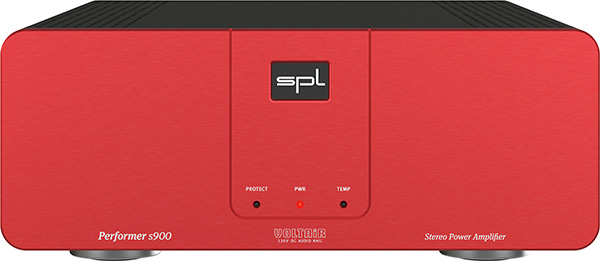
SPL Performer s900 power amplifier
In building my listening systems over the years, my primary goal has been to hear as much of the source recordings, and as little of the system itself, as possible. Every piece of every system imposes its own sound to some degree onto what comes out of the speakers. I don't only mean obvious, measurable things like distortion, noisefloor, S/N ratio, and so on.
Sumo Andromeda power amplifier
James">http://blog.stereophile.com/ces2009/now_thats_what_i_call_music">James Bongiorno, the engineer behind the Sumo Andromeda, has enjoyed a long and colorful career as an audio amplifier designer. He has cast himself at times as an enfant terrible, exploding at audio critics and running scandalous advertisements (footnote 1). His best-known amplifier is the Ampzilla, produced by Great American Sound, but he also designed the Dyna 400. Currently Jim is living on a boat and serving as part-time consultant to the Sumo Company.
Sumo Polaris II power amplifier
What's in a name? Quite a bit, when you stop and think about it. Would you rather have prostate surgery by Dr. Steadyhand or Dr. Whoops? Names imply a lot, even if we don't consciously make the connection; that's why your Polo shirt was made by Ralph Lauren instead of Ralph Lipshitz.
Symphonic Line Kraft 400 monoblock power amplifier

Things didn't start off auspiciously. I'd been after Symphonic Line's Klaus Bunge for more than a year to send me the Kraft 400 Reference monoblocks. Finally he called. He said he was going to be in town for a few days, and he had with him a pair of what he described as his "traveling" Kraft 400s, which he proposed to leave with me.
Theta Digital Citadel monoblock amplifier

As we all know, it's the sound that counts. However, good looks enhance pride of ownership, and Theta Digital's class-AB, 400W Citadel is as handsome a monoblock as these jaded eyes have laid eyes on.
Theta Digital Enterprise monoblock power amplifier
Monoblock power amplifiers seem to be moving in and out of my listening room faster than green-onion salsa from Chi-Chi's. Over the past six months I've had the Parasound">http://www.stereophile.com/amplificationreviews/774">Parasound Halo JC-1, the Halcro dm68, the Pass">http://www.stereophile.com/amplificationreviews/1103pass">Pass XA-160, the Musical">http://www.stereophile.com/amplificationreviews/104mf">Musical Fidelity kW, and now these 300W (into 8 ohms), $4500-each beauties from Theta Digital. All of these amps sounded as different as they looked, which was no surprise; too bad the "measures the same, sounds the same" dogmatists remain open for business.
Theta Digital Intrepid 5-channel power amplifier
Theta makes a power amp?
Theta Digital Prometheus monoblock power amplifier

Several seconds after I began listening to it, I knew that Theta Digital's Prometheus monoblock amplifier ($12,000/pair) was different from other amplifiers. The violins and brass were more dynamic, and had more pace. The orchestra sounded more three-dimensional, depicted in relief by a degree of hall ambience I hadn't heard when I played the same recording through my reference solid-state stereo amplifier, a Mark Levinson No.334.
Threshold SA-1 monoblock power amplifier
Eleven years ago, Threshold Corporation entered the high-end audio market with the first amplifier ever to use sliding bias (footnote 1) in its output stages. Some 10 years later, Threshold spawned another innovation: their so-called Stasis circuitry, which yielded the S-series amplifiers. The SA-1 and its lower-powered sister SA-2 are the latest from Threshold, and are the first Threshold amps to abandon sliding bias for straight class-A operation. Both use the Stasis circuit.
Threshold Stasis SA/12e power amplifier
"Tomorrow we'll go over to Larry">http://www.stereophile.com/asweseeit/593">Larry Archibald's house and pick up the Threshold amplifiers."