

Benchmark Media Systems AHB2 power amplifier
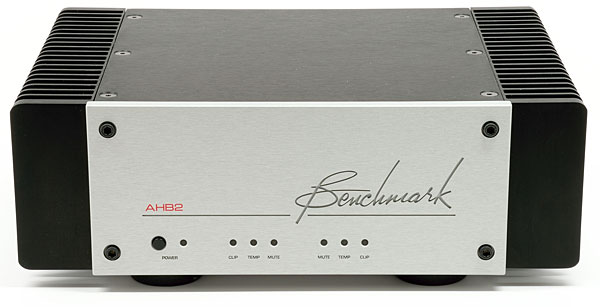
I first saw Benchmark's AHB2 stereo power amplifier at the 2013 Convention of the Audio Engineering Society, in New York City. On silent display in Benchmark's booth on the convention floor, its compact size and comprehensive features made the amp immediately attractive, and the design was described as a departure from traditional analog and digital amplifiers. It was also explained to me that the AHB2 was based on designs by Benchmark's founder, Allen H. Burdick (whose initials it bears). By the time of Burdick's retirement, in 2006, Benchmark didn't yet offer a power amplifier, but the company used a prototype based on his work to evaluate their new digital products, and that amp was soon developed as a commercial product; Burdick died just weeks before the AHB2, now named in his honor, was shown at the 2013 AES convention.
Boulder 1060 power amplifier
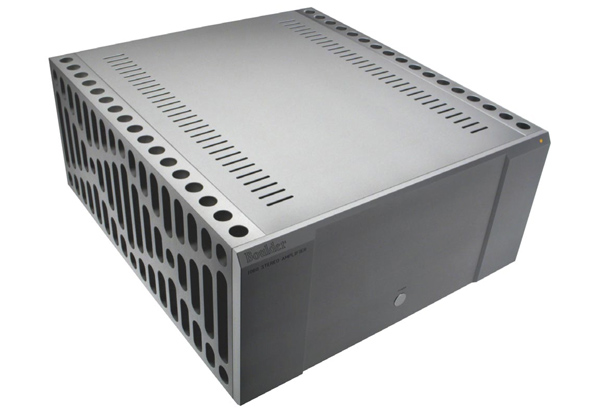
Can an $18,000 power amplifier be a bargain?
Can an $18,000 wristwatch?
Boulder 1151 monoblock power amplifier

For several decades—from well before I toured the Boulder factory in 2016—I've wanted to get a handle on the best sound the now41-year-old company can offer. Multiple listening sessions at shows had more than hinted at excellence. But neither my time in Boulder's large, dedicated music room, which was intentionally dry, nor exposure at various hi-fi shows left me convinced that I'd heard Boulder's full potential.
My first opportunity for an in-home audition came in 2021, when I reviewed the 866 stereo integrated amplifier ($17,500 with DAC, $16,000 without). But that entry-level (by Boulder standards) product, which Senior Engineer Jameson Ludlam said was released to build brand awareness and expand the company's reach by offering "a more accessible product that provides the features we think many people are looking for with the performance they have come to expect from Boulder," only provided a peek at the excellence I expected Boulder to achieve.
So when a last-minute review cancellation opened space to review the just-released Boulder 1151 mono power amplifier ($47,000/pair), I thought, "At last!"
Boulder 2050 monoblock amplifier
How much power do you really need? How much power can you actually use? What's necessary, and what's icing on the cake? And does anyone really need 1000Wpc?
Boulder 500 power amplifier
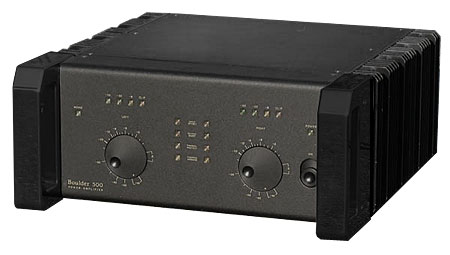
Yet another amp from Colorado! This is the third amp to come my way from that state (the others being the Spectrascan and the Rowland Research), and at this point, after living with it for a couple of months, I'm quite comfortable in declaring the Boulder 500 to be one helluvan amp.
Boulder 500AE power amplifier

To high-end audiophiles, the Boulder 500 amplifier and its less expensive derivative, the 500AE (Audiophile Edition), would not seem to be "high-end" designs. They are designed around op-amps (felt by many to be generally poor-sounding), they have scads of negative feedback (which is perhaps why op-amps sound bad), and they have only a moderately hefty power supply. Why, then, is Stereophile publishing a review of an op-amp–based power amplifier? Read on...
Boulder Amplifiers 2150 monoblock power amplifier
"I'm a recording engineer, so I value accuracy," said a panelist in a discussiontitled "How to Read Between the Lines of Audio Advertising"at last October's Rocky Mountain Audio Fest. I, too, was on the panel, which was moderated by Brent Butterworth, a writer for the SoundStage! Network of online audio magazines.
"Accuracy is overrated," I interjected from the other end of the dais. "Accurate to what? To your sonic tastes? To what you hear on your preferred loudspeakers? Other than one's personal preferences, I'm not sure the term accuracy has much meaning."
Bricasti Design M15 power amplifier

On the second morning of a recent audio show, I walked into the exhibit room of Bricasti Design.
"How about some Mahler?" asked cofounder and designer Brian Zolner.
"Oh God. Not at 10am!"
Bricasti Design M28 monoblock power amplifier

Google Bricasti and all that comes up are sites relating to Bricasti Design products. The name must be fancifulit sounds Italian, but cofounders Brian Zolner and Casey Dowdell most likely are not, and the company's headquarters are not in Milan or Turin but in Massachusetts.
While its name might be whimsical, nothing else about Bricasti is. As John Marks reported in his review of Bricasti's M1 DAC in the August 2011 issue, both founders previously worked at Lexicon: Dowdell as a DSP-software engineer, Zolner as international sales manager. Bricasti develops its products in conjunction with Aeyee Labs, formed by a group of ex-employees of Madrigal Audio Laboratories and based in New Haven, Connecticut.
Bryston 14B-SST power amplifier
Talking to fellow audiophiles, I sometimes hear generalizations about power-amplifier design: "High-power amplifiers don't sound as good as low-power amplifiers." "Tube amps are more musical than solid-state amps." "Class-A circuit designs always sound better than class-AB." "Bridged amplifiers don't image precisely, throw deep soundstages, or have the transparency of non-bridged output stages." Etc.