

Schiit Audio Aegir power amplifier

Class-D audio amplifiers: What's the argument for them? Class-A audio amplifiers: What's the argument against them? Class-AB amplifiers: Why does everybody make them? Each of these amplifier output architectures has strengths and weaknesses. Each will interface more or less successfully with a given loudspeaker in a given room. Each has a distinctive sonic signature. Consequently, as knowledgeable audiophiles with a laundry list of system-building goals, we are required to choose the amplifier type that best suits our speakers, our room, and our individual musical-aesthetic predilections.
Schiit Audio Tyr monoblock power amplifier

It's a not untypical tale. Two veteran engineers, Jason Stoddard, who had extensive experience in product design, development, manufacturing, and marketing, and Mike Moffat, who had an impressive track record designing hi-fi products (footnote 2), got together in June 2010 to start an audio company. What wasn't typical was the new company's brand name: Schiit Audio. What also wasn't typical was the company's business strategy.
Simaudio Moon 860A v2 power amplifier

We've all been in similar situations. We approach an undertaking with the highest of expectations. Then reality intervenes, expectations change radically, and we have another story to tell, post on social media, or use to begin a review.
This tale of altered expectations began a few years after my birth, at AXPONA 2022, where I covered several stellar-sounding rooms that included Simaudio Moon electronics. By the third such room, I'd resolved to contact Simaudio, check in with Jim Austin, and see if there was a product that made sense to review in my system.
Simaudio Moon Evolution 860A power amplifier
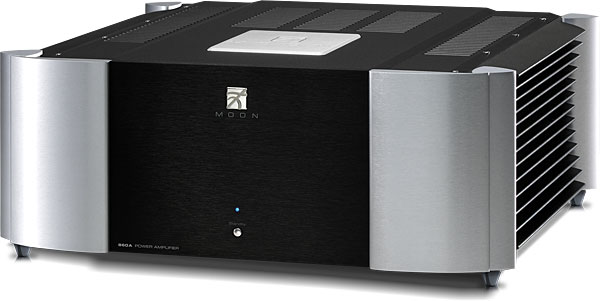
In the May 2015 issue, I fairly raved about Simaudio's Moon Evolution 740P line-stage preamplifier, and now here I am confronting its Moon Evolution 860A power amp. The two are companion models of sorts, with prices of $9500 for the 740P, $15,000 for the 860Aand for much of the time I spent listening to the 740P it was hooked up to the 860A, so some of the descriptions of sound in this review will seem familiar. The two components are both products of the same design shopSimaudio, Ltd., of Quebec, which has been a prominent brand in high-end audio for 35 yearsand are often marketed as a pair, so it should be no surprise if they have a common sound.
Simaudio Moon Evolution 880M monoblock power amplifier
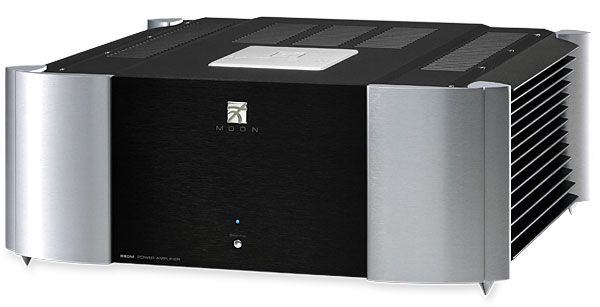
In the September 2005 issue (Vol.28 No.9), I reviewed Simaudio's first reference-quality power amplifier: the 1000W, 220-lb Moon Rock monoblock ($37,000/pair). At the time, the Rock was a dramatic departure for Simaudio, then primarily known as a maker of midpriced gear that was good for the money. I found a lot to like about the Rock, concluding that while it wasn't quite up to the standard of the best superamps of the time, it was very goodand, for Simaudio, an admirable first shot at the state of the art.
Simaudio Moon Evolution W-7 power amplifier

When I reviewedhttp://www.stereophile.com/solidpreamps/simaudio_moon_evolution_p-7_lin…; the Moon Evolution P-7 preamplifier ($6900) from Canadian manufacturer Simaudio in March 2009, I was impressed by the qualities of both the audio engineering and the sound. It was a no-brainer, therefore, to follow that report with a review of the matching power amplifier, the Moon Evolution W-7. In March 2006 Kalman Rubinson reviewedhttp://www.stereophile.com/solidpoweramps/306sim">reviewed; Simaudio's Moon Evolution W-8, which offered at least 250Wpc into 8 ohms (I measured 310Wpc at clipping). The W-7 looks identical to the W-8, but is 10 lbs lighter, offers 150Wpc into 8 ohms, and retails for $8900 compared with the W-8's $13,500.
Simaudio Moon Evolution W-8 power amplifier

The W-8 ($10,200) is the first of Simaudio's Moon series to incorporate the new Evolution cosmetics and new circuitry. I loved its predecessor, the Moon">http://www.stereophile.com/solidpoweramps/167">Moon W-5, which was one of the first power amplifiers I reviewed for Stereophile (March 1999, Vol.22 No.3). I also loved the "new and improved" W-5 when I wrote about in the May 2001 issue. In the September 2005 issue, Brian Damkroger praised Simaudio's monstrous Moon">http://www.stereophile.com/solidpoweramps/905sim">Moon Rock monoblock, a contemporary of the Moon Evolution W-8 stereo amp.
Simaudio Moon P-5 preamplifier & W-5 power amplifier

I first saw and heard SimAudio's Moon amp and preamp at WCES two years back, and something about their aesthetics appealed to me: Canadian ruggedness coupled with a decidedly French panache. I remember that those attributes also characterized the demo's sound, although I can't recall the speakers or the sources involved. At succeeding shows, it gradually dawned on me that the Moon components were the fixed elements in a succession of impressive demos.
Simaudio Moon Rock monoblock power amplifier

For years, I thought of Simaudio gear as good-sounding, attractive, and modestly priced, often describing it to friends as "really good for the money." The $5500 Moon">http://www.stereophile.com/cdplayers/343">Moon Eclipse CD player, which I reviewed in our April 2001 and April 2003 issues, stretched the "modestly priced" descriptor a bit, but its sound was still, I thought, really good for what it cost, and I adopted it as a reference. Simaudio expanded the Moon series and eventually discontinued its older, less expensive Celeste brand, but, I thought, its products could still be described as "really good for the money."
Smart Devices 2X150VT power amplifier
If your audiophile habit goes back more than a couple of decades, you're probably doing a double take looking at the Smart Devices 2X150VT. Looks like a Hafler DH-200, doesn't it? That's because, at its core, a Hafler DH-200 is exactly what it is. Smart Devices doesn't name names in its brochure, but they do say that "You may recognize this amplifier as one of the dominant premium performers of the 1970s and '80s"—a reasonable enough description of the MOSFET-output DH-200, which combined outstanding sound with a very reasonable price—especially if you built the kit.