

Recording of June 1987: Copland: Appalachian Spring, etc.
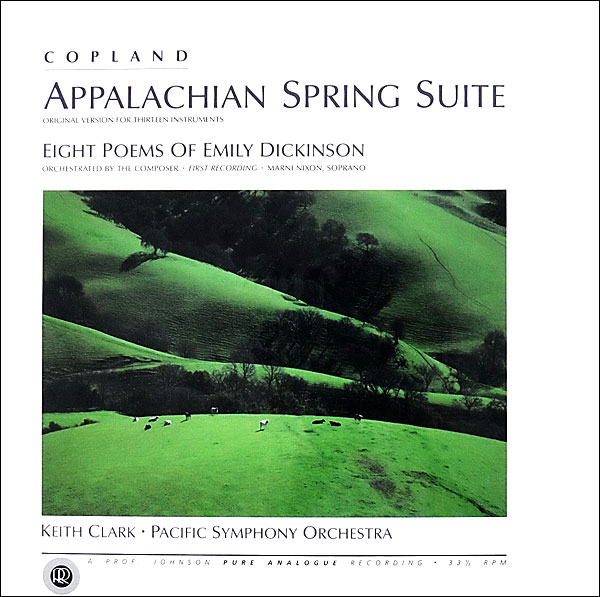
Copland: Appalachian Spring (Suite), Eight Poems of Emily Dickinson, An Outdoor Overture (CD only)
Pacific Symphony Orchestra/Clark/Marni Nixon (soprano)
Reference Recordings LP RR-2 and CD RR-22CD. Tam Henderson, prod.; Keith Johnson, eng. This is unquestionably one of the best recordings Reference Recordings has done. The sound of the LP is up-front and quite bright, giving the orchestra that peculiarly nasal quality I usually associate with small French orchestras. There is truly remarkable detail and naturalness here; I was about to write that the recording makes the orchestra sound very small and pinched in Appalachian Spring when I noticed on the record jacket that this is the "Original version for 13 instruments." Okay, so I know what it costs to hire musicians in the US, but I still prefer the version of this work scored for full, bombastic, overblown 108-piece symphony orchestra. The 13 instruments are superbly balanced, thougheven the piano, which is usually (and wrongfully) relegated to behind the orchestra. About a half a block behind it.
Pacific Symphony Orchestra/Clark/Marni Nixon (soprano)
Reference Recordings LP RR-2 and CD RR-22CD. Tam Henderson, prod.; Keith Johnson, eng. This is unquestionably one of the best recordings Reference Recordings has done. The sound of the LP is up-front and quite bright, giving the orchestra that peculiarly nasal quality I usually associate with small French orchestras. There is truly remarkable detail and naturalness here; I was about to write that the recording makes the orchestra sound very small and pinched in Appalachian Spring when I noticed on the record jacket that this is the "Original version for 13 instruments." Okay, so I know what it costs to hire musicians in the US, but I still prefer the version of this work scored for full, bombastic, overblown 108-piece symphony orchestra. The 13 instruments are superbly balanced, thougheven the piano, which is usually (and wrongfully) relegated to behind the orchestra. About a half a block behind it.
Recording of June 1988: Songs My Mother Taught Me
 Songs My Mother Taught Me
Arturo Delmoni, violin; Meg Bachman Vas, piano
Kreisler: Tempo di Menuetto; Brahms: Hungarian Dance No.1; Valdez: Gypsy Serenade; Paradis: Sicilienne; Sarasate: Romanza Andaluza; Massenet: Meditation; Tartini: Variations on a Theme of Corelli; Smetana: From the Home Country; Gluck: Melodie; Vieuxtemps: Romance "Desespoir"; Faure: Apres Un Reve; D'Ambrosio: Canzonetta; Mendelssohn: Song Without Words ("May Breeze"); Kreisler: Sicilienne et Rigaudon; Dvorak: Songs My Mother Taught Me
Mobile Fidelity Sound Lab MFCD 877 (CD), North Star DS 0004 (LP). David Hancock, eng.; Bruce Foulke, prod. A-D. TT: 52:51 Here, at last, is one huge exception to the "Rule": an outstanding musical performance superbly recorded. Songs My Mother Taught Me is the product of a love affair between violinist Arturo Delmoni and the almost defunct practice of programming only short pieces in recitals. Delmoni's aim was to recreate that lost practice, and the result is stunning.
Recording of June 1990: I'm With You

DELBERT McCLINTON: I'm With You
Curb D2-77252 (CD only). Justin Niebank, Carry Summers, engs.; Delbert McClinton, Barry Beckett, prods. DDD? TT: 34:11
Curb D2-77252 (CD only). Justin Niebank, Carry Summers, engs.; Delbert McClinton, Barry Beckett, prods. DDD? TT: 34:11
Recording of June 1992: Nevermind
Nirvana: Nevermind
Geffen/Sub Pop DGCD-24425 (CD only). Butch Vig, Nirvana, prods. AAD. TT: 59:22
Geffen/Sub Pop DGCD-24425 (CD only). Butch Vig, Nirvana, prods. AAD. TT: 59:22
Recording of June 1993: The Oxnard Sessions, Volume Two

MIKE GARSON: The Oxnard Sessions, Volume Two
Mike Garson, piano; Eric Marienthal, alto & soprano sax; Brian Bromberg, bass; Ralph Humphry, Bill Mintz, drums
Reference Recordings RR-53CD (CD, LP to come). Keith Johnson, eng.; J. Tamblyn Henderson, prod. DDD. TT: 73:50
Mike Garson, piano; Eric Marienthal, alto & soprano sax; Brian Bromberg, bass; Ralph Humphry, Bill Mintz, drums
Reference Recordings RR-53CD (CD, LP to come). Keith Johnson, eng.; J. Tamblyn Henderson, prod. DDD. TT: 73:50
Recording of June 1994: Mirror Blue

RICHARD THOMPSON: Mirror Blue
Capitol CDP 7 81492 2 (CD). Tchad Blake, eng.; Mitchell Froom, prod. AAD. TT: 55:13
Capitol CDP 7 81492 2 (CD). Tchad Blake, eng.; Mitchell Froom, prod. AAD. TT: 55:13
Recording of June 1995: Train a Comin'

STEVE EARLE: Train a Comin'
Steve Earle, guitar, harmonica, vocals; Peter Rowan, guitar, mandolin, mandola, vocals; Norman Blake, guitar, dobro, fiddle, Hawaiian guitar; Roy Huskey, acoustic bass; Emmylou Harris, vocals
Winter Harvest WH 3302-2 (CD only). Steve Earle, William Alsobrook, prods.; Wayne Neuendorf, Mike Elliot, engs. ADD. TT: 40:01
Steve Earle, guitar, harmonica, vocals; Peter Rowan, guitar, mandolin, mandola, vocals; Norman Blake, guitar, dobro, fiddle, Hawaiian guitar; Roy Huskey, acoustic bass; Emmylou Harris, vocals
Winter Harvest WH 3302-2 (CD only). Steve Earle, William Alsobrook, prods.; Wayne Neuendorf, Mike Elliot, engs. ADD. TT: 40:01
Recording of June 1996: New Moon Daughter

CASSANDRA WILSON: New Moon Daughter
Cassandra Wilson, vocals; Brandon Ross, guitars; Kevin Breit, guitars, banjo, Irish bazouki; Charlie Burnham, violin; Lonnie Plaxico, bass; Dougie Bowne, drums; others.
Blue Note CDP 8 32861 2 (CD only). Craig Street, prod.; Danny Kopelson, eng. TT: 61:59
Cassandra Wilson, vocals; Brandon Ross, guitars; Kevin Breit, guitars, banjo, Irish bazouki; Charlie Burnham, violin; Lonnie Plaxico, bass; Dougie Bowne, drums; others.
Blue Note CDP 8 32861 2 (CD only). Craig Street, prod.; Danny Kopelson, eng. TT: 61:59
Recording of June 1997: Keepers

GUY CLARK: Keepers
Sugar Hill SHCD-1055 (CD). 1997. Guy Clark, prod.; Miles Wilkinson, prod., eng.; Johnny Rosen, eng. AAD? TT: 64:45
Performance ****½
Sonics *****
Sugar Hill SHCD-1055 (CD). 1997. Guy Clark, prod.; Miles Wilkinson, prod., eng.; Johnny Rosen, eng. AAD? TT: 64:45
Performance ****½
Sonics *****
Recording of June 1998: Elgar: Enigma Variations

EDWARD ELGAR: Enigma Variations, In the South, Coronation March
George Hurst, Bournemouth Symphony Orchestra
Naxos 8.553564 (CD). 1997. Paul Myers, prod.; Dave Harries, eng. DDD. TT: 58:47
Performance ****
Sonics ****
George Hurst, Bournemouth Symphony Orchestra
Naxos 8.553564 (CD). 1997. Paul Myers, prod.; Dave Harries, eng. DDD. TT: 58:47
Performance ****
Sonics ****