

Trip and Jitter: the Electronic World of Dan Deacon

Violet- and orchid-colored LED banks shimmer across the room. Green and pink spots radiate out and back. A steady stream of beats and keyboards from other electronica luminaries rumbles out of the speakers. Let's dance! Or maybe just listen?
Onstage, Dan Deacon is busy tweaking his gear. Out on the floor, the audience is oddly antsy. To fight the waiting, one woman hangs on her boyfriend. Clumps of hipsters conviviate. Very strong drinks (a sponsorship deal?) flow for seven bucks a pop. Anticipation thickens. Impatience turns to pacing. Young men make solo air grooves.
Tube Porn: Leeds Radio
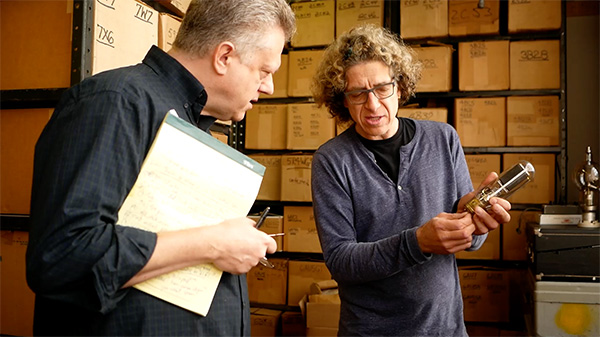
Richard Matthews has sold upwards of 30,000 tubes in the last ten years and he still has 100,000 tubes to go! Working out of his Leeds Radio warehouse in the Bronx, Matthews has every tube imaginable in stock, as well as a vast variety of tube testers, classic radios, capacitors, beautiful vintage tube boxes and many, many collector's pieces.
Ulrik Poulsen and his Amazing Alpha-Core Cables
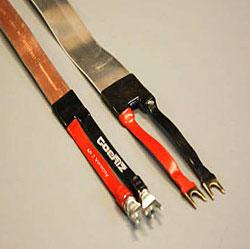 Jonathan Scull: How long have you been making cables, Ulrik?
Ulrik Poulsen: It's actually close to three years now...It's a spinoff from other products we make. Actually, Alpha-Core manufactures magnetic cores and various materials and components for transformers...And we have a daughter company called Tortran that manufactures toroidal transformers. Anyway, five years ago we introduced a new product called Laminax. It's a combination of copper and aluminum with various kinds of dielectrics. This is laminated together continuously in various fashions to produce a material that's used as shielding for EMI and RFI in the electronics industry.
Jonathan Scull: How long have you been making cables, Ulrik?
Ulrik Poulsen: It's actually close to three years now...It's a spinoff from other products we make. Actually, Alpha-Core manufactures magnetic cores and various materials and components for transformers...And we have a daughter company called Tortran that manufactures toroidal transformers. Anyway, five years ago we introduced a new product called Laminax. It's a combination of copper and aluminum with various kinds of dielectrics. This is laminated together continuously in various fashions to produce a material that's used as shielding for EMI and RFI in the electronics industry.
Vandersteen's Richard Vandersteen Talks Loudspeakers

"Richard Vandersteen doesn't look like a typical loudspeaker designer," wrote Ken Kessler when he interviewed Vandersteen in the July 1988 issue of Stereophile. JA talked speakers with Richard Vandersteen at the 2018 Consumer Electronics Show, held January 9-12 in Las Vegas, NV.
Vince Mendoza's Learning Laboratory

Photo by Reinout Bos
Audio engineers never get the credit they deserve. The same is true for music arrangers, who are also an unheralded but hugely fundamental part of any musical success. As a composer, conductor, and inventive arranger of popular music, the modest but multitalented Vince Mendoza says he's most focused on enhancing the song he is arranging and the story it is trying to tell.
"Young arrangers are very concerned with their own voice and spinning their own melodies and turning things upside down and backwards, and they forget what a song really is about," he told me in a recent Zoom conversation from his home in Los Angeles. "You could be writing about heartbreak, and there are a million and one ways to tell that story, but the listener still has to feel it."Vivid Video: JA Interviews Speaker Designer Laurence Dickie

This past weekend, John Atkinson and I attended the debut of Vivid Audio's new flagship speaker, the G1 Spirit, at a private home in Itasca, IL (to the west of Chicago.) The event was hosted by concert pianist and audio retailer George Vatchnadze of Kyomi Audio. Prior to the event's start, JA and Vivid speaker designer Laurence Dickie had a stimulating conversation about speaker design, focusing on the G1 Spirit loudspeaker.
VTL's Luke Manley
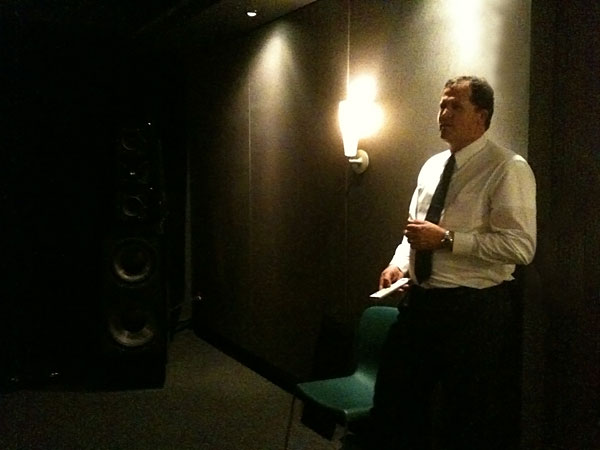
Luke Manley at Manhattan's Innovative Audio (Photo: John Atkinson)
Jonathan Scull: How long has VTL been in business, Luke? Luke Manley: My dad, David Manley, and I co-founded VTL in June of 1986. We started small on the East Coast, and soon after we moved to California. Scull: Is it because you're really a West Coast kind of guy? Manley: [laughs] You bet! There's a lot of supporting industries out there; a big base of electronics manufacturers, for example. Scull: What, in the San Francisco area?
Walter Sear's Analog Rules
The first thing you notice about Walter Sear's legendary">http://www.searsound.com">legendary Manhattan studio is that it feels so darn comfortable. Sear Sound doesn't have a wall of gold records, gleaming million-dollar consoles, or the latest high-resolution digital workstations, but a quick stroll around the three studios reveals a treasure trove of tube and analog professional gear: a pair of Sgt. Pepper–era Studer recorders plucked from EMI's Abbey Road studios; an early Modular Moog synthesizer Sear built with Bob Moog; and a collection of 250 new and classic microphones.
Wayne Shorter: How the Future Would Be

Wayne Shorter is 85. His mind moves at warp speed, a million miles from Art Blakey's Jazz Messengers, who rescued him from Newark, New Jerseyor the Miles Davis's second great quintet, for which the saxophonist wrote the compositions that would establish his genius. Shorter's constellation of classic Blue Note recordings from 196467Night Dreamer, JuJu, The All Seeing Eye, ETC, The Soothsayer, Adam's Apple, Speak No Evil, Schizophreniais now but a dim cluster of stars in his ever-expanding musical galaxy.
What's His Naim? Julian Vereker
 Editor's Introduction: One of the big industry stories of 1985 was the split, both personal and commercial, between the British Linn and Naim companies. Led by Ivor Tiefenbrun and Julian Vereker (footnote 1) respectively, both companies had started up in the early 1970s. Both men held similar views, both about the fat-cat complacency of British designers (which had led to a grievous sound-quality slump in the mid '70s), and about the system rethinking necessary for what some writers, unaware of the rigors of thought required by followers of that spiritual descendant of Fowler, William Safire, would term a "quantum leap" forward in sound reproduction.