

The Puzzle of Perception
"Nothing is real, and nothing to get hung about."---John Lennon
The Quality Deficit
I grew up with a healthy disrespectalmost a dislikefor rich people. Though my home town, Winchester, Mass., is one of Boston's wealthier suburbs, and my father and grandfather were officers in a Boston-area company, my father grew up on a farm and I seemed to inherit his farm-grown distrust for those who have money.
The Real Thing
At a CES press breakfast in Las Vegas last January, a member of the "all amplifiers (and digital sources!) sound the same" school of audio journalism made an interesting assertion. He argued that if our society were studied by extraterrestrials, they would find an unhealthy obsession with the re-creation of experience at the expense of experience itself. This speculation was a vehicle to support his position that buying good hi-fi is a waste of money; for the same financial outlay, one can attend hundreds, even thousands of live performances. Moreover, this anti-high-end writer suggested that ETs would consider our quest for better music reproduction a bizarre folly when the real thing is so readily available (footnote 1).
The Recording Angel
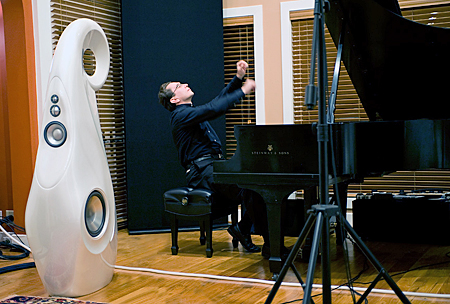
Back in the last century, I mused in this space about the essential difference between recorded sound and the real thing. I had been walking to dinner with friends when I heard the unmistakable sound of live music coming from a window. But here was the kicker: rather than the instruments being of the audiophile-approved acoustic variety, they were two amplified electric guitars. Their sounds were being reproduced by loudspeakers, yet it was unambiguously obvious that it was not a recording being played through those loudspeakers, but real instruments.
The Restorative Power of Music

It was an unusually fine day for a New York September. The W train crept from the subway tunnel into the sunlight of the Manhattan Bridge—"My God, the World Trade Center's on fire!" came the voice of the woman driving the train. I vividly remember what I did the rest of that day—the day the world terribly changed.
The Reviewer's Art

How many times have I asked myself what the purpose of music is? And what music really is, and what exactly I am trying to convey. What feelings? What ideas? How can I explain something that I myself cannot fathom?Gabriel Fauré, letter to his wife, August 31, 1903
In writing reviews for Stereophile, I face a challenge. Whether I'm evaluating an audio component, a recording, or a live performance, I'm confronted by the fact that, when all is said and done, no one fully understands why or how the sound of a particular component, composition, or artist can affect us as powerfully as so many of them do. How and why music and sound moves us remains, fundamentally, a mystery.
The Reviewer's Lot
"Time to write another equipment report," thought the Great Reviewer, aware that the IRS would soon require another small donation to keep the country running on track. Deftly donning his Tom Wolfe vanilla suit, he sat at the antique desk acquired on one of his many all-expenses-paid research trips to Europe, patted the bust of H.L. Mencken that invariably stood by the word processor, ensured that his level of gonzo awareness was up to par, arranged his prejudices and biases in descending order of importance, checked that the requisite check was in the mail, coined a sufficient number of Maileresque factoids appropriate to the occasion, and dashed off 3000 words of pungently witty, passionately argued, convincingly objective, and deeply felt prose.
The Right Thing To Do
"There are two kinds of fools: One says, 'This is old and therefore good.' The other says, 'This is new and therefore better.'"—Bob">http://www.digido.com">Bob Katz
The Road to Analog-Sounding Digital: Are We There Yet?
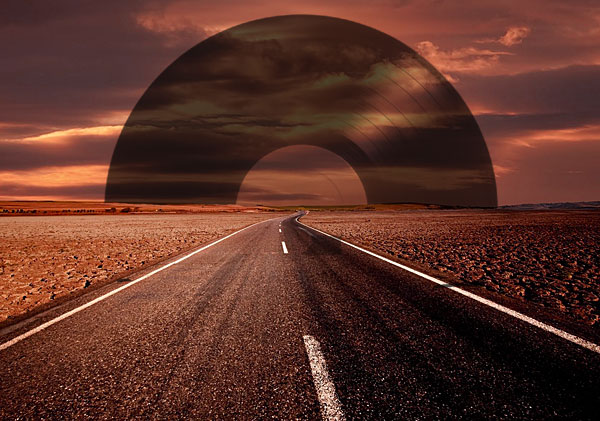
To say that a digital source "sounds like analog" has always struck me as coming up short. The notion that one format sounds like another is not really sensible or even ideal. While I love listening to LPs, there are some physical attributes of vinyl that, ideally, you don't want to reproduce. You know what I'm talking about because, every chance they get, LP haters remind us about pops, ticks, skips, surface noise, inner-groove distortion, etc. So when we say that a digital source sounds like analog, what we're really saying is that it doesn't sound like digital.
The Search for Musical Ecstasy
Every once in a while, some mainstream journalist discovers the audiophile underground.