

Carver Silver Seven-t monoblock power amplifier

In 1988, Bob Carver set out to design the best amplifier he possibly could, without regard for cost. It was more of an ego exercise than an attempt to build a product with wide commercial appeal. The result was the four-chassis, $17,500 Silver Seven.
Interestingly, Bob Carver chose vacuum tubes to realize his dream of building the ultimate power amplifier. The Silver Seven uses fourteen KT88 output tubes per channel, and puts out 375W into 8 ohms. Bob built three pairs of Silver Sevens, not expecting to sell many at the $17,500 asking price. When those sold quickly, another 10 pairs were manufactured. Now, demand is so great that Silver Sevens are built in groups of 30 pairs.
CD: Promises Unfulfilled
If you are to believe all the promotions for the Compact Disc, simply buying a player will transport you instantly to sonic nirvana. No background noise! No distortion! Flat frequency response from 20 Hz to 20kHz, pIus or minus zilch! The most perfect sound that modern hightech can provide! But if CD sound is so perfect, what are so many people screaming bloody murder about? It seems that half the golden ears who hear it are smitten with hate at first hearing. The other half finds it the best thing since tax shelters.
Changes of Everything
As of February, 1982, the ownership of this publication passed to other hands. In total despair about its precarious finances, JGH accepted with alacrity an offer by Larry Archibald (an occasional contributor in recent years) to purchase the magazine. This has now come to pass, and it is because of the resulting infusion of money that you are holding this issue in your hot little hands now instead of three months from now (and that is probably being a little optimistic about the way things were).
Chasing Rainbows
There was a time, very recently in terms of human history, when high fidelity promised to free the music lover from the constraints of the concert hall and the local repertoire, allowing him to choose at his whim any orchestra in the world playing any work he desired under the baton of any conductor he preferred. "All the pleasure of concert-hall listening, in the comfort of your home," was the way one display advertisement painted this musical utopia which, only 20 years ago, seemed right around the corner.
Components, Unite!
Ever since Stereophile took up the cudgels for subjectivity, and had the temerity to insist that even the best products have certain colorations, we have stressed compatibility in choosing components. By compatibility we do not mean merely matching impedances and signal levels, but mating components whose sonic peculiarities tended to offset one another.
Conrad-Johnson Premier 3 preamplifier

It says something for the state of technology that, after a quarter of a century, there still is no authoritative explanation for why so many high-end audiophiles prefer tubes. Tubes not only refuse to die, they seem to be Coming back. The number of US and British firms making high-end tube equipment is growing steadily, and an increasing number of comparatively low-priced units are becoming available. There is a large market in renovated or used tube equipment—I must confess to owning a converted McIntosh MR-71 tuner—and there are even some indications that tube manufacturers are improving their reliability, although getting good tubes remains a problem.
Conrad-Johnson Premier Five monoblock power amplifier

Many audiophiles who have only recently subscribed to Stereophile will be surprised to find that those clunky, heat-producing, short-lived tubes that reigned up through the mid-'60s are still Executive Monarchs in the mid-'80s. Why, for Heaven's sake? Because, despite everything, people like them.
Conrad-Johnson Premier Seven preamplifier
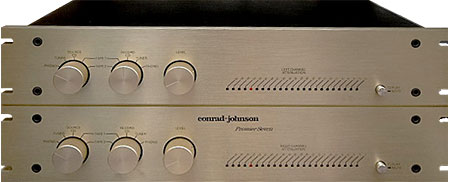
Whenever an audio high-ender thinks about tubes, he usually thinks about Audio Research. This is only natural, because Audio Research Corporation was almost single-handedly responsible for saving tubes from oblivion in the early '70s when everyone else switched to solid-state. But ARC was soon joined in its heroic endeavor by an upstart company called Conrad-Johnson, which entered the fray in 1977 with its PV-1 preamp, priced at an affordable (even then) $500.
Conrad-Johnson PV-5 preamplifier
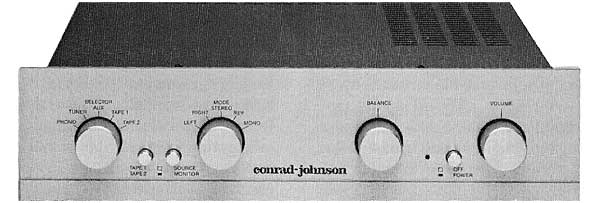
The $1485 PV-5 is a "budget" version of C-J's $2850 Premier Three preamplifier, but according to the manufacturer it embodies much the same kind of circuitry.
Tubed preamplifiers have a well-earned reputation as system busters. Many of them during warmup produce horrendous bangs or plops so severe that every speaker fuse in the system blows. If fuses are absent, or rated too high to protect things, the amplifier, speakers, or both are likely to blow up (not literally; they just twitch once and lie down dead). The PV-5 contains one of the most effective pop suppressors I've encountered, and produces no noise whatsoever during warmups and turnoffs.
Controversy: The Single Speaker Dem Myth
The issue is this business of "single-speaker" listening and demonstration, which has become fashionable in the UK.
The premise: bringing a second pair of loudspeakers into your auditioning room upsets the sound of the pair you're listening so badly that the first speaker's ability to correctly reproduce the timbre of musical instruments is destroyed. This observation is almost surely correct.