

Sugden A21ai Series 2 integrated amplifier

Winter has returned to Cherry Valley, New York, and I'm reminded of a bad habit that I used to conceal: On cold mornings I started my car well before driving off, then actually weighted down the accelerator pedal—with the heavy socket tray from my toolbox—in an effort to keep the idle high, and thus more quickly warm the windshield and the interior. Whether my lazy trick had the desired effect is a matter of some debate, but I wish now that I hadn't been so wasteful and so casually fouled the air.
T+A Caruso R multisource receiver

I've been on a Kim Gordon kick lately. It began a few months ago with rediscovering some Sonic Youth albums and picking up Gordon's solo record, No Home Record. I recently finished reading her memoir, Girl in a Band, about her life, art, and musical career. I tend to read books rather than listen to them, but this time I listened with the Audible app, and I found the experience compelling. Gordon's delivery is direct, her voice even-keeled, almost deadpan. She's giving us the straight dope. Subtle inflections are detectable: moments when she felt strong and proud; leftover cobwebs of postbreakup pain. Her humanity came through.
T+A PA3100 HV integrated amplifier
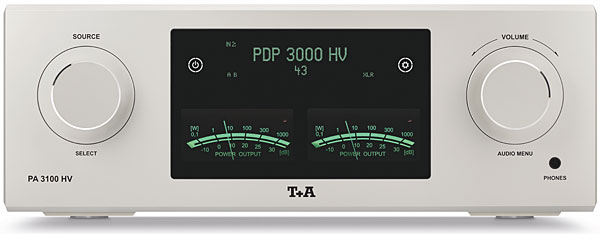
"I want to redo that painting," the spouse declared. "It's too dark."
"What's wrong with dark?" I responded. "Rembrandt's portraits are often dark. So are the paintings of Courbet and Hobbema. Your color palette represents how you were feeling at the moment. If it's true to you and speaks strongly, why change it?"
T+A Power Plant integrated amplifier
With the Music">http://www.stereophile.com/mediaservers/ta_music_player_media_streamer"… Player, T+A also sent along the Power Plant integrated amplifier ($2700). The Power Plant (PP) looks almost identical to the MP, and the two comprise a handsome, fully functional audio system in a single modest stack. To make this even easier, you connect the two at their rear panels with a supplied RJ-12 cable (T+A calls this the E Link), which coordinates their functions and allows the MP and PP to be operated with a single remote control.
T+A R 2500 R multisource receiver

The hi-fi receiver has been many different things. Early examples, like the Harman Kardon "Stereo Festival" TA-230 from 1958 (said by modern-day Harman/Samsung to be the first stereo receiver), featured separate FM and AM monophonic tuners that could assign a speaker to each if you wanted to listen to what was then a fad: stereo broadcasts over two stations (left channel over FM, right over AM, for instance). Standardized FM stereo broadcasting began in 1961, and by then, receivers had evolved into large, complex, nearly complete stereo systems; an example of that was the Fisher 800.
It might be nice if the receiver can connect to a modern TV, which will have either TosLink or HDMI-ARC output, or both. For those of us who still own a bunch of CDs, we might as well include a robust DACand maybe even a built-in CD transport. Throw in FM analog and digital tuners, and voilà, you have the R 2500 R, the "21st Century Receiver" from T+A Elektroakustik of Herford, Germany, southwest of Hanover.
T+A Symphonia streaming receiver

German aesthetes are fond of saying "Das Auge isst mit": "The eye feasts too." In audio terms, your ears do the listening, but your eyes want their share of pleasure. I thought of that expression after I opened the T+A Symphonia's double factory box.
T+A V10 integrated amplifier

"That sounds really great—what are you listening to?" my wife hollered to me from her home office, adjacent to my listening room.
Technics SU-G700M2 integrated amplifier

When I reviewed Technics's SU-R1000 integrated amplifier for the December 2021 issue, I found its performance beyond my expectations. It practically rewrote the ritual of listening to music on my home hi-fi. With its wealth of technological advancements, significant user options, and clear, three-dimensional sound, it cast a large sonic shadow over the other integrated amplifiers in my possession.
Technics SU-R1000 integrated amplifier

Technics, an arm of the Japanese giant Panasonic Corporation, has long been a major player in the hi-fi world, even if, in some recent decades, it stayed below the radar.
In the 1970s, analog-centric audiophiles particularly praised the Technics SP-10, the world's first direct drive turntable. Created by Matsushita engineer Shuichi Obata in 1969, the SP-10 and its successors became the standard in vinyl playback for American radio stations during that heyday of broadcast radio.
The Acoustic Research integrated amplifier

The first time we saw an AR amplifier (at a Hi-Fi Show), we were struck by its bland, almost antiseptic appearance. Amidst all those other audio products that looked as though they had been high-styled for Madame's boudoir, the unadorned simplicity of the AR amplifier made it stand out like an Eames chair at Williamsburg.