

Franco Serblin Accordo Goldberg loudspeaker
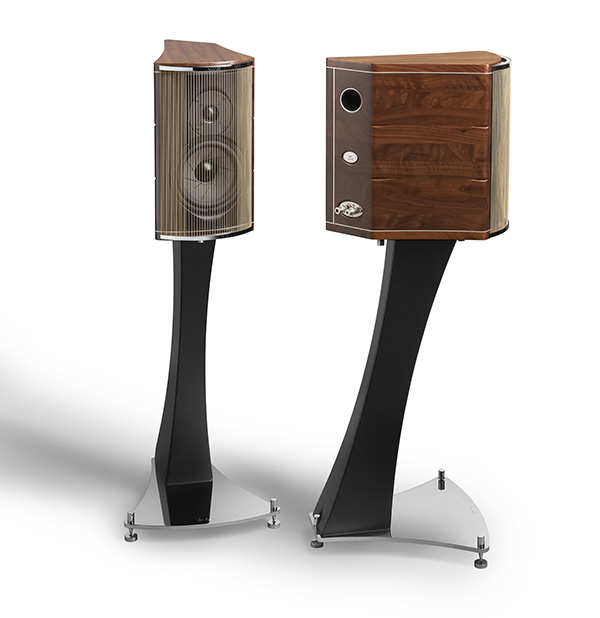
As founder and chief designer of Sonus Faber, Franco Serblin designed and manufactured many loudspeakers of acclaimed high quality, mainly in box form. Nevertheless, he remained painfully aware that such conventional rectangular parallelepiped constructions inevitably possessed an inherent and hard-to-suppress resonant signature characteristic of box-form cabinetry, significantly differing from that for a musical instrument. Franco had long obsessed over the sound and construction of classical string instruments, violins, violas, and cellos made by grand masters over centuries. He valued highly those richly resonant, expressive, complex sonic signatures.
Göbel High End Divin Marquis loudspeaker

Although it was founded by ex-Siemens loudspeaker engineer Oliver Göbel in 2003, I am embarrassed to admit that I had never heard of Göbel High End until I visited the room hosted by Florida retailer Bending Wave at the 2019 AXPONA. There, I listened to the German manufacturer's ginormous $220,000/pair Divin Noblesse loudspeakers, which were making their US debut. I was impressed by what I heard. I was interested, therefore, to learn that Göbel was introducing a smaller Divin model, the Marquis, which would not be too large for my listening room and would be priced at $80,000/pair.
Genesis II.5 loudspeaker system

Whenever anyone marvels at the enormous Genesis II.5 loudspeakers in my house, I'm quick to tell them that the II.5 is the smallest, least expensive loudspeaker made by Genesis Technologies. In fact, the company makes two larger speaker systems, the $33,000 Genesis II and the $70,000 Genesis I (footnote 1).
Goldmund Mimesis 8 power amplifier
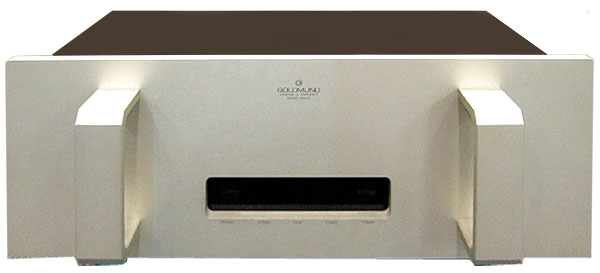
To judge from the $6400 Mimesis 8, Goldmund walks its own way when it comes to power amplifier design. High-end solid-state amplifiers from US companies like Krell, Mark Levinson, Threshold, and the Jeff Rowland Design Group marry massive power supplies to large numbers of output devices (these often heavily biased to run in class-A), built on chassis of such nonmagnetic materials as aluminum. By contrast, the Mimesis 8 has a magnetic (steel) chassis, and uses a relatively modest power supply, that for each channel based on two main 4700µF reservoir capacitors. The 8 offers just two pairs per channel of complementary output MOSFETs (Hitachi K134/J49). These carry a modest bias current of around 80mA total.
Goldmund Telos 2800 monoblock power amplifier
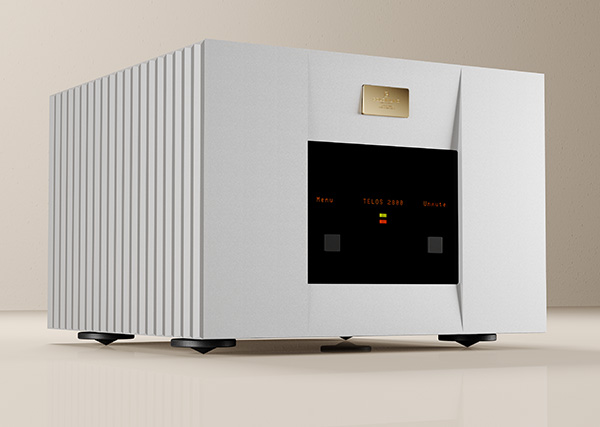
Frederich Nietzsche distinguished between two approaches to culture: The Apollonian, which is characterized by order and rationality, and Dionysian, which is about chaos, intoxication, and vitality. Apollo was the god of Music, Art, Light, and Knowledge, and to Nietzsche, the Apollonian impulse was the main source of beauty.
Gramophone Dreams #19: HiFi Man Susvara headphones

I spend my days comparing cartridges and speaker stands, arguing about imaging and microphone placement, speculating about DAC filters, and lately, sometimes, very secretly listening to headphones connected not to commercially available headphone amplifiers but directly to the outputs of basic tubed and solid-state power amplifiers. No person in his right mind would or should try thisit's too easy to destroy a pair of delicate, expensive headphones. But for me, it's been worth the risk.
Grimm Audio LS1c active loudspeaker system

It's not unusual for audiophiles to have fond childhood recollections of the old family stereo, but Eelco Grimm's memory of his dad's audio system probably stands alone. It's not just that Piet Grimm, a professional pilot for the Dutch air defense, had a pair of very fine Infinity speakers, a Pioneer receiver, and a Technics turntable. Others surely did, too. It's more that he purchased the system from a military PX shop at a US air force base in Germany, then happily flew the equipment home to the Netherlands on his Northrop F5 supersonic fighter plane. That's not run-of-the-mill cool, that's Top Gun cool.
Years later, Eelco, too, started taking stereo gear to new altitudes, becoming a designer of high-end speakers and electronics. After Grimm Audio, a 15-person enterprise, moved to a building near Eindhoven airport in the southern Netherlands, he realized that it stands in almost the exact spot where his dad used to park his fighter jet.
Gryphon Apex Stereo power amplifier
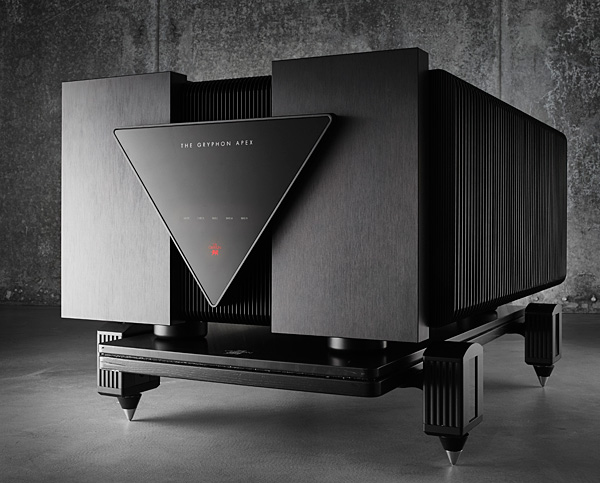
Some time ago, an amplifier in for review caught fire when first powered up. I don't mean it smoked and sizzled and shut downI mean that actual flames shot through the top grate. Fortunately, I was able to grab a kitchen fire extinguisher and douse the thing with foam. (Sorry, this was decades ago, and I don't remember the brand, but I think the company had a fire sale and was shut down.)
Gryphon Audio Designs Diablo 333 integrated amplifier
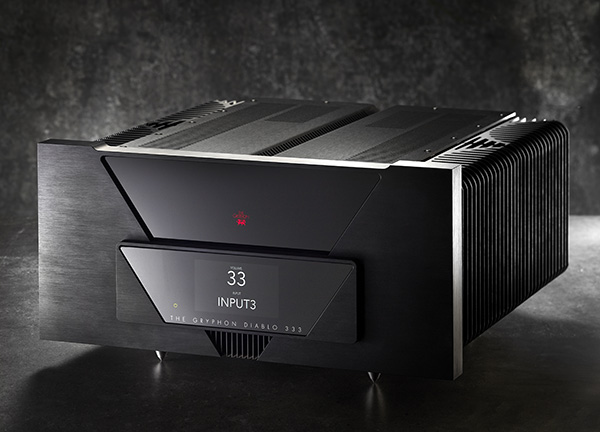
What's in a name? Denmark-based Gryphon Audio Designs laid down a marker when company founder Flemming Rasmussen chose that name in 1985. Browsing through the current Stereophile Recommended Components list, I only found one other manufacturer that utilizes an animal moniker. The imagery summoned by the use of the mythical treasure-guarding Gryphon seems appropriate; a hybrid creature combining features of the eagle and the lion, creatures of strength and speedthis choice underlines some of the aesthetics and performance Gryphon Audio has become known for. The handsome hardcover user's manual for the Diablo 333 simply states in gold "The Gryphon," along with a side-on profile of that winged lion-tailed creature, as a logo.
The Gryphon Diablo 333, a solid state, stereo integrated amplifier ($24,900 without optional DAC and phono stage modules), replaces the Gryphon Diablo 300, which was in production since 2016.
Gryphon Commander line preamplifier

Are well-heeled audiophiles ready for a knob-free future? Gryphon Audio Designs thinks so. In contrast to Gryphon's volume knobdominated Pandora preamplifier, the Danish company's new Commander offers nothing on its bold front panel to grab or turn.
Instead, there's a large, extra-thick, triangular glass protuberance that extends dramatically below the chassis's vertical dimension. That's where you'll find an "on/off" button, the main unit's only physical switch.