

Dan D'Agostino Master Audio Systems Relentless line preamplifier

D'Agostino President Bill McKiegan asked if I might be interested in writing the first US review of the top-line, three-piece, fully balanced D'Agostino Relentless preamplifier ($149,500, plus $19,500 for the optional digital streaming module), which since its 2021 introduction had only received a single review, in Europe.
Me, review a $150,000 preamp? This was not a kid in a candy storescale event. This was a kid let loose in a big-assed candy factoryscale event.
My glucose levels spiked. Questions whirled. What new virtues might a cost-no-object, presumably state-of-the-art preamplifier bring to my reference system? Would images be more corporeal? Would the soundstage be wider and deeper, tonal colors more intense? Would bassalready fabulousbe even more solid? Would the Relentless preamp move me closer to a premium-seat-in-a-live-concert experience?
Dan D'Agostino Momentum M400 MxV monoblock power amplifier

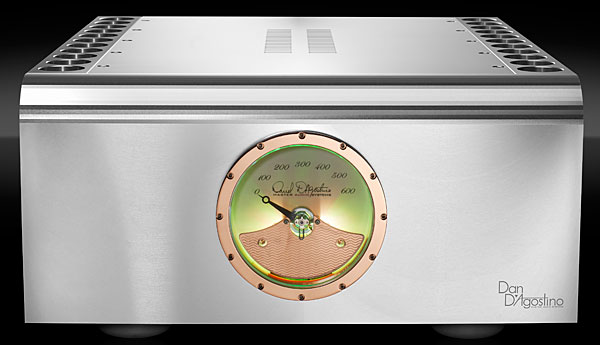
The Momentum M400 MxV Mono amplifier ($79,500/pair) is the latest iteration of Dan D'Agostino Master Audio Systems' debut amplifier of 2011, the Momentum Mono amplifier. Weighing 95lb, it is smaller and lighter than its entry-level sibling, the more powerful, 125lb Progression M550 Mono amplifier ($47,500/pair), and is veritably dwarfed by some other monoblocks, including the flagship D'Agostino Relentless Epic 1600 (570lb) and the Karan Acoustics POWERa mono (231lb), which I reviewed in May 2023. But if the M400 MxV's rock-solid look and feel and its exquisite aestheticsa sleek amalgam of silver and copper fronted by a power meter that glows green and radiates Rolex qualityare any indication, a helluva lot is going on beneath its showy exterior.
Dan D'Agostino Momentum monoblock power amplifier

What better way to celebrate the expiration of a noncompetition clause than to debut a product that has no competition? That's what Dan D'Agostino appears to have done with his Momentum monoblock amplifier ($55,000/pair)his first new product since leaving Krell, the company he cofounded more than 30 years ago.
Dan D'Agostino Progression Mono monoblock power amplifier
For as long as I've known about high-end audio, I've put Dan D'Agostino, co-founder of Krell, on the same pedestal reserved for the likes of Frank McIntosh, Saul Marantz, Avery Fisher, H.H. Scott, and Sidney Harman. The reason is simple: Dan's the man whose achievements at Krell led me from the harsh sound of my first high-end amp into another dimension, one of truly musical sound reproduction.
darTZeel CTH-8550 integrated amplifier

As the 2009 Consumer Electronics Show neared its end, I wandered into Blue Light Audio's room, which was dominated by the innards of darTZeel's new NHB-458 monoblocks—think of a 3D "exploded" diagram and you'll be on target. So impressive was that display of brute engineering that I almost didn't notice the amplifier that was actually making the music: the CTH-8550 integrated ($20,300).
darTZeel NHB-108 model two power amplifier

Like the proverbial pot of gold, darTZeel's golden equipment beckons. That, at least, is how it felt in January 2010, when John Atkinson and I ended our coverage of T.H.E. Show Las Vegas in the room shared by darTZeel, Evolution Acoustics, and Playback Designs. Listening to darTZeel's discontinued NHB-458 monoblocks (footnote 1) and NHB-18NS reference preamplifier (now updated), I was transfixed by the fullness of the system's midrange and overall beauty of the sound. "It was as though the system was opening its heart and welcoming us in," I wrote. "That's how warm and nurturing the sound was."
darTZeel NHB-458 monoblock amplifier

A recent (unpublished) letter to the editor argued that the reference for audio perfection is the sound of real instruments in a real space. The writer claimed that, since the art and/or science of audio is advancing, and because it is a "scientific truth" that the closer you get to perfection, the less divergence there is components, that therefore there should be less difference in sound among the components listed in Class A of Stereophile's "Recommended Components" than among those in Class B, much less Class C. This should be true of loudspeakers, he said, but even more true of top-rated amplifiers, since "they inherently have less divergence."
darTZeel NHB-468 monoblock power amplifier

What's the point of reviewing a pair of monoblock amplifiers that costs more than most people spend on two or even several cars and far more than most audiophiles spend on an entire music system? That's a good question. Another is: Why should I write this review when, just seven years ago, I reviewed a pair of darTZeel monoblocks that look exactly like this new pair?
I realize that products such as the darTZeel NHB-468 ($170,000/pair) are for the very few, but the very few include far more people throughout the world than you may realize people who can afford such costly audio products and who do buy them. I know, because in my travels I've met a lot of them, and they deserve to read reviews of products they're considering buyingthings most of us can only dream of owning.
dCS Debussy D/A processor

Don't have $80,000 to drop on dCS's four-component Scarlatti SACD stack that I reviewed in August 2009, or $17,999 for their Puccini SACD/CD player that John Atkinson raved about in December 2009? Even if you do, the new Debussy D/A processor ($10,999) might be a better fit for your 21st-century audio system. Sure, you don't get an SACD transportor any kind of disc play, for that matterbut the odds today are that you already have a player you like that's got an S/PDIF output that can feed the Debussy.
dCS Puccini SACD playback system
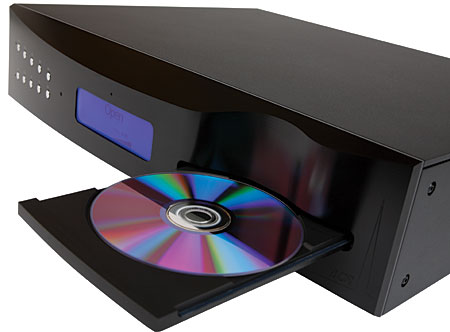
It's now 10 years since the launch of the two high-resolution audio disc formats, SACDhttp://www.stereophile.com/asweseeit/164">SACD; and DVD-Audiohttp://www.stereophile.com/asweseeit/1099awsi">DVD-Audio;. Yet, perhaps partly because both were hobbled">http://www.stereophile.com/asweseeit/257">hobbled in various ways to please the record industry, perhaps partly because too many supposed hi-rez releases sounded no better than CD, and perhaps partly because record retailers weren't sure how to display the formats to their best advantage, neither took off in any substantive way. DVD-A disappeared, and SACD survived only as a niche format for high-quality classical releases in both two- and multichannel forms. As we got deeper into the same decade, digital technology, despite various sparks and flashes, went into the doldrums. Mainstream digital technology was increasingly concerned with squashing the music into fewer and more portable bits, not with increased sound quality. Even the concept of "CD sound quality" began to seem an unattainable goal, as MP3">http://www.stereophile.com/features/308mp3cd">MP3 files became the dominant music carrier.