

Analog Corner #309: SME Model 6 turntable, Sculpture A.3L phono cartridge

"I got some Audio-Technica ATLP120X turntables in the other day, which had been back ordered for maybe 6 or 7 months, so I called to see if they had more. I was told there were 17,700 of that model on back order," a dealer I know told me recently in an email.
Analog Corner #314: OMA K3 turntable & Schröder tonearm

If you're going to spend a year-plus in COVID lockdown, it doesn't hurt to have a million dollars' worth of turntables keeping you company, right? That's been my good fortune. Sounds like a roomful, but it's only three: the SAT XD1, the TechDAS Air Force Zero, and the OMA K3 ($360,000, footnote 1).
You'll find this issue's cover girl either strikingly beautiful or homely. Visitor reactions fall strongly into one of those two camps, with nothing in between. I love the looks. Whatever your opinion, the K3's visual distinctiveness cannot be denied. The innards are equally unique.
Analog Corner #320: DYLP phono cartridges, SME Model 6 Classic turntable, Loricraft PRC6i record cleaning machine

What? Suddenly a new Japanese cartridge manufacturer? That's what I was thinking when Mockingbird Distribution's Phillip Holmes dropped three cartridges on me from DYLP Audio. Never heard of thembut then I'd not heard of MuTech either when Holmes sent me one of that company's $4500 RM-Kanda (now Hyabusa) moving coil cartridges, which I reviewed in the March 2019 issue's Analog Corner. If that cartridge is not on your moving coil radar, you ought to put it there.
Analog Corner #323: J.Sikora Reference turntable and KV12 VTA tonearm
Lublin, Poland, is about 130 miles from Lviv, Ukraine, a town that has been in the news lately. That's about the same distance as Hershey, Pennsylvania, is from my desk in northern New Jersey, where I'm writing this. They are close. Russian missiles struck Lviv on March 18, 2022, and as I write these words Lviv is preparing for more intense bombardment.
AnalogueWorks Zero turntable
My main task is to describe an audio component's basic character. How was it made? How did it fit into my system? How effectively did it deliver musical performances? My goal is to create stories that generate sounds and images in your mindstories that will allow you to imagine how the component might perform in your system.
I can hear the moans from all you objectivist guys: Please, Herb, spare us your purple prose.
Andover Model-One turntable music system

Apart from the Beatles and Hendrix I heard in my audiophile father's basement, one of my earliest rock'n'roll memories involved a multipurpose record player at school. In third grade, six of us were moved as a separate group to a round table to watch a filmstrip in a darker part of a large, open-plan classroom. A clunky old record player in a self-contained carrying case with a half-dozen headphone jacks sat on the table.
Basis Audio Ovation turntable
As audio enters its second digital decade, it gives me great pleasure to proclaim a great audio truth: to groove is divine, to error-correct ain't so benign.
Basis Debut Mk.V turntable
As it did for so many other designers and manufacturers of specialty audio gear, the current occupation of Basis owner/designer A.J. Conti began as a hobby and personal quest. A longtime audiophile and home-based dealer of brands like Krell and Quicksilver, Conti decided to build his own "killer" turntable using a fluid-damped suspension.
Bauer Audio dps turntable

Although LPs remain, for me, the high-end medium of choice, I'm not terribly interested in today's high-end record players. Most of them, from the 1980s through the present, have been soulless, uninspired, me-too products that utterly fail to communicate the presence, momentum, and punch of recorded music. And in certain ways—expense, complexity, size, cosmetics—some have been, quite simply, ridiculous.
BennyAudio Odyssey turntable
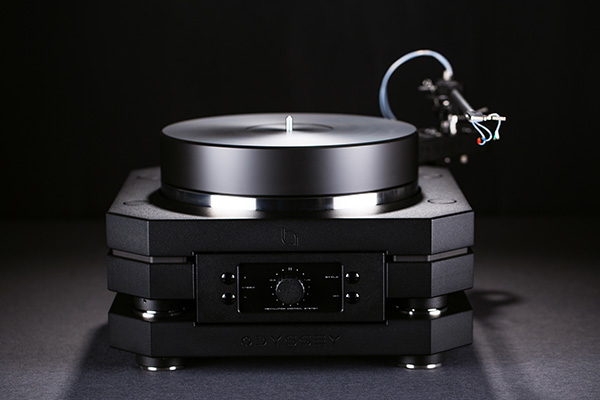
International audio shows are a white-knuckle thrill ride. The moment I first entered one of the four colossal, cathedral-like "Halles" of High End Munich 2024, my brain short-circuited. Among the products that gripped my senses that weekend, the Brutalist allure of the BennyAudio Odyssey Turntable ($45,000) spoke to me loudest.