

PS Audio GCPH phono preamplifier

PS Audio's first product, back in 1973, was a standalone phono stage; more recently, their PCA-2 preamp had an optional phono board. The GCC-100http://www.stereophile.com/solidpoweramps/106ps">GCC-100; integrated amplifier that I review this month has no room inside for a phono board, so they've gone back to producing a separate phono stage: the GCPH ($995). Like the other products in PS Audio's current line, this one is based on the Gain Cell, one module on the input side connecting to the cartridge, followed by a passive RIAA curve (with a claimed accuracy of 0.1dB over the 40dB range of the curve), and another Gain Cell on the output side.
PS Audio Stellar Phono phono preamplifier
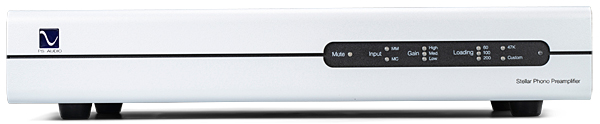
We usually save the question of value for the end of a review, but this time it's worth mentioning up front, if only because PS Audio has been in the news lately. Late last August, the company announced they were switching from a traditional dealer network to a factory-direct sales model. So, to some readers, it might seem fair to judge the brand-new, full-featured Stellar Phono Preamplifier ($2500) against ones selling in stores for $5000.
Pure Vinyl LP recording & editing software

As long as you're spinning an LP for your listening pleasure, and if digitizing it at a resolution of 24-bit/192kHz is transparent to the analog source, why not record and store the LP on your computer at that high sampling rate for future convenient playback via iTunes or for iPod use, or for burning to CD-R? And, while you're at it, why not record the LP unequalized and apply the RIAA curve in the digital domain, where you're not dependent on capacitors and resistors that are imprecise to begin with, and can drift over time? With no drift of phase or value, the virtual filter's results should be better than with any analog filter. And in the digital domain, you can program in any curve known, and select it at the click of a mouse. Aside from the sweat equity invested in programming it in the first place, it wouldn't add a penny to the program's cost.
Sentec EQ11 phono preamplifier
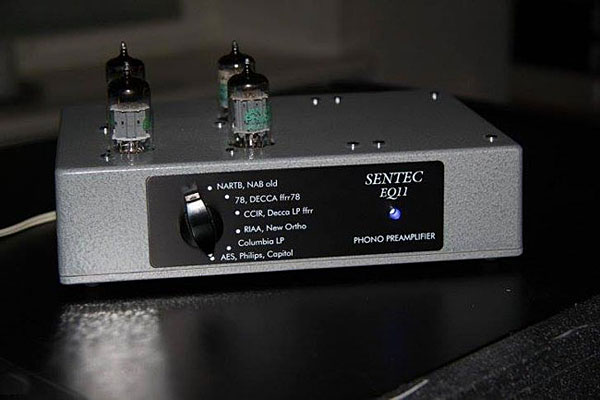
With quiet elegance, the Sentec EQ11 phono stage and equalizer entered my expanding world of gramophone dreams. The EQ11 ($2500) is a modestly sized, tubed phono stage with the industry-standard RIAA phono equalization and five other EQ curves. These additional curves are for records pressed by companies that did not fully or promptly comply with the new, supposedly global industry standard introduced by the Recording Industry Association of America (RIAA) in 1954.
Seta Model L phono preamplifier

The minuscule electrical output of an analog signal from a moving-coil cartridge needs to be boosted before it can be converted to digital and equalized in the digital domain. Of course, you could use your current phono preamplifier and record an equalized signal to hard disk, but then you wouldn't get to experience Pure Vinyl's digital RIAA correction—nor would you be able to avail yourself of all the equalization curves provide by Pure">http://www.stereophile.com/computeraudio/pure_vinyl_lp_recording_amp_ed… Vinyl, of which there are almost too many to count.
Seta Nano phono preamplifier

The minuscule electrical output of an analog signal from a moving-coil cartridge needs to be boosted before it can be converted to digital and equalized in the digital domain. Of course, you could use your current phono preamplifier and record an equalized signal to hard disk, but then you wouldn't get to experience Pure">http://www.stereophile.com/computeraudio/pure_vinyl_lp_recording_amp_ed… Vinyl's digital RIAA correction—nor would you be able to avail yourself of all the equalization curves provide by Pure Vinyl, of which there are almost too many to count.
Shindo Aurieges Equalizer Amplifier

At some point within the last few years of his life, the late Ken Shindo designed an outboard phono preamplifiera decision perhaps made inevitable by his earlier decision to answer popular demand with line-only versions of the Aurieges and the more upmarket Vosne-Romanee preamps...
Simaudio Moon LP5.3 phono preamplifier

Simaudio's Moon LP5.3 MM/MC phono preamplifier ($1400) is silly good! It has single-ended RCA inputs and both single-ended and true balanced-differential outputs. It also offers a wide range of adjustments for gain (54, 60, and 66dB), resistive loading (10, 100, 470, 1k, and 47k ohms), and capacitive loading (0, 100, and 470pF), all accomplished via a series of internally mounted jumper banks. You can even choose RIAA or IEC equalization. Removing the top plate to get to the adjustments reveals boards filled with high-quality parts for the well-isolated power-supply and signal-handling circuits.
Sonic Frontiers Phono One phono preamplifier

I've been in love with British sports cars ever since a visiting highway engineer brought a green MGB-GT to my tiny Nebraska town 30 years ago. Since then, there's been a steady stream of ferocious little cars in my life. Triumphs, MGs, Healeys, you name it—right up to my current crop, a Triumph TR6 and roughly two-and-a-half Jensen-Healeys.
Spin Doctor #10: Tone Controls, Vinyl EQ Curves, and the Mola Mola Lupe
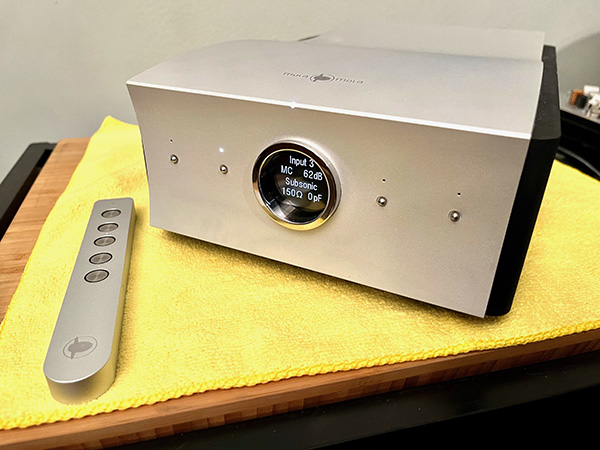
Twice in the last month I have been at someone's house, servicing their turntable, when they asked whether they should be considering a new phono preamp that offers additional playback equalization curves besides the standard RIAA. My usual reaction is to thumb through their record collection, where, more often than not, I find that they don't own a single record that was cut using a curve other than RIAA.
Phono playback EQ is one of those audiophile topics that stokes some people's passions, with plenty of disagreements about how important it is. I have seen grown men get into heated discussions about the history of record EQ curves, but in truth, the subject is only likely to matter if you listen to a lot of 78s or original mono LPs pressed between the late 1940s and the mid-1950s.