

Music in the Round #85: Nimitra, exaSound, Baetis, Roon

It's been going on for a while now: Despite support for multichannel in audio/video receivers and A/V processors priced from as little as $200 to $30,000, there are still very few offerings that cater to the music listener. They may offer stereo-only streaming features through their USB or Ethernet inputs, but these inputs don't see your multichannel files. To handle such files, they would require you to add a music server with HDMI output. However, I know of no turnkey music servers that will output multichannel audio via HDMI.
Music in the Round #90: Merging+Player PL8

Merging Technologies' original NADAC Multichannel-8 ($11,500) is an impressive device. (NADAC is an acronym for network-attached digital-to-analog converter.) It has eight channels of high-resolution D/A conversion, and two more for its front-panel headphone jack; a cutting-edge Ravenna Ethernet input (based on the AES67 Audio over Internet Protocol, or AoIP); and, to my delight, a real volume-control knob on the front.
Music in the Round #92: Digibit Aria Piccolo +
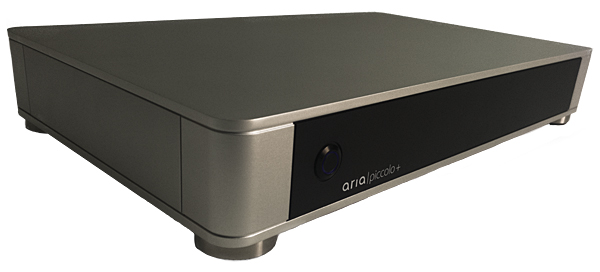
Lovers of high-resolution multichannel sound still don't have it easy. While the two-channel market is replete with snazzy, efficient music servers in stylish boxes, the only multichannel equivalents are Merging Technologies' Merging+Player Multichannel-8, and a handful of stereo devices that are rumored to do multichannel, though no such claims are made in print. To be candid, the latter will play multichannel tracks via USB, Ethernet, or HDMI outputs to suitable DACs (but that's another story), but because they're aimed at the two-channel market, they tend to skimp on the CPU horsepower and RAM needed to handle higher-resolution multichannel files. Even the Merging+Player Multichannel-8 ($13,500), with its Intel i3 CPU running Roon, couldn't entirely keep up with everything in my library.
Music in the Round #93: miniDSP & Ripping SACDs
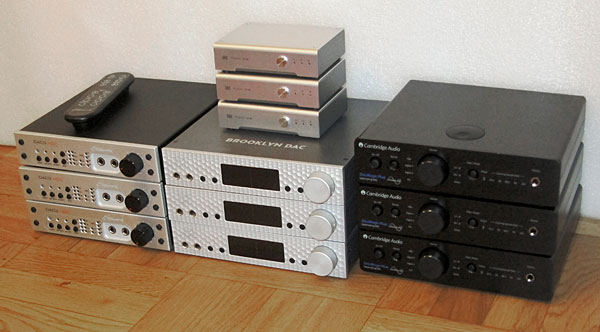
As I took my valedictory lap around High End, the immense audio show held each May in Munich, Germany, it was clear that this year's event was an exuberant flowering of mature technology. I witnessed the dominance of hardware for LP playback, as well as analog amplifiers, many of them based on tubes, and passive loudspeakers with traditional cone-and-dome drive-units. And there was no shortage of excellent and impressive musical demonstrations. Still, I experienced no revelations, and heard no announcements of any new technology that might trigger a hopeful anticipation of the near future. It was as if HE2018 were reflecting on the past with reverence and commitment, rather than striving toward the future with innovation and adventure.
Music in the Round #98: Trinnov Altitude 32 & Essence Evolve II-4K
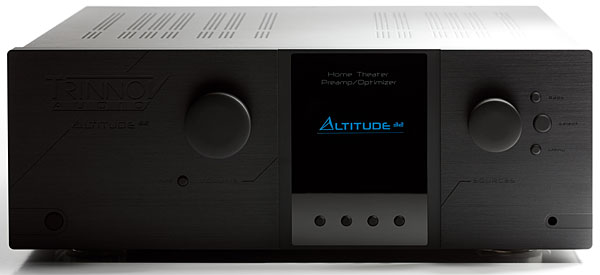
As I wrote before in these pages, I have long been acquainted with French electronics manufacturer Trinnov. Years ago, at an Audio Engineering Society convention in New York, a Trinnov rep used a mastering console equipped with their processor to move, at will, the sounds of instruments around the 3D soundstage and left me thoroughly impressed. That was before my conversion from stereo to multichannel music listening, and before the blurring of borders between home theater and mainstream audio.
Music in the Round #99: Revel & exaSound

There is necessity as well as comfort in having a long-term reference recordings and, system. The necessity derives from the familiarity with the reference that allows for comparisons and contrasts with the equipment being tested. The comfort that comes from the familiarity lets me relax and enjoy recreational music, relieved from the need to focus my attention intently on the sound. I do relish getting my hands on lots of interesting audio equipment and getting to play it in my own home, but it's like a two-month one-night stand: The new stuff usually goes back even if I am impressed. I don't change my audio equipment often.
Musical Fidelity A324 D/A processor
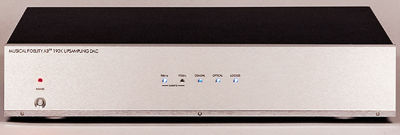
It was 1988. What to do about digital?
Musical Fidelity Digilog D/A processor
 The rapidly evolving world of the late 20th century is the source of much stress. Changes in the status quo, whether wrought by social, political, or technological forces, are often accompanied by anxiety brought on by the struggle to assimilate new patterns of thought. New ideas necessitate abandoning or modifying one's old ideas, thus creating conflict (footnote 1). However, these periods of rapid change can also be exciting, allowing one to chart a course of discovery and growth.
Musical Fidelity M1 CLiC universal music controller
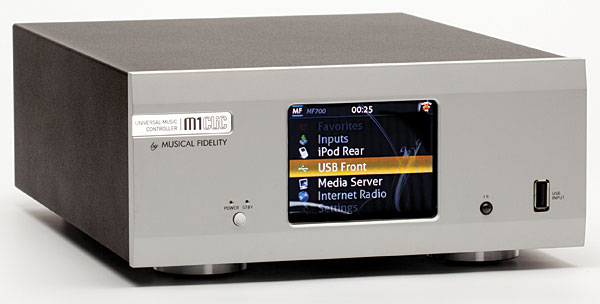
The taxonomy of audio products used to be easy. An amp, a preamp, speakers, a disc player or twodone. Now that hard drives, streaming clouds, and computers have entered the scene, unless your world revolves around only an iPod or a disc player, you have choiceslots of choices.
Musical Fidelity M1 DAC

The M1 DAC is by Musical Fidelity. At $699, it's a stunning bargain. Comparing it to $995 for the Digilog in 1989. Meanwhile, the M1 is far more versatile, way better built, and, if memory serves me right, sounds vastly better.
It appears that the way to sell a DAC in 2011 is to almost give it away, in real-dollar terms. Some people pay far more than this for a set of speaker cables, a pair of interconnects, even a power cord. The M1 DAC is a piece of kit that can transform your system. I kid you not.