

Acoustic Geometry Curve System room treatments

For a few weeks each year in the high summer of Minnesota, the corn sold from rickety roadside stands is so sweet and tender it is best eaten unadorned. For the wise and lucky nibbler willing to forgo condiments, the rewards of eating these naked kernels are the pure taste of Midwestern soil and sun transformed into a juicy, golden confection. I've begun to wonder if the yearly encounter with this magnificent and ephemeral sweet corn reminds Midwesterners of the joys of simplicity and plainness. Though my hypothesis is a stretch, it sure would explain a great deal about the Midwestern mentality. Perhaps Midwesterners subtly learn from this corn that if we get too fancy or try too hard, we can often screw up what nature has already made perfect. Conversely, we learn that no amount of fancy accoutrements will make a bad ear of bland, mealy corn come alive in the mouth.
Acoustic Sciences Corp. Tube Traps
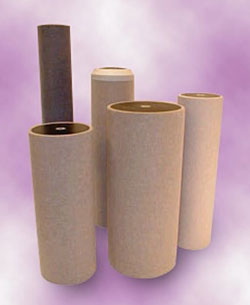
In my rather jaded report">http://www.stereophile.com/asweseeit/the_1986_winter_ces/">report from the 1986 Winter CES (Vol.9 No.2), I remarked that there was nothing really new in the field of high-end audio. Well, I was wrong. I overlooked the Acoustic Sciences Corporation Tube Traps, a patented new acoustic device designed by Arthur Noxon (president of ASC). The Traps represent the first practical and effective solution to a perennial audiophile problem: standing waves in the listening room.
Acoustic Sciences Corporation Studio Traps
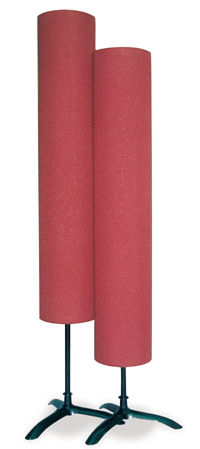
Over time I've successfully used a variety of tuning devices to refine the acoustics in Kathleen's and my listening room. But I've always suspected that Acoustic">http://www.stereophile.com/accessoryreviews/215">Acoustic Science's Tube Traps might be a good way to finish it off. I've occasionally asked visitors to stand in one spot or another behind the speakers as I listened for tergiversation (ie, "to change one's tune"; Hoo-hah!). I found several locations where a nice, dense audiophile body made an improvement to the sound.
Analog Corner #234: Do You Believe in Magic?

When a magician pulls a quarter from someone's ear or saws a woman in half, I believe in magic. I know it's an illusionnot realbut that doesn't mean that magic isn't real.
What's real is that the magician's illusion is believable because your eyes see it and, until sometime latereven if only a fraction of a secondyour brain doesn't argue. The best your brain can do is tell you, "Yes, you saw that, but you know it didn't happen."
Funny, then, how anti-audiophiles always claim that the ear is more easy to fool than the eye. Yet books have been devoted to cataloguing optical illusions. Do you believe that a railroad track's two rails meet at the horizon? Sure looks like it! The brain and ear are easily fooled, yet our very survival depends on their reliability. And the survival of an audio reviewer's credibility depends on his ability to be fooled as rarely as possible.
Analog Corner #286: StillPoints Aperture II, VPI Voyager, Bespoke Passive Preamplifier

VPI Industries Voyager phono preamplifier
Following my auditioning of Channel D's Lino 2C current-mode phono preamplifier, back in the world of voltage amplification, here's another phono preamp from another company based, like Channel D, in New Jersey. Probably not since Dynaco manufactured its electronics in Pennsauken has the Garden State enjoyed such riches of analog electronics!
Following my auditioning of Channel D's Lino 2C current-mode phono preamplifier, back in the world of voltage amplification, here's another phono preamp from another company based, like Channel D, in New Jersey. Probably not since Dynaco manufactured its electronics in Pennsauken has the Garden State enjoyed such riches of analog electronics!
Anti-Node: Active Room-Acoustics Correction

Recently, I assessed four disparate room-correction systems based on digital signal processing (DSP): Copland DRC205, Lyngdorf Audio RoomPerfect, Velodyne">http://www.stereophile.com/musicintheround/1105mitr">Velodyne SMS-1, and Meridian">http://www.stereophile.com/musicintheround/706mitr">Meridian DRC. I concluded that Meridian's approach—which applies IIR (Infinite Impulse Response) "anti-resonance" filters to suppress room resonant modes, if only partially—was, in many respects, the best. What I particularly like about Meridian DRC is that, unlike the Copland and Lyngdorf processors, its approach to system tonal balance is largely hands-off. Yes, it lightens up the extreme bass a little, as you'd expect, but it doesn't recast the system balance in any way that might prove undesirable. If you like your system's tonal character as it is, Meridian DRC behaves just as you'd want a room-correction system to behave: it quells room resonance effects while leaving the system's essential sound well alone.
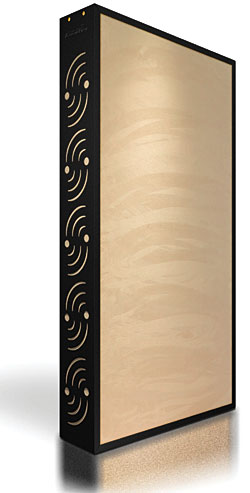
Echo Busters Decorative Room Treatments

One of the biggest challenges in setting up any new listening room is getting the room to work with your equipment rather than against it. I faced this challenge in spades when Trish and I moved into our dream house in the California hills. What would serve as my listening room was a wonderful, open space with panoramic views of the surrounding hills—a space that bore no resemblance at all to a traditional, rectangular, dedicated listening room. Instead, there was a wall of glass, a huge marble-and-glass fireplace, a 20' ceiling—and did I mention that it isn't actually a "room," but one arm of a continuous flowing space?
IsoAcoustics Gaia loudspeaker isolation feet
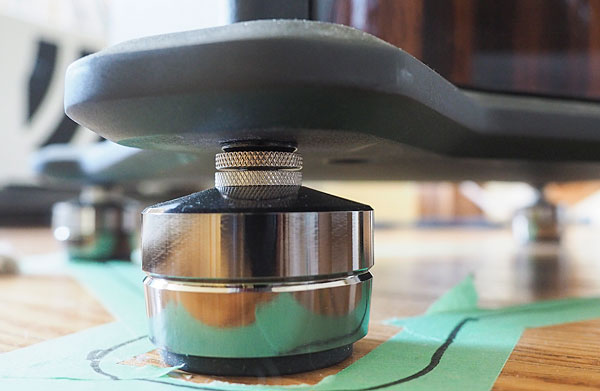
IsoAcoustics Inc. has its head office in Ontario and its manufacturing facilities in China, and is headed by Dave Morrison, who for 20 years has been involved in designing radio and television studios for the Canadian Broadcasting Corporation. The IsoAcoustics products are the result of this experience. Although relatively new on the consumer-audio market, IsoAcoustics' speaker-isolation products have gained wide acceptance in pro audio; their client list of recording and mastering studios includes Blackbird (Nashville), Mastering Palace (NYC), Flux (NYC), United Recording (LA), the Boston Symphony Orchestra, Skywalker Ranch, and Abbey Road.
Music in the Round #31
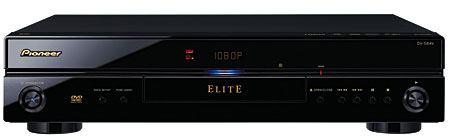
Recently, I got an e-mail from a colleague at another audio magazine complaining about the paucity of new SACD hardware. We've been hearing about the slowing pace of new SACD releases, and about Sony's neglect of a format they themselves developed, but I now realize that, apart from the High End (footnote 1), machines that can play SACDs have been fast disappearing from the middle of the market. When the battle of SACD vs DVD-Audio was raginghttp://www.stereophile.com/asweseeit/305awsi">raging;, universal players that could play both formats were available from almost every major manufacturer. Even John Atkinson jumped on the bandwagon, acquiring a Pioneer DV-578A universal player for $150 to use as a reference. The exceptions were the very companies that had developed the new formats: Sony offered only SACD players, and Panasonic, at least at first, only DVD-A players. No matter—you could buy a universal player at any national electronics chain store, even if that store didn't stock recordings in either format and their staff had never heard of DVD-As or SACDs. Some things never change.
Music in the Round #38
We all recognize that the Super">http://www.stereophile.com/features/374">Super Audio Compact Disc, despite being an almost ideal format for high-resolution audio, has not replaced the "Red Book" CD. However, Sam Tellig's comments in the June and July issues of Stereophile, and Steve Guttenberg's "As">http://www.stereophile.com/asweseeit/whatever_happened_to_51-channel_mu… We See It" in July, unleashed e-mails urging me to champion multichannel sound (don't I do this already?) and smite the unbelievers (not a chance).