

Nucore Cathedral Sound Room Treatments
One of my favorite Charles Rodrigues cartoons, originally published in Stereo Review and reprinted in the book Total Harmonic Distortion (Perfectbound Press, 1988), shows a customer in the soundroom of an audio dealer, auditioning a pair of speakers. This is no ordinary soundroom: the floor, walls, and ceiling are completely covered with irregularly shaped boxes, apparently an extreme form of acoustical treatment. The salesman is saying, "Of course, you realize that it won't sound exactly the same in your living room, sir..."
Phantom Acoustics Shadow active low-frequency acoustic control
The acoustic environment for music reproduction is easily the most overlooked source of sonic degradation. Many fine playback systems are compromised by room-induced anomalies that severely color the reproduced sound. When we live in a world of directional wire, high-end AC power cords, and $4000 CD transports, paying attention to the listening room's contribution to the musical experience takes on greater urgency.
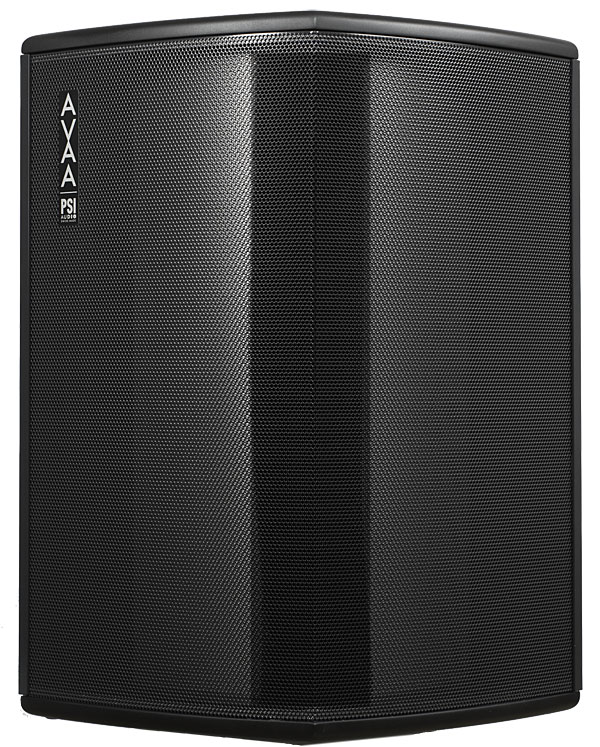
PSI Audio AVAA C20 electronic bass trap
"Bassthe final frontier," declared Captain James T. Kirk. I have no doubt: The biggest problem in nearly every listening room is getting the bass to sound right. Today, we voyage to the frontier of bass response.
A Brief History of Time
Because my listening room is also a mastering room, it has to be as accurate as possible (see photo 1). The floor is a concrete slab, with solid-block wall construction and a cathedral ceiling 23' high at the rearthere are no floor-to-ceiling resonances. A bay window hidden behind the curtains disperses the lengthwise room mode by varying it between 18' and 20.6'. The curtains tighten the stereo image and damp the subtle resonant chamber that would otherwise color the sound.
Because my listening room is also a mastering room, it has to be as accurate as possible (see photo 1). The floor is a concrete slab, with solid-block wall construction and a cathedral ceiling 23' high at the rearthere are no floor-to-ceiling resonances. A bay window hidden behind the curtains disperses the lengthwise room mode by varying it between 18' and 20.6'. The curtains tighten the stereo image and damp the subtle resonant chamber that would otherwise color the sound.
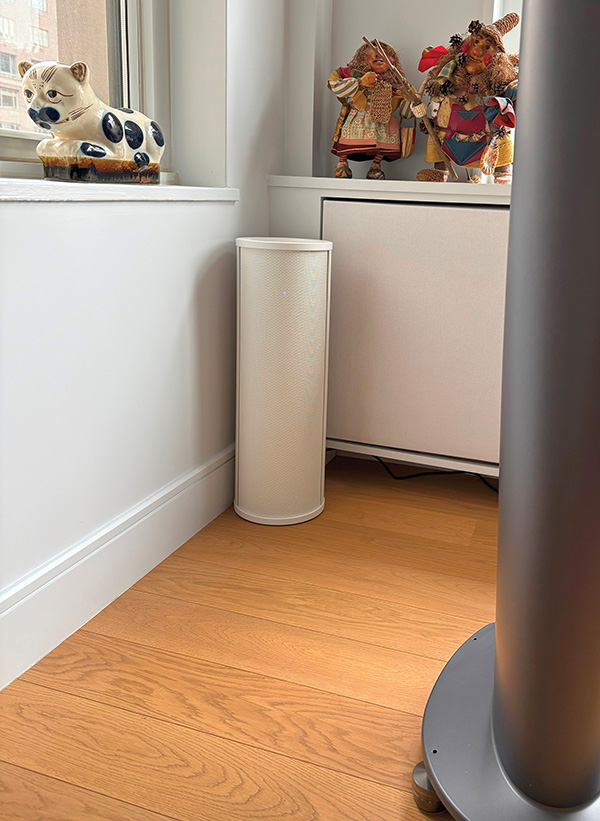
PSI Audio AVAA C214 active bass trap
Ever since I became interested in—nay, obsessed with—high-quality music reproduction, my goal has been to attain the experience of being at a performance. Some audiophiles target the recreation of the event in their room—a "they are here" experience.
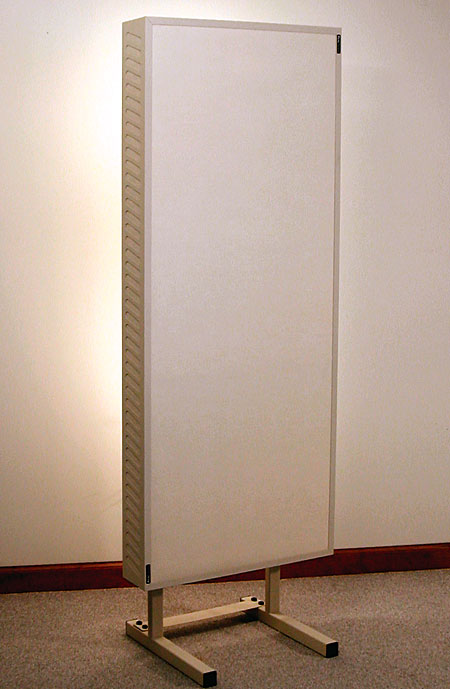
RealTraps MondoTrap room acoustics treatment
For a hobby based on science and technology, audiophilia has more than its share of unscientific elements. That's not necessarily a bad thing; not all of those elements are obvious snake oil, and there's more than science to creating—or re-creating—a musical experience. Still, for the more technical-minded it's a little disconcerting that even the most basic distinctions, such as why two CD players sound different from each other, are hard to explain using technical measurements and simple scientific concepts.
RealTraps room treatments

In the beginning, I had a room adjacent to my office—a room filled with bicycles, hi-fi gear, and assorted crap I'd never gotten around unpacking since our last move. Feeling ambitious, I thought I might turn it into a guest room, and emptied it.
Rives Audio PARC 3-Band Parametric Equalizer

Last January, the Stereophile website conducted a pollhttp://www.stereophile.com/showvote.cgi?236">poll; asking readers what they thought was their audio system's weakest link . The results indicated that 24% thought that their room was the most problematic component. What this says is that, though often accused of being obsessed with hardware, we audiophiles are aware of what a potent effect the speaker-room setup has.
Room Tuning: ASC Tube Traps & the MATT Test

One of the challenges I faced in optimizing the performance of the Thiel">http://www.stereophile.com//loudspeakerreviews/216/">Thiel CS7.2 loudspeakers that I reviewed in February 2000 was controlling and tuning their interaction with my listening room. Intuition, experience, trial and error—all came into play, as did several of the procedures and calculations covered by Jonathan Scull in his "Fine Tunes" column.
TacT Audio RCS 2.0 digital equalizer/preamplifier

I anticipated the installation of the TacT Audio RCS 2.0 room-correction processor with mixed emotions—I already liked my system and room, and such a device threatened to make all my studied efforts trivial. What if one might use any decent amps and speakers, cables that were merely conductive, and no room treatment at all? And what if, on top of that, you could just put them wherever your significant other thought they looked right? What if all the magic you needed was contained in this box? Scary.
The Fifth Element #90

As a film title, Quantizing Hanson Hsu might not rank up there with Kissing Jessica Stein, but we work with what we have to work with. Hanson Hsu is the principal designer at Delta H Design, Inc., an acoustics and architecture firm based in Marina del Rey, California. Though he dabbles in some weird science, Hsu doesn't wear a white lab coat, literal or figurative. He's down-to-earth and personable, with a conversational style that evinces warm wit and a real love of music. At one point in our conversations, he exclaimed, "I get so much joy when things sound good."