

Listening Tests and Absolute Phase

The problem confronting the magazine reviewer when organising the necessary listening tests to accompany/reinforce the measured behavior of a device under test is complex. There has never been a problem with the measurement aspect; as long as someone has access to the same test gearand full knowledge of the test conditionsthen he should be able to replicate the critic's findings exactly (assuming an infinitely narrow spread of behaviour from sample to samplea rasher assumption with some manufacturers' equipment than of others). However, when it comes to determining reliably the audible (or inaudible?) effects on music program by an amplifier/cartridge/loudspeaker etc. then the going gets tough.
Mentors & Audio Shows
Where do audiophiles come from?
Missing In Action
Dear High-End Dealer,
Resistance Is Futile
The mechanical toys were very superior, and looked down upon every one else; they were full of modern ideas, and pretended they were real.—Margery Williams, The Velveteen Rabbit
Snobs, Slobs, & Marley's Ghost
As often as not, it ain't the heat—it's the stupidity. When confronted by the smattering of self-referential dilettantes, acrimonious Internut wannabes, and obsessive-compulsive types who suck the air out of our aural fun-house, I find myself overcome with the desire to program my phaser for CLIP.
System Building Rules—and How to Break Them
Much has been made of the influence that Linn, Naim, and Rega have had on our ideas about music-system hierarchies: Before they and a handful of other British audio manufacturers kicked off the debate in the 1970s, the conventional wisdom worldwide was that the loudspeaker was more important than the record player, amplifier, or any other link in the domestic audio chain, and thus deserved to be the object of significantly greater care and attention, not to mention investment of cash. But the Brit-fi approach was different, and ostensibly better reasoned: Because musical information that's distorted or dropped entirely by a record player, a CD player, or any other source can't be made right by any other component in the system, it is the source that must be considered the most important component of all, and to which the majority of funds should be allocated.
The 2011 Richard C. Heyser Memorial Lecture: "Where Did the Negative Frequencies Go?"
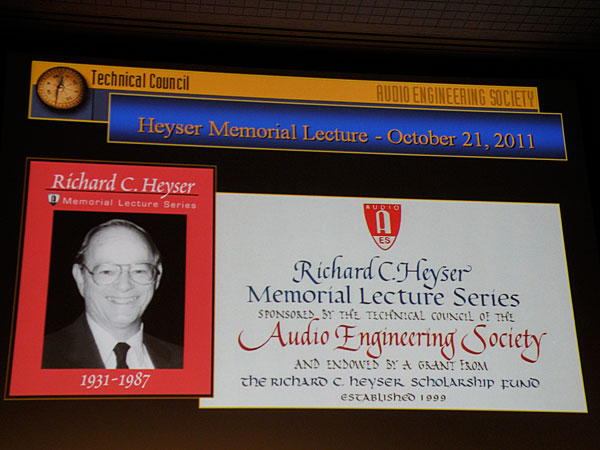
In the summer of 2011, Stereophile's long-time editor in chief, John Atkinson, was invited by the Technical Council of the Audio Engineering Society to give the Richard C. Heyser Memorial Lecture at the 131st Audio Engineering Society Convention in New York, October 21, 2011.
The High End, Mid-Fi, & Pretend High End
If there's a phrase that increasingly gets my dander up, it's "mid-fi." I'm even starting to lose patience with the term "High End."
The Holy Trinity
In an e-mail exchange with Stephen Mejias about why the mere mention of cassette decks on www.stereophile.com can so easily inflame our readers (and John Atkinson), I began to develop the idea that the brains of audiophiles and music lovers are governed by three complementary needs, or desires, that define who we are. I joked to SM that these desires, which apparently shift over time, constitute the Holy Trinity of Audiophiledom. They are, respectively, the love, desire, and need for:
The Search for Musical Ecstasy
Every once in a while, some mainstream journalist discovers the audiophile underground.