

Gramophone Dreams #19: HiFi Man Susvara headphones

I spend my days comparing cartridges and speaker stands, arguing about imaging and microphone placement, speculating about DAC filters, and lately, sometimes, very secretly listening to headphones connected not to commercially available headphone amplifiers but directly to the outputs of basic tubed and solid-state power amplifiers. No person in his right mind would or should try thisit's too easy to destroy a pair of delicate, expensive headphones. But for me, it's been worth the risk.
Gramophone Dreams #2
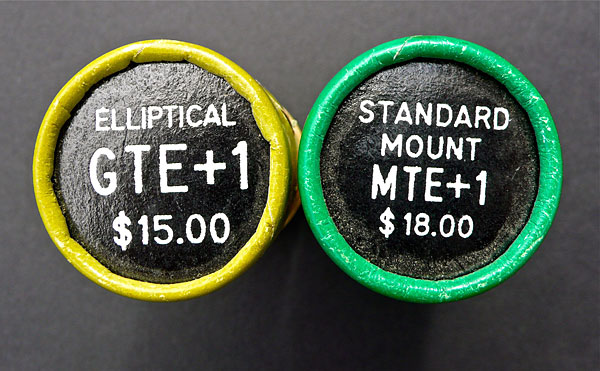
1947: General Electric introduces a variable-reluctance phono cartridge with a 0.3mil sapphire stylus and 11mV output.
1948: Brook Electronics Inc. (Elizabeth, New Jersey) introduces the 12A audio amplifier and 12A3 preamplifier, beginning the era of high-fidelity audio separates.
Since hi-fi's postwar beginnings, hundreds of high-quality audio inventions for the home have thrilled and satisfied music lovers worldwide. But inevitably, no more than a few score companies, and maybe a dozen or so engineer-designers, have defined audio's most creative and enduring achievements.
Gramophone Dreams #20: Lounge Audio & MoFi UltraDeck
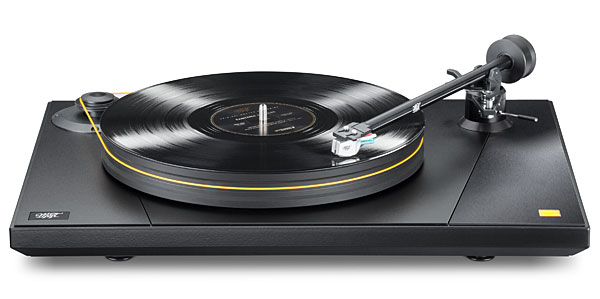
In my October 2017 column I reported on two turntables, the Palmer 2.5 and AMG Giro G9, each costing $10,000 and up, depending on ancillaries. It wasn't that I wanted to get all Mikey Fremer Uptown on you; I wanted to refine my listening skills and familiarize my senses with what my own humble system would sound like with a pair of world-class record players.
Gramophone Dreams #21: EMT, Koetsu, Miyajima

I spent a snowy New York City evening at Rhapsody Music & Cinema, talking with the proprietor, Bob Visintainer, and watching my friend Michael Trei install a Lyra Etna SL moving-coil cartridge in a Graham Engineering Phantom III tonearm mounted on a TechDAS Air Force 3 turntable tethered to a Zesto Tessera phono stage. Every wall was lined with big, floorstanding speakers, all of them expensive. On the main stage that day were Alta Audio's Hestia Titaniums ($32,000/pair).
Gramophone Dreams #22: Koss, Focal, iFi

Brooklyn, 1979: Fridays were fierce. After a week of doing construction, I would gobble Wild Turkey at the Spring Lounge, then fall asleep on the F train with a fold of cash and a Sony Walkman stuffed in a chest pocket of my paint-spattered Belstaff Trialmaster jacket. Usually I missed my York Street stop by only a few stations, but occasionally I'd wake up at sunrise on Saturday at the last stop: Coney Island. I didn't mind. It was restorative to shuffle the deserted boardwalk, listening to the Ramones' Road to Ruin or Television's Marquee Moon.
Gramophone Dreams #23: AudioQuest, Triode Wire Labs

Before I spin this 23rd edition of "Gramophone Dreams," I must ask: How many of you are using zip-cord as your speaker cables? RadioShack interconnects? Those black universal 18/3 power cords that come standard with virtually every audio amplifier?
AudioQuest Storm Tornado/High-Current power cord
A few months after I wrote about AudioQuest's Niagara 1000 power-line conditioner ($1000), my friend Sphere asked if I'd ever then removed the Niagara from my system, listened, and still thought it improved the sound.
A few months after I wrote about AudioQuest's Niagara 1000 power-line conditioner ($1000), my friend Sphere asked if I'd ever then removed the Niagara from my system, listened, and still thought it improved the sound.
Gramophone Dreams #24: Hana & Musical Surroundings
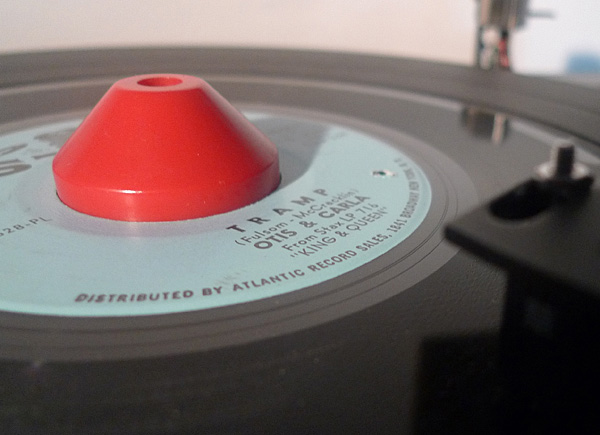
The days were long, the strawberries ripe, but it wasn't quite summer. It was, however, a perfect night for Otis Redding and Carla Thomas singing the Lowell FulsonJimmy McCracklin classic "Tramp," on a 7" 45rpm single (Stax 45-216).
Otis: What you call me?
Carla: Tramp! You don't wear continental clothes, or Stetson hats.
Gramophone Dreams #25: Dr. Feickert, Jelco, Koetsu, My Sonic Lab

I needed one black tiddledywink (not provided) to use Dr. Feickert Analogue's three-speed, two-motor, two-armboard Blackbird turntable. The tiddledywink was for covering the Blackbird's painfully bright power-on LED so that it didn't blind me when I cued up a record. The first night, in my dark listening room, this tiny indicator sprayed the wall behind and the ceiling above with more light than a bright-emitting 845 vacuum tube.
Gramophone Dreams #26: Nelson Pass & Harmonic Distortion

Every time I fly to California, my brain gets stuck on the lyrics of that Arlo Guthrie song: "Coming into Los Angeles / bringing in a couple of keys . . ." Even landing in San Francisco, I'm always smiling, because I've never been busted in California.
Which means that I'm a lucky guy. In this life I have acquired nothing of material value, but I did see Howlin' Wolf and Little Walter in Chicago in 1962, at Theresa's. I spent the whole Summer of Love (1967) in San Francisco listening to music. And because I lived only a few blocks away, I witnessed the Ramones' first gig at CBGB, in 1974.
Gramophone Dreams #27: EleKit TU-8600R amplifier kit

I will never forget.
In 1988 I had my first experience with Western Electric 300B tubes. It took place on a quiet, streetlights-and-snow night at my friend Ryoichi's apartment on Riverside Drive, in Manhattan.
I had never heard of the late Japanese amplifier designer Ken Shindo, of Shindo Laboratory. But that evening, Ryo's audio system was all Shindo: a hammertone gray Shindo-restored, grease-bearing Garrard 301 turntable sitting on a Shindo plinth of glossy wood, with a Shindo-modified Ortofon tonearm and SPU cartridge, a Shindo moving-coil step-up transformer, and a Shindo preamplifier with a moving-magnet phono stage.