

Gramophone Dreams #75: dCS Bartók APEX; HiFiMan Audivina, HE-R10P, HE1000 V2 headphones

I view poetry as more than a literary genre. It's a worldview and a state of being that frames my daily experience in the supernal. I've consumed a lifetime keeping my senses peeled for authentic, manmade mysteries, especially in art and music. Music is my favorite hunting ground, and nowhere have I found mysteries as DNA-deep as the 59 takes of 29 songs recorded in only five days by Delta blues legend Robert Johnson (19111938). I've played the Columbia Records 1961 anthology King of the Delta Blues Singers (Columbia LP CL 1654) 100 times since my days in Chicago as a teenager, and I still haven't grasped more than a portion of its juke-joint poetics.
Gramophone Dreams #76: Lounge Silver Copla, Grado Platinum3 High, Benz Gullwing SLR, Shure V-15 Type III

I'm going to tell a story about blind listening, because it illustrates what I consider the most important issue in today's audiophile environment. I'm going to skip the names of the participants because you probably know them. And I'm not going to name the components, because their role in this story is merely as symbols of their type. Here is what I'll reveal: We were playing LPs through an expertly curated, six-figurepriced sound system in a largish room that suited the large speakers perfectly.
The occasion was a "listening party" at a friend's apartment. The guest list included me and four of the most experienced listeners I know. The plan was for everyone to nosh lightly, drink good wine, and weigh in on a new, unnamed, not-free low-output MC phono cartridge, only available on a limited, made-to-order basis.
Gramophone Dreams #77: Laissez-faire Listening & the Thöress EHT MKII integrated amplifier

With a system like this, Thoreau would never have gone into the woods to begin with.
Last weekend, I visited an old friend who lives near Walden Pond of Henry Thoreau fame. I hadn't visited him since before the pandemic. He had just finished adding a wing to his house that included a dedicated hi-fi listening room the size and shape of a small church. Below a cathedral ceiling, the sweet spot featured seating for no fewer than 30 guests. Besides serving as his main listening roomhe has another one that's smallerit serves as a large residential parlor with a baby grand piano for use in chamber music performances, which feature prominently in his and his wife's social calendar.
It was a high-SPL thrill to experience his towering, field-coiled RCA theater horns powered by RCA 845 amplifiers.
Gramophone Dreams #78: The EMT Experience

If you've read any of my previous Dreams, you no doubt realize that I am an empiricist by tradethat I believe in the value of relaxed, mindful observation, especially if my solitary observances are independently corroborated by others. Whenever possible, I test my observations by getting either the Spin Doctor, the Audiophiliac, or my Russian neighbor to listen and tell me what they notice. If they notice the same things I noticed, independently, I relax. Corroboration is important because when I submit a review, I have an obligation to get it right. I need to be confident that readers, when they listen, will likely hear the same thing I heard, for themselves.
Gramophone Dreams #79: a Vintage Lenco L75 turntable & the PrimaLuna EVO 100 phono stage

My adoptive mother, Lily Mae, was a retired businesswoman and former fashion model turned stay-at-home mom and artist-painter with famously good taste in everything. She raised me to have good manners, an "active awareness of color and texture," and "an eye for form." She expected me to critique her paintings, her decorating, and her wardrobe, urging me constantly to develop "good taste in everything."
In Lil's world, a perfect day was for me to skip school and go with her clothes shopping at Marshall Field's, where it was my job to sit in a plush chair offering comments about which outfits had the best fabrics and best "complimented her form." She always said "form is bones" and fashion is about "how fabrics hang on people's bones."
Gramophone Dreams #8

Everyone in the room can hear the difference when I swap one phono cartridge for another. Same thing happens with loudspeakers. This is because both of these magnet-based transducer technologies are electromechanical devices, traditionally made of paper, wood, iron, and copper. (Nowadays, polymers, aluminum, and carbon composites are more typical.) Both are motor-generator mechanisms that either convert mechanical energy into electrical energy (cartridges) or vice versa (speakers). As audio devices, they are spool-and-wire simple, but even tiny changes in the materials and/or how those materials are configured can cause easily audible differences in how they transmit or present recordings of music. Why? Because every gross fragment and subatomic particle of these electromechanical contraptions is moving and shakingshaking everything from the tiny jumping electrons to the wood, metal, and/or plastic containers that fix and locate these motor generators in space.
Gramophone Dreams #80: Mobile Fidelity Electronics MasterPhono
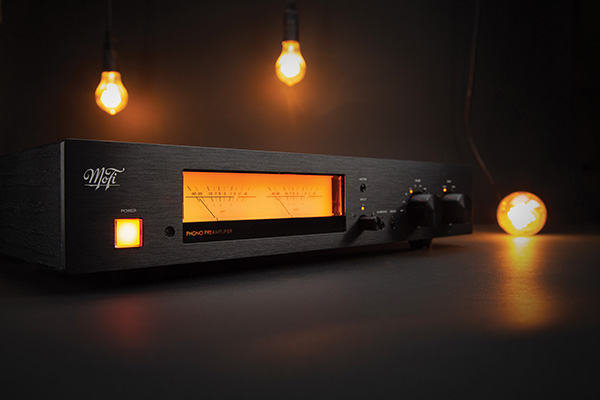
During my cub reporter days at Stereophile, I was always on the lookout, casting about for midlevel analog components I might latch on to, ones that could join my long-term daily-driver reference system by complementing the character of my midlevel DeVore Fidelity Orangutan O/93 and Falcon LS3/5a loudspeakers. I was searching for these basic traits: alive and vigorous, clear and well-sorted, relaxed and natural. One of my first-ever Stereophile reviews, in the October 2014 issue, was of Sentec's EQ11 phono preamplifier, which featured six EQ choices, selectable from the front panel, Bakelite knobs, Switchcraft switches, and a gray Hammerite-paint finish.
When I reviewed the Sentec, I owned three turntables and about 300 records. But phono stagewise, I was a beggar and a borrower, hoping a friend's phono pre or some review product would jump out of the deck and become my reference.
Gramophone Dreams #81: Feliks Envy headphone amplifier

I always say I can't find what I'm not looking for, which doesn't mean I always know what I'm looking for. And not knowing what I want is unsettling. Recently, I was reminded of the thoughts of French polymath-philosopher René Girard (19232015), who suggested that people are not actually motivated by specific things like lust or capital or power, as major philosophers have declared, but by subtle, disconcerting forces of existential desire for something outside ourselves, never actually knowing what that something is.
Girard explains how this not knowing drives history and invention. His main premise is that we feel desire but, not knowing what we desire, mimic the desires of others. These "others" we mimic constitute a third element, interrupting the lines of force between a person and the objects desired. This, according to Girard, makes desire, and by extension human evolution, a nebulous but powerful anthropological force engaged in forming human cultures.
In other words, you might like big speakers and fat speaker cables, but maybe only because people around you appear to like them. Same with cars and clothes and lovers.
Gramophone Dreams #82: IKIGAI Kangai-level cables, dCS Lina headphone amplifier

Decades ago, when I was peddling million-dollar sound systems, an astute potential customer asked me: "If I buy your very expensive system, what will I get that I'm not getting with my less expensive system?" Smiling my best fatherly smile, I whispered to his ear, "Goosebumps, tears, and laughter."
With a slightly worried look, he asked, "How much did you say those silver cables cost?"
Thirty years later
Changing audio cables always changes the sound of my system, sometimes a lot but usually just a little. Typically, the sonic effects of cable changes are modest shifts in focus, tone, or transparency. But sometimes during blue moons I've seen a new set of cables turn a blah, dull, fuzzy system into a macrodynamic, microdetailed one. Or turn a cool, mechanical-sounding system into something fierce and mammalian.
Changing audio cables always changes the sound of my system, sometimes a lot but usually just a little. Typically, the sonic effects of cable changes are modest shifts in focus, tone, or transparency. But sometimes during blue moons I've seen a new set of cables turn a blah, dull, fuzzy system into a macrodynamic, microdetailed one. Or turn a cool, mechanical-sounding system into something fierce and mammalian.
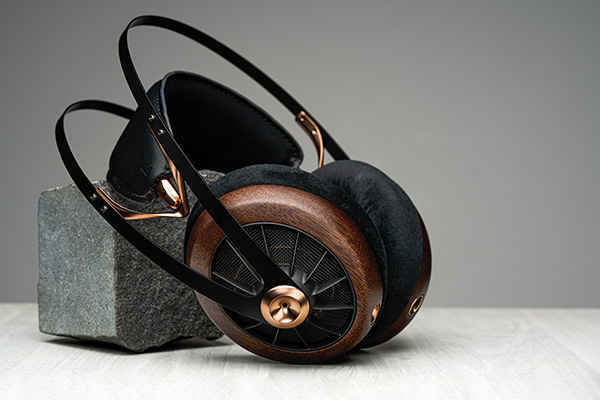
Gramophone Dreams #83: Benz Micro Gullwing SLR, Goldring Ethos phono cartridges, Meze 109 Pro headphones
It was almost Christmas, a perfect, chilly, blue-sky day to visit the Met Museum and see the Manet/Degas show before it ended. On my way, walking north on Madison Avenue, I passed the uptown branch of Gagosian Gallery and noticed a brightly lit poster behind thick glass announcing their exhibition of American artist Brice Marden's last paintings. The title of the show was "Let the painting make you," which sounded like an invite and a challenge, so of course I had to go in. I was in the perfect mood to ride in Gagosian's swanky private elevator and see how a famously serious painter with a six-decade career chose to communicate his last thoughts.