Solid State Preamp Reviews

Sort By: Post DateTitle Publish Date

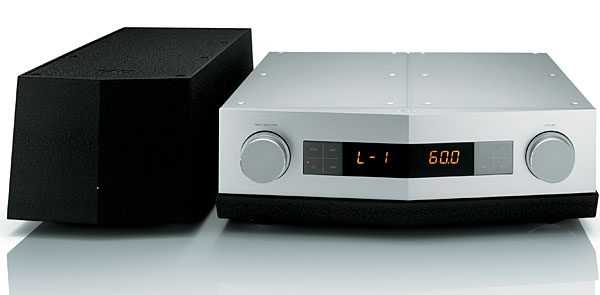
Dan D'Agostino Master Audio Systems Momentum line preamplifier

A preamplifier is the port of entry through which you gain access to the sources you've so carefully assembled. It's also the gate through which all of your music passes. So while its sonic performance is obviously critical, you'd also better assess how it feels, how it looks, and how it operates—you're going to be in an intimate relationship with it for a long time. Before choosing a preamplifier, therefore, take some time to drive it around the block, or at least shake hands with it. Use your imagination as much as your ears.

Parasound Halo P 5 2.1-channel D/A preamplifier

Asked how to make a guitar, the celebrated luthier Wayne Henderson offered a straight-up answer: "Just get a pile of really nice wood and a whittling knife. Then you just carve away everything that isn't a guitar." (footnote 1)


The making of a preamplifier seems more or less the opposite. You start with a simple volume control and a couple of jacks, then add whatever you think constitutes a preamplifier. Choices might include electronic source switching, line-level gain, phono-level gain and equalization, tone controls, tone-defeat switches, a balance control, a headphone jack, an iPod input, and maybe even a digital-to-analog converter with a USB receiver. The sky is pretty much the limit.

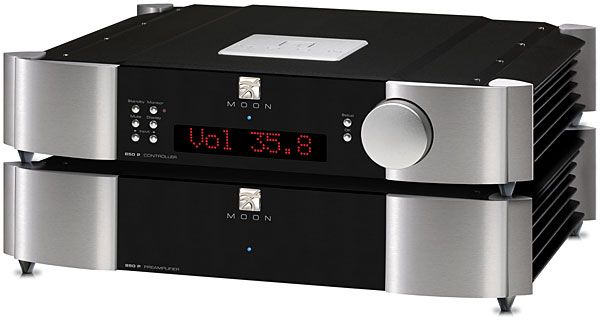
Simaudio Moon Evolution 850P line preamplifier

When I reviewed Simaudio's Moon Evolution 880M monoblock amplifier for the June 2013 issue, I communicated via phone and e-mail with the company's VP of marketing, Lionel Goodfield. When the topic of hearing the 880Ms at their best came up, I could almost imagine him shrugging as he said, "Just use it with the most transparent, revealing preamp you can find." Not surprisingly, he then went on to say that Simaudio's own Moon Evolution 850P would serve nicely in that role. My cynical side might normally have discounted any such suggestion from a marketing man, but I'd been hearing the same sort of thing from other sources. And, as it happened, there was an 850P at Stereophile World Headquarters . . .

TAD C600 line preamplifier

In the early 1970s, Stereophile's founder, J. Gordon Holt—a man I used to describe, with all due respect, as having been clothed by the haberdasher to the homeless—said that Audio Research's SP-3 tubed preamplifier was "the closest thing available, in fact, to the ideal straight wire with gain" ie, it would amplify the signal without editorializng in any way. Back then, the SP-3 cost $595. Today it would cost around $3500. But TAD's C600 dual-mono, solid-state, balanced preamplifier costs more than 10 times that: $42,000.

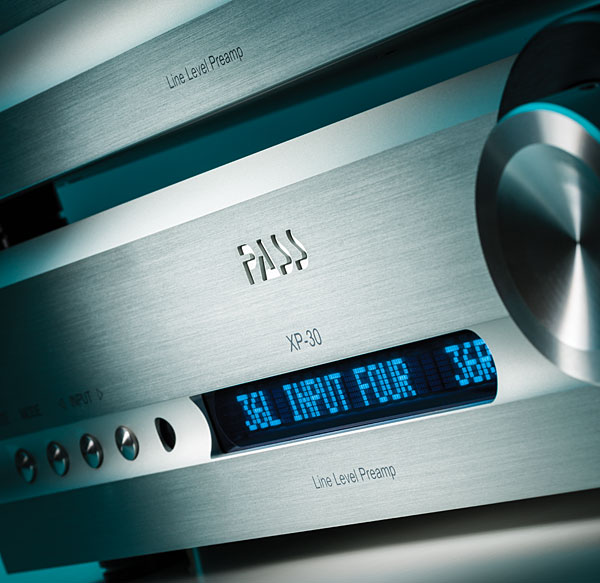
Pass Laboratories XP-30 line preamplifier

It was the strangest thing. In the fall of 2008 I was comparing Ayre Acoustics' then-new KX-R line preamplifier with no preamplifier at all—I was feeding the power amplifier directly with the output of the Logitech Transporter D/A processor. (Levels were matched for the comparisons, of course, made possible by the fact that the Transporter has a digital-domain volume control.) Being a rational being, I knew that the active circuitry of a preamplifier, as well as the extra socketry and cables, would be less transparent to the audio signal than a single piece of wire. I wanted to determine by how much the Ayre preamp fell short of that standard.

Music in the Round #58

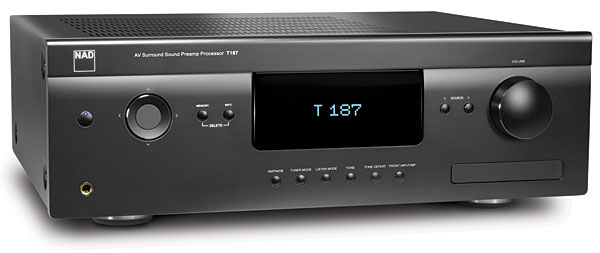
NAD's T 187. Another pre-pro? And not inexpensive at $3000! Why do I care?


First of all, NAD has come to the forefront of established full-range manufacturers as innovators in digital audio. From their original digital preamp, the 118, which I reviewed in the July 1998 issue; to the M2 Direct Digital amp, reviewed by JA in March 2010; to the Masters M51 high-resolution DAC, reviewed last July by Jon Iverson; and their Masters M50 and M52 music-streaming devices, NAD has never simply repackaged available chips and modules, but has always gone their own way.

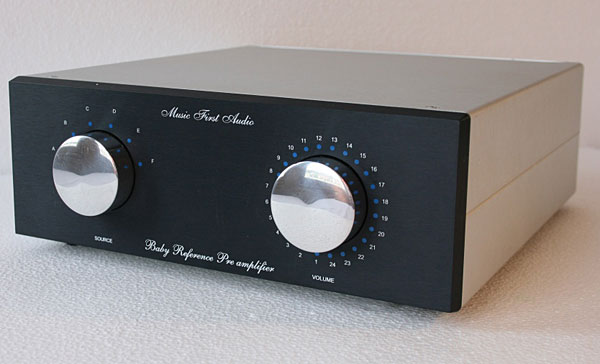
Music First Audio Baby Reference passive preamplifier

In April 1987, Anthony H. Cordesman had mixed feelings about the Mod Squad Passive Line Drive System Control Center. (Read his review here.) Introduced in 1984, the Line Drive offered volume and balance controls, five line-level inputs, and switching and monitoring for two tape decks. You didn't plug it into the wall; it provided no gain. Was it even a proper preamp? (footnote 1)


AHC demurred. "I'm not sure that I'm ready to advise anyone to take the risk of not buying a unit with a top-quality phono stage, no matter how well CD or DAT perform," he concluded, between commenting on Middle East wars.

Classé CP-800 D/A preamplifier

I was setting up for some musical demonstrations I was to present for a Music Matters evening at the ListenUp! store in Boulder, Colorado, in May 2011. For these events, an audio store invites manufacturers (and the occasional journalist) to demonstrate to local audiophiles the musical benefits of high-end audio playback. In Boulder, I was to share the store's big listening room with Dave Nauber, president of Classé Audio, who had set up a system with B&W Diamond 802 speakers, a Classé stereo amplifier, and a preproduction sample of Classé's new CP-800 preamplifier ($5000), all hooked up with AudioQuest cable. I unpacked my MacBook, with which I was going to play the high-resolution master files of some of my Stereophile recordings, and looked around for a DAC. There wasn't one.

Ayre K-5xeMP line preamplifier

I asked for a sample of the K-5xe so I could do a Follow-Up to Sam's review, but other review commitments kept getting in the way. When I finally spent some time with it (S/N 10J002), I found the sound a little on the robust, forward side, which made system matching problematic. Then, as I was about to spill some ink on the K-5xe, I got an e-mail from Charlie Hansen letting me know that the development of the QB-9 USB DAC had led them to rethink the K-5xe's design, and that Ayre would be sending a sample of what would be called the K-5xeMP. After a longer delay than I had anticipated, the K-5xeMP, priced at $3500, arrived for review.

Music in the Round #47

The AV7005 is Marantz's second multichannel preamplifier-processor and, at $1499.99, the least expensive pre-pro I've used or reviewed. The Integra DTC-9.8, which has been resident in my stable since 2007, when it cost $1600, and its successors, have since then steadily risen in price. The Marantz's predecessor, the AV8003 ($2599.99), was highly praised in many quarters. I never got my hands on one because, like a churlish child, I felt it lacked features I considered essential. Other reviewers didn't seem bothered by those limitations, or were unaware of them. The AV7005, however, looks and feels like a winner for music and home theater. I see no evidence of skimping—the AV7005 sports such high-end features as balanced outputs, network controllability and streaming, and, of course, HDMI v1.4a for compatibility with 3D and all audio codecs.
Advertisement
Advertisement
Advertisement