Music and Recording Features

Sort By: Post DateTitle Publish Date

The Musician in the Middle

Ask most professional symphony musicians for their views concerning recording sessions, and you might be greeted with seemingly nonchalant and cavalier responses. You will probably be told that although recording can be quite lucrative, it is almost always an exercise in futility. If you press further, and inquire as to why these "artists" display such negative attitudes, they would treat you to both a lecture concerning the shortcomings and gross musical distortions usually involved in the recording process, and to a tirade on the incompetence and arrogance of many recording engineers and producers. And once you have opened this can of worms, you will undoubtedly be told about the frustrations of having to deal with inaccurate and distorted representations of their art at the hands of the musically inept.

Audio: The View From Outside

I have a confession to make: I play contrabassoon . . . for a living. Now to many this may not seem like such a sin, but within the musical community my instrument is viewed with about as much regard as the common garden slug. This perception is not completely unjustified; often being relegated to roles depicting monsters and evil, along with the occasional digestive grunt, helps perpetuate the general disdain for the contra. However, playing the lowest (non-keyboard) instrument in the symphony orchestra gives me a somewhat different perspective on things, not unlike that of a dwarf in a crowded elevator: a view from the bottom up. It's amazing just how much pitch and harmonic coloration there is down in the subbasement. And shoring up the foundation of the wind section, as well as being the true bottom of the orchestral sonority, can be very satisfying. Although playing an instrument with a limited repertoire can sometimes be disconcerting, it also has its advantages. During rehearsals, if I'm not required for a certain work, I can go out into the house for my own private concert, or stay put in the orchestra and get a sonic thrill that makes the IRS and WAMM systems sound like tin cans.


Dancing on the Edge: Keith Jarrett on Music & Art

Years before I moved to Santa Fe, where I eventually became Stereophile's copyeditor, assistant editor, and first music editor, I lived in Boston, Massachusetts. There, I'd spent a year as the in-house typesetter, copyeditor, and book-review editor of East West Journal, an eclectic monthly magazine devoted to nutrition, spirituality, cooking, gardening, conservation, and other subjects. Two years after I'd left EWJ, managing editor Meg Seaker called to ask if I wanted to interview Keith Jarrett for the magazine.

The Stereo Image

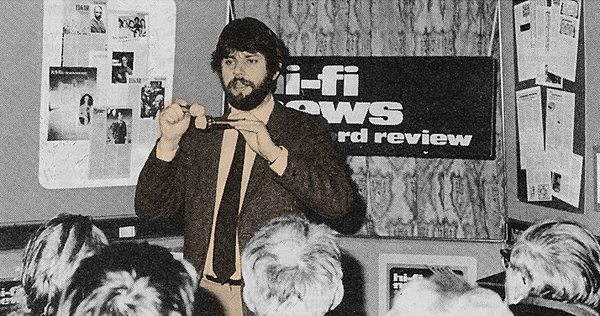
The author demonstrating stereo microphone techniques at an English audio show in 1981.


For most people the terms hi-fi and stereo are synonymous, and yet it is clear that there is still a great deal of confusion over what the word "stereo" actually means. There isn't even a consensus of opinion amongst producers of records, designers of hi-fi equipment, audio critics and music lovers as to the purpose of stereo, and considering that the arguments show no sign of diminishing in intensity, it is instructive to realise that 1981 sees both the 100th anniversary of Clement Ader's first stereo experiments and the 50th anniversary of Alan Blumlein's classic patent on stereo.

Brilliant Corners #30: disco é cultura

"Art is the only political power," the artist Joseph Beuys once said. If only it were true. Often, when power is wielded against an entire people with enough brutality and efficiency, it reduces the culture to a sickening silence, leaving room only for state-sponsored propaganda. Think of the Soviet Union under Stalin, or Germany during the Third Reich. But in other, rarer cases, repression is met with an efflorescence of great art, like a charred field welling up into a riot of wildflowers.

Sound Chaser #1: Brian's Songs

Outside of Vincent Van Gogh, Brian Wilson had the most infamous—and ultimately the most valuable—left ear in the world. Wilson—the chief architect of countless Beach Boys pop classics, who passed away at age 82 on June 11, 2025—lost the hearing in his right ear at an early age. One could reasonably argue that he only ever heard all the sonic masterpieces he constructed, for that quintessential California band he cofounded, in mono.

Sound Chaser #4: John McLaughlin, Life in the Emerald Beyond

If you find yourself in Monaco on a Sunday night, make your way to La Note Bleue, a rant and music bar on the beach by the Avenue Princesse Grace. There, you're likely to find a legendary world/fusion guitarist sitting in with a group of young jazz musicians eager to cut heads with the acknowledged maestro of inner awareness and otherworldly spirits.
Advertisement
Advertisement
Advertisement