
Tube Power Amp Reviews

Sort By: Post DateTitle Publish Date

Woodside MA50 Renaissance monoblock power amplifier

Brian Tucker, the US Quad importer, introduced me to the Woodside MA50 tube amplifiers and their manufacturer, John Widgery, during the 1992 Summer CES. Tucker's combination of Woodside MA50 tube amplifiers and Quad">http://www.stereophile.com/floorloudspeakers/416">Quad ESL-63 USA Monitors sounded unusually neutral, dynamic, and detailed. This was good news; back in 1987, Dick Olsher (Vol.10 No.6, pp.104–5) was unable to recommend an earlier Woodside-manufactured amplifier, the Radford STA 25 Renaissance. Brian mentioned that the MA50's design is a much-improved version of that earlier Radford model. Time for another review.
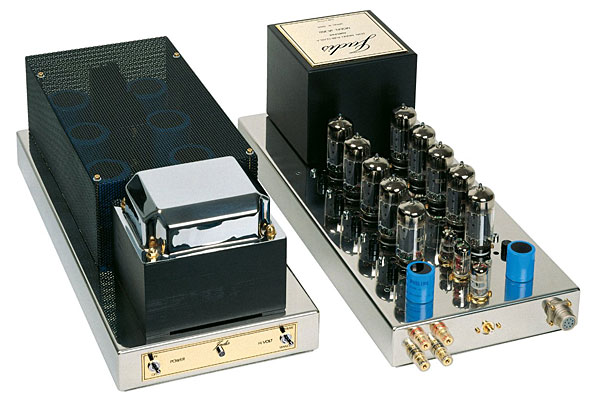

Cary Audio Design CAD-805 monoblock power amplifier

Lee de Forest filed for a US patent on his "Audion"—the first triode—on October 25, 1906, but never could explain why it worked (footnote 1). It was up to Armstrong and Langmuir, in their pioneering work, to place the hard-vacuum triode on firm scientific ground. When the US entered World War I in April 1917, the Army had to rely on French tubes. Six months later, Western Electric was mass-producing the VT-1 receiving tube and the VT-2 transmitting tube. However, it was only in the decade following World War I, as designers became conversant with the triode amplifier, that many of the crucial elements of tube amplification were nailed down. Technical issues such as coupling two gain stages and selection of optimal coupling impedance were already resolved by the mid-1920s. The triode ruled supreme until the tetrode came along in 1926, followed in 1929 by the pentode from Philips's research laboratories in Holland.


Jadis Defy-7 Mk.II power amplifier

Owning a powerful tube amplifier is like owning a classic automobile. Great pleasure may be had, but ownership involves a little more care and maintenance than usual.

Jadis, an audiophile company specializing in all-tube amplifiers and operating out of a small French town, has enjoyed a good reputation for some years, even if some of its models have suffered from the reliability problems that occasionally afflict the largest tube amps. Another problem area is that of power consumption and heat output. In common with class-A amplifiers and high-bias A/B types, including solid-state models, larger tube amps give off substantial heat. The Defy-7's 240W idling consumption may or may not be welcome, according to your location and the season.

McIntosh Laboratories MC275 power amplifier

Tubes, tubes, tubes.


The amps (and preamps) keep coming.


McIntosh Laboratories is back in the act with a limited-edition revival of the MC275 tube amplifier, the original of which was produced from May 1961 through July 1973—one of the longest model runs in hi-fi history.


New companies devoted to tube gear keep cropping up—in recent years, America's VAC and Cary and Canada's Sonic Frontiers. The same thing appears to be going on in the UK. The pages of British magazines are filled with new tube gear.

Berning EA-2101 power amplifier

It was back in the mid-'70s that David Berning made a name for himself in the Baltimore-Washington area as an avant-garde designer—someone with a truckload of fresh ideas about tubes. At the time, though Audio Research was starting to crank out pretty decent amplifiers, tube design was pretty much reduced to a rehash of the Williamson circuit and the Dynaco mod of the month.


Dynaco Stereo 70 II power amplifier

I dig tube amps. When all's said and done, good tube amps seem to sound more like real life than most solid-state gear; even after listening to and enjoying the hell out of musical solid-state designs like the Audio Research D-240 II and the Muse Model One Hundred, once I hook up the big VTL Deluxe 225s again it's just like going home. I could go on about timbral accuracy and clearer midrange textures, but the bottom line is, music just plain sounds better when you shoot it through good tubes, and once most people experience that magic, they're hooked.


Nobis Cantabile power amplifier

I dig tube amps. When all's said and done, good tube amps seem to sound more like real life than most solid-state gear; even after listening to and enjoying the hell out of musical solid-state designs like the Audio Research D-240 II and the Muse Model One Hundred, once I hook up the big VTL Deluxe 225s again it's just like going home. I could go on about timbral accuracy and clearer midrange textures, but the bottom line is, music just plain sounds better when you shoot it through good tubes, and once most people experience that magic, they're hooked.


Jadis Defy 7, Quicksilver KT88, VAC PA90 tubed power amplifiers

"It's the difference between a stuffed dog and the real thing," said Gunter (George) Bischoff, of Melos Audio, on the difference between solid-state gear and tubes. "The real dog may piss on the rug, needs visits to the vet, gets fleas, has to be walked, but it's a living thing—a real dog. The stuffed dog requires no care, needs no maintenance, but has no life."

VTL Compact 160 monoblock power amplifier

891vtl160.250.jpgWhen I reviewed VTL's 25W Tiny Triodes in April 1991, I found them to be incredibly fun little suckers to play with, but got frustrated with their inability to drive my Spica Angeluses to reasonable levels with most of my recordings. I loved what I was hearing, but there wasn't nearly enough of it! As it turns out, John Atkinson was listening; not just to my plea, but also to the new VTL Compact 160 monoblocks in preparation for a full review. However, while all this was going on, David Manley decided that the power-supply voltages in the 160 weren't beefy enough to exploit his new KT90 output tubes; back the amps went for a transformerectomy.
Advertisement
Advertisement
Advertisement