
Interviews

Sort By: Post DateTitle Publish Date

Tim de Paravicini: Dialing-in the Original Experience

Meeting Englishman Tim de Paravicini for the first time, you start to wonder if your mind has slipped a gear, whether premature brain fade has cut in. The conversation seems not only to be racing by unexpectedly quickly, but also subjects you hadn't even realized were subjects are being examined in knowledgeable depth. It was at the end of the 1970s that I bumped into Tim at a trade show in the UK; having wanted to ask his opinion of tube-amp design, knowing that the gangling, wispy-bearded, Nigeria-born, one-time resident of South Africa and Japan, ex-Lux engineer (footnote 1) had cast a magic wand over the Michaelson & Austin product line, I found myself instead being treated to an exposition of color phosphor problems in TV monitors. For Tim is a true polymath, his mind seemingly capable of running at high speed along several sets of tracks simultaneously.

David Wilson: WAMM!! WATT?!? WHOW!!! (& the Puppies!)

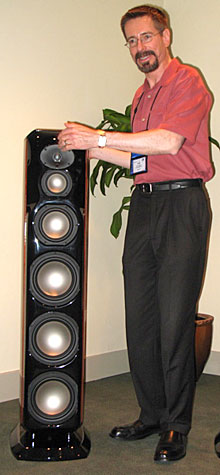
The French have a phrase for it: plus ça change, plus la même chose, which can be roughly translated as "the more things change, the more they stay the same." I was reminded of this when recently reading through the December 1980 issue of The Absolute Sound. There on p.368 was the statement that "Dave Wilson (Virgo) has joined the staff...to construct a testing program that will allow us to determine if some of the peculiarities and anomalies we hear in evaluating equipment can indeed be numerically measured."

Kevin Voecks: Loudspeakers, Crossovers, & Rooms

Since he joined Snell Acoustics in the mid-1980s, Kevin Voecks, their chief designer (footnote 1), has been involved in the design or redesign of the entire Snell line, from the minor revision of the Type">http://www.stereophile.com/floorloudspeakers/378snell">Type A/III (incorporation of a new tweeter), to the complete redesign of the Type C (now the CIII). Snell Acoustics is located in Massachusetts, and although Kevin spends a good deal of time there or at the measurement and analysis facilities of the Canadian National Research Council (NRC) in Ottawa, he does a great deal of his conceptual and preliminary design work, as well as his listening, in Los Angeles, where he makes his home. I visited him there last summer to gather a little insight into his background and loudspeaker design philosophy. I started by asking Kevin when had he first become interested in loudspeaker design...


Bob Carver: Carving a Name For Himself

Although it was Thomas Edison who set the tone for technological development in the 20th century, with his intellectual sweatshop in New Jersey, it is the lone inventor who has always had a special place in the heart of the American public. Since the days of Samuel Colt, Eli Whitney, and Nikola Tesla, fortune and fame have awaited the genius tinkerer who emerges from his back yard with a better mousetrap, cotton gin, etc., etc.


Noel Lee: The Monster is 10!

They say that time flies on faster wings once you pass 40, something that I have found to be more true than I care to think about. Yet even considering the unfortunately subjective nature of time, it hardly seems possible that it was 10 years ago, in those golden days of the first Conrad-Johnson preamplifier, Infinity">http://www.stereophile.com/floorloudspeakers/579infinity">Infinity RS4.5 and Hill Plasmatronic loudspeakers, Infinity class-A and Audio Research D110B power amplifiers, that a small San Francisco company, led by a drummer and mechanical engineer who had previously worked on laser-fusion target design at Lawrence Livermore Laboratory, virtually invented the high-end cable industry. I say "virtually," because Jean Hiraga in France, Robert Fulton in the US, and Saboru Egawa in Japan had laid down considerable experimental work in the mid-'70s showing that interconnects and speaker cables were hardly the passive devices conventional engineering considered them, and the highly capacitative Cobra Cable, distributed in the US by Polk and in the UK by Monitor Audio, was already destroying marginally stable power amplifiers in 1977.


A Babel, a Babble . . .

Twice a year, Stereophile brings some of its writers out to Santa Fe, New Mexico, to discuss the compilation of the magazine's "Recommended Components" listing, the most recent of which appeared in the October issue. Following a comment from Will Hammond, John Atkinson's collaborator on the recent">http://www.stereophile.com//features/113/">recent amplifier blind listening tests, that the magazine's readers would love to eavesdrop on the conversations that take place on these occasions, it seemed a good idea to tape (footnote 1) some of the discussions and publish the transcript as this month's "As We See It" (footnote 2). Accordingly, Lewis Lipnick, Gary A. Galo, Robert Harley, Thomas J. Norton, Guy Lemcoe, Richard Lehnert, Dick Olsher, Peter Mitchell, Robert Deutsch, J. Gordon Holt, Larry Greenhill, John Atkinson, and Arnis Balgalvis all gathered in LA's palatial listening room one August Saturday. JA set the ball rolling by asking the assembled writers where they thought Stereophile had been, where it was, and where they thought it should be going, particularly in view of Robert Harley joining the magazine as Technical Editor.


Sheffield Steel? Doug Sax

Doug Sax is undoubtedly one of the most controversial and outspoken figures in audio. As co-founder, with Lincoln Mayorga, of Sheffield Lab, Doug pioneered the first modern direct-to-disc recording. His perfectionist methods may be controversial, but the results certainly are not: Sheffield Lab recordings are nearly universally praised by the audiophile community, while the Billboard Hot 100 always features at least one Sax-cut disc.


Poem: Stereophile Cuts an LP

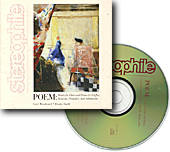
Why had a high-end hi-fi magazine felt the need to produce a classical LP when the thrust of real record companies in 1989 is almost exclusively toward CD and cassette? Why did the magazine's editors think they had a better chance than most experienced professional engineers in making a record with audiophile sound quality? Were they guilty of hubris in thinking that the many years between them spent practicing the profession of critic would qualify them as record producers?


Tam Henderson, Reference Recordings

As fascinating as the design of high-end hardware can be, it goes without question that without musical software (or firmware, as our more computer-minded readers would have it) of an appropriately high standard, the whole business would be pointless. Stereophile's interviews have therefore often featured engineers and producers whose recorded work reveals sound quality to be a major concern. I interviewed Performance Recordings' James Boyk back in Vol.9 No.6; J. Gordon Holt spoke in Vol.10 No.3 with Doug">http://www.stereophile.com/asweseeit/1282awsi">Doug Sax and Lincoln Mayorga, of Sheffield Lab, and with Keith Johnson of Reference Recordings, about their history-making Moscow sessions; JGH also discussed Brad Miller's and Lou Dorren's Colossus digital project in Vol.10 No.1 and Vol.11">http://stereophile.com/asweseeit/the_colossus_of_audio">Vol.11 No.4; while last month Dick Olsher interviewed Peter McGrath, responsible for some superb-sounding recordings for Harmonia Mundi USA as well as for his own Audiofon label.


Robin Marshall: A Modicum of Genius

One of the things that fascinates me about the field of box loudspeaker design is how few original talents there are capable of designing a model from first principles. Yes, armed with the Thiele-Small papers on bass alignment, an understanding of filter theory, and a working knowledge of the OEM drive-unit field, almost anyone can, and has, come up with one commercially and sonically successful design—given a fair degree of luck. And the teams of well-trained engineers at companies like KEF, B&W, and Celestion have shown that they can produce a steady stream of affordable boxes with a high ratio of performance for the dollar. But for an individual to create more than just one good box speaker requires a modicum of genius, and genius is thin on the ground.
Advertisement
Advertisement
Advertisement