Tube Preamp Reviews

Sort By: Post DateTitle Publish Date

Convergent Audio Technology SL-1 preamplifier

It takes more than passing courage to make another assault on building the world's best tube preamplifier. You face stiff competition from well-established firms like Audio Research, Conrad Johnson, and Counterpoint. Such units can't be made inexpensively, and you face the steadily growing problem of tube supply: it is getting harder and harder to get tubes that are stable, have predictable sound and performance characteristics, and are long-lived. And you have to show audiophiles who have been burned before that you will still be around when they need service.

Counterpoint SA-7 preamplifier

In appearance the Counterpoint SA-7 tube preamplifier is quite attractive, possessing the thin, low-profile look currently in vogue. There is a mute switch which (if you remember to use it) protects your amplifier from the preamp's turn-on and turn-off thumps. Unfortunately, the volume control on my unit didn't track accurately, and it was necessary to adjust balance with each change in volume. One unusual feature: the balance control allows very fine gradations in balance adjustment (a large movement of the control results in a small change in balance).

Conrad-Johnson PV-4 preamplifier

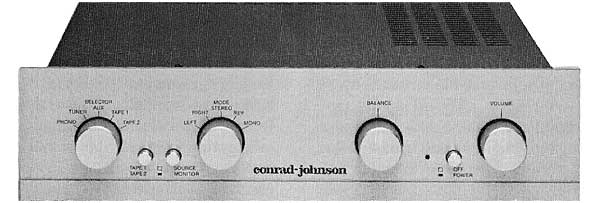
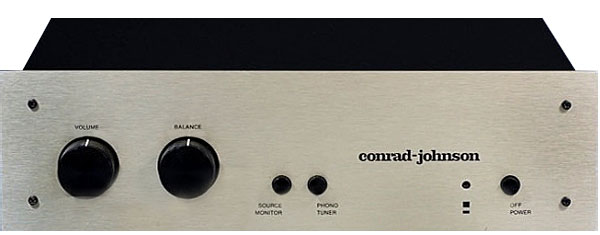
In appearance Conrad-Johnson's PV4 is distinctly plain: a basic black and silver box with a few simple knobs and buttons. The controls are logically laid out, clearly labeled, and work properly. The two channels track well through the volume control, maintaining balance; pushbuttons and control knobs have a smooth, solid feel (except for the noises audible through the system when switching inputs). Don't forget the turn-on and turn-off thumps mentioned above; the PV4 is the only one of the preamps I review in this issue—the others are the Audible Illusions Modulus ($450) and the Counterpoint SA-7 ($595)—that lacks a mute switch.

Audible Illusions Modulus preamplifier


Once upon a time, all audio equipment used vacuum tubes. In recent years, however, tubes have become the exclusive province of super high-end audio. It is more expensive to accomplish any particular task with tubes than with transistors, and few manufacturers (with the exception of Conrad-Johnson) seemed willing until now to refine their techniques and pare back their budgets to make tube components more affordable.

Conrad-Johnson Premier 3 preamplifier

It says something for the state of technology that, after a quarter of a century, there still is no authoritative explanation for why so many high-end audiophiles prefer tubes. Tubes not only refuse to die, they seem to be Coming back. The number of US and British firms making high-end tube equipment is growing steadily, and an increasing number of comparatively low-priced units are becoming available. There is a large market in renovated or used tube equipment—I must confess to owning a converted McIntosh MR-71 tuner—and there are even some indications that tube manufacturers are improving their reliability, although getting good tubes remains a problem.


Audio Research SP-10 preamplifier

It says something for the state of technology that, after a quarter of a century, there still is no authoritative explanation for why so many high-end audiophiles prefer tubes. Tubes not only refuse to die, they seem to be Coming back. The number of US and British firms making high-end tube equipment is growing steadily, and an increasing number of comparatively low-priced units are becoming available. There is a large market in renovated or used tube equipment—I must confess to owning a converted McIntosh MR-71 tuner—and there are even some indications that tube manufacturers are improving their reliability, although getting good tubes remains a problem.


Conrad-Johnson PV-5 preamplifier

The $1485 PV-5 is a "budget" version of C-J's $2850 Premier Three preamplifier, but according to the manufacturer it embodies much the same kind of circuitry.


Tubed preamplifiers have a well-earned reputation as system busters. Many of them during warmup produce horrendous bangs or plops so severe that every speaker fuse in the system blows. If fuses are absent, or rated too high to protect things, the amplifier, speakers, or both are likely to blow up (not literally; they just twitch once and lie down dead). The PV-5 contains one of the most effective pop suppressors I've encountered, and produces no noise whatsoever during warmups and turnoffs.

Berning TF-10 preamplifier

Several issues back, we reviewed rather enthusiastically a pre-production prototype of this preamp. The original was an unprepossessing-looking device on two chassis, interconnected by a 3' umbilical, with a squat little preamp box and an even squatter power supply with humongous cans sticking out the top. We averred that it sounded nice. The production model is so nicely styled and functionally smooth that we wondered if it might not be another Japanese product. 'T'ain't.

Audio Research SP-3 preamplifier

We thought Audio Research's previous-model SP-2C (footnote 1) was excellent, but this is even better—the closest thing available, in fact, to the ideal straight wire with gain. Our sample had a minor glitch—there was a slight "plop" if you rotated the tone controls rapidly—but we could find nothing else about it to criticize. Currently, by far the best preamplifier than money can buy. And would you believe it uses tubes (at reduced heater voltage, for extended life and cooler operation)!
Advertisement
Advertisement
Advertisement