Audacious Audio

Sort By: Post DateTitle Publish Date

EMM Labs DA2i D/A processor

More than five years have passed since I evaluated the original, Canada-made DV2 D/A converter ($30,000 in 2019) from EMM Labs. Since then, I've heard it and other top DACs—many of them at audio shows; some in my reference system—and my appreciation for what the original DV2 could deliver has only increased.


Now arrive two new components, the DV2's twin successors: the DV2i, an "integrated" stereo D/A converter with a software-driven, high-resolution digital volume control, and the subject of this review, the DA2i, a straight D/A with no volume control. Both cost $35,000.

Soulution 727 preamplifier

Almost 14 years have passed since a review of a Soulution product appeared in the pages of Stereophile. Given the Swiss company's steady ascent in the high-end pantheon, it is high time that we again reached into the German-speaking region of Switzerland north of the Swiss Alps to evaluate another of the reference products from a company equally renowned for its sonic achievements and refined and elegant design aesthetic.


Enter the full-function Soulution 727 preamplifier ($74,975), whose optional MC/MM phono section ($11,975) will be evaluated in a future issue. Because Soulution claims that the 727 "sets benchmarks in terms of noise, phase errors, common mode rejection and distortion," one would hope that there's far more than 62lb of classy casework and an easy-to-handle lightweight remote to account for its price.

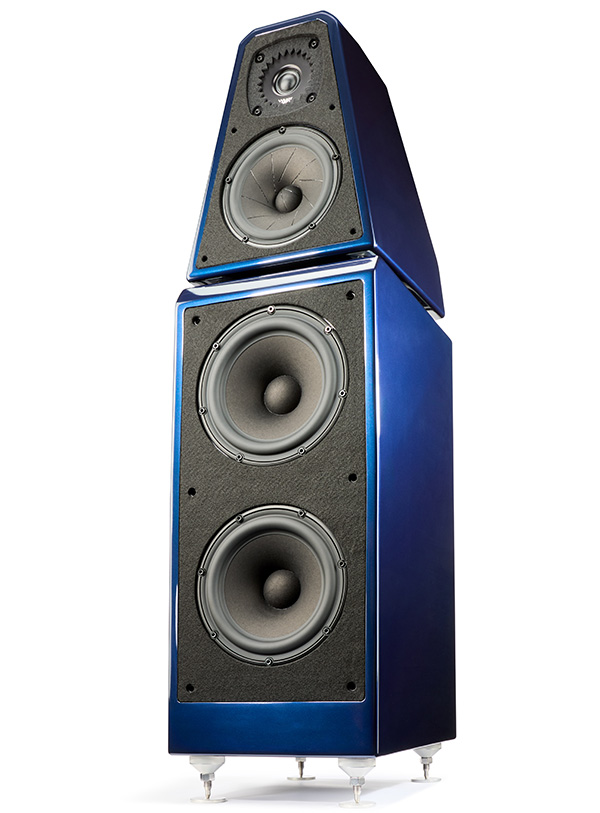
Wilson Audio Specialties The WATT/Puppy Loudspeaker

Since the original WATT/Puppy concept kicked off in the late 1980s, there has been a 40-year evolution leading to the latest version reviewed here. The loudspeaker's price in 2025 is around $40,000/pair compared to the original's $8000. While inflation alone would have lifted the price to $25,000/pair, the current price takes into account the many technological and design improvements. While remaining physically separable, the upper "WATT" (Wilson Audio Tiny Tot) component, namely the head unit of the latest design, can no longer be run as a small full-range loudspeaker in its own right. This is because the mid/treble crossover, which was originally in the WATT, is now relocated to the lower "Puppy" section. Certainly, that original two-box "full range," strongly sculpted WATT/Puppy stack radically broke the mold in deviating from those rather plain, coffin-shaped tower loudspeakers that were popular in this category.


The late David Wilson originally created the WATT as a shelf-mount studio monitor to help produce his recordings. At the time, this compact two-way promised near–state-of-the-art sound quality, especially transparency, indicative of very low self-noise. This quality also helped to maximize dynamic range and contrast. Later, David used the WATT as the foundation for a three-way floorstanding design by matching it to a low-frequency system (the Puppy), which also stood in as a physical platform for the WATT. This idea became reality in the successful W/P line of bass augmented systems.

Audia Flight FLS10 integrated amplifier

The dogma of separates has long reigned supreme among audiophiles: If you're serious about sound quality, you're supposed to need a dedicated preamp and power amp. The logic goes that separates reduce interference and offer maximum control over your sound. But there's an argument to be made that integrated amplifiers are more practical ... and potentially better-sounding.


The beauty of an integrated amp lies in its synergy. Audio engineers know exactly how the pre and power sections will interact; the two are literally designed to work together. On paper at least, that means optimized impedance matching, and signal integrity that can rival and perhaps surpass separates. How do you know whether a standalone preamp is a great match for a power amp? For most of us, it's through trial and error. It isn't unusual for restless stereo aficionados to own multiple combos over the years, in search of the ideal one. That gets costly.


Then there's the fact that an integrated amp helps declutter a room, appealing to minimalists and people whose living spaces are less than cavernous. Another plus: no need to shell out for audiophile-grade interconnects.

Moon 891 streaming preamplifier

No fewer than eight boxes, powered by six after-market power cables, comprise my current reference front-end. As much as separate boxes can afford superior isolation and provide far more room for visionary engineers to work their magic, the advantages of a single box, which requires a single power cable and far fewer after-market interconnects, are obvious.


Enter Simaudio's Moon 891 network player/preamplifier ($25,000; footnote 2). Also called a "streaming preamplifier,"it includes a DAC that converts PCM and MQA files up to 32/384 (with 24-bit files upconverted to 32-bit) and DSD files up to 256. It also includes what Simaudio company co-owner Costa Koulisakis describes as "a fully configurable" MC/MM phono stage. Both theoretically and practically, it's an ideal solution for someone with space and/or budget constraints.

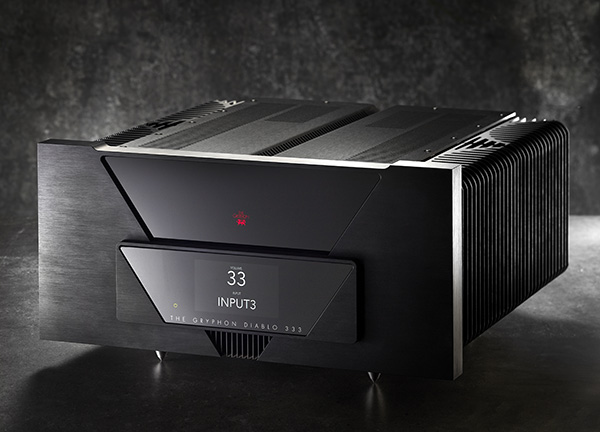
Gryphon Audio Designs Diablo 333 integrated amplifier

What's in a name? Denmark-based Gryphon Audio Designs laid down a marker when company founder Flemming Rasmussen chose that name in 1985. Browsing through the current Stereophile Recommended Components list, I only found one other manufacturer that utilizes an animal moniker. The imagery summoned by the use of the mythical treasure-guarding Gryphon seems appropriate; a hybrid creature combining features of the eagle and the lion, creatures of strength and speed—this choice underlines some of the aesthetics and performance Gryphon Audio has become known for. The handsome hardcover user's manual for the Diablo 333 simply states in gold "The Gryphon," along with a side-on profile of that winged lion-tailed creature, as a logo.


The Gryphon Diablo 333, a solid state, stereo integrated amplifier ($24,900 without optional DAC and phono stage modules), replaces the Gryphon Diablo 300, which was in production since 2016.

Estelon X Diamond Mk II loudspeaker

Taste is a funny thing. Love cilantro? Millions swear it tastes like soap. Similarly, design cognoscenti will gush over a minimalist Scandinavian sofa that others dismiss as just a pricey plank with delusions of grandeur.


There's no accounting for taste, or so the truism goes. But arguing over preferences is exactly what many audiophiles do. Similarly, Stereophile reviewers are all about parsing and evaluating sound, and how a product looks isn't usually a big part of the equation. But I'll buck that convention and say that the radically shaped Estelon X Diamond Mk IIs aren't just the most visually sublime speakers I've laid eyes on; they ought to be part of the Cooper Hewitt Museum's permanent collection. Or MOMA's.

Moon 861 stereo/mono power amplifier

It is unusual to begin a review with a detailed discussion of setup. But setup protocol for the Moon 861 power amplifier ($22,000 each), the top-level amplifier in the North Collection from Moon, which I reviewed bridged in mono, proved crucial to its sound.


The setup saga began when Moon co-owner Costa Koulisakis traveled to Port Townsend from Quebec to help remove two 861 amplifiers from their sturdy flight cases and set them up.

CH Precision L1 line preamplifier

As editor, I love it when Stereophile reviews new equipment. "New" attracts readers. But there are good reasons to review stuff that's not totally new (though usually it is still shiny). The best reason is experience, first-hand: You hear a component at a show or in your own system. You're impressed and decide it deserves a closer look.


That's why I'm reviewing the CH Precision L1 line preamplifier ($34,500 in silver), which has been on the market for several years.

Avantgarde Duo SD iTRON G3 active loudspeaker

Active speakers make sense. The amplifiers, crossovers, and drivers are designed as a unit, so the design isn't compromised by the need to interface with components with unknown electrical or acoustical characteristics (except for the room, and that can't be helped). Concurrent design and testing of the various pieces can result in an integrated, through-designed system. Plus, the elegant simplicity that active speakers bring to a system just appeals to me.


Like many audiophiles, I've found myself intrigued by the variety of approaches that are taken to achieve the same goals: point source, line source, panels, horns. Whenever I've heard horns paired with a flea-powered amp, the dynamics have always impressed. I've consistently heard a jump factor that makes music feel remarkably alive. The combination of these two traits, though—horns plus active—is quite rare.

Advertisement
Advertisement
Advertisement