Audacious Audio

Sort By: Post DateTitle Publish Date

Wilson Audio Specialties Sasha V loudspeaker

Wilson Audio's new Sasha V loudspeaker (that's "V" as in victory, not "five") extends the line that began in 2009 with the debut of the Sasha 1 model. The installation manual includes a page titled "Sasha Evolution," with elegant line drawings of the various versions of the Sasha loudspeaker—now four—which were preceded by the two-box WATT/Puppy combo, which dates from 1989. The Wilson Audio Specialties Sasha V ($48,900/pair) replaces the prior Sasha model, the Sasha DAW, in the Wilson lineup.


The hefty, floorstanding Sasha V maintains a close family resemblance. The new Sasha's width and height are almost identical, logging 14½" and 45 1/16", respectively. The cabinets gain an inch in depth and now measure 23 15/16". The cabinets' subtle beveling is slightly different; probably only recent Sasha owners would notice. Extra thickness in the cabinets adds 9lb for a total of 245lb per speaker.

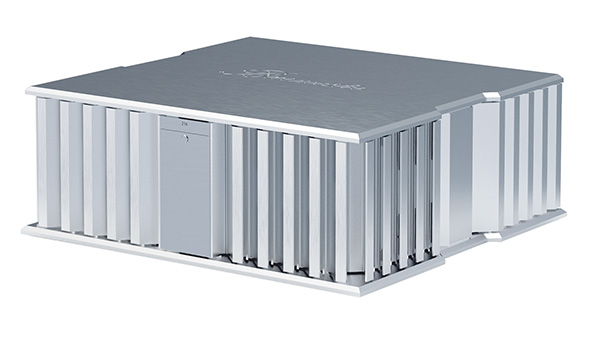
Plinius Reference A-150 power amplifier

When Jim Austin offered the Plinius Reference A-150 stereo amplifier ($14,995) for review, it felt like a welcome blast from the past. Plinius has, lately, maintained a low profile in the US, likely due to several changes in US distributorship...Under the auspices of Ralph Abramo and California-based Plinius Audio Sales and Repair, Plinius's US profile seems to be rising again.

Accuphase A-300 monoblock power amplifier

One of the finest chamber music performances I have ever attended took place this past August under far from ideal circumstances. The venue was one-month-old Field Hall in Port Angeles, Washington, a city of fewer than 20,000 people known more for its port and proximity to the Olympic National Forest than for its rich culture. Perhaps that reputation will soon change, because the performers in the concluding concert of the Music on the Strait chamber music festival included its two local founders, violinist James Garlick of the Minnesota Orchestra and violist Richard O'Neill, the newest member of the Takács String Quartet. These excellent musicians, who have been friends since high school, were joined by the superb pianist Jeremy Denk and cellist Ani Aznavoorian. These are world-class musicians who attract eager audiences to New York's 92nd Street Y and Carnegie Hall, London's Wigmore Hall, and other prestigious venues. . .


What was true for that live performance in Field Hall is also true for performances reproduced on audio systems: A system can be less than technically perfect yet still transmit with eloquence every iota of care and feeling that artists and engineers put into recordings. Perfection is not an essential component of musical truth. Inspiration is.


Lest readers think this preamble is intended to suggest some shortcoming in the component under review, the Accuphase A-300 monophonic power amplifier ($51,900/pair), let me reassure you at the outset: Time and again, the A-300, like Jeremy Denk's artistry, inspired a state of wonder. The more I listened to the A-300 monoblocks, the more I wanted to listen. In my too-busy life, every occasion for listening was an occasion indeed, a special event.

Infigo Method-3 monoblock power amplifier

I should have trusted my ears. When I first encountered Infigo (pronounced In-FEE'-go) electronics, paired with Alta Audio's Adam loudspeaker, at T.H.E. Show 2022 in Long Beach, California, I wrote, "Timbres were beautiful on bass and high-pitched percussion. The chimes and vibes sounded special and clean, colors were plentiful, and deep bass was all of one piece." Nor was I exaggerating. In that system, Infigo's Method 3 monoblocks ($55,000/pair) pleased my ears as much as their blue-illumined interiors delighted my eyes.


Rather quickly, Editor Jim Austin suggested I review the Method 3. Perhaps he'd already been tipped off by Ken Micallef's praise when he first encountered Infigo in November 2021 at the Capital Audio Fest, and by the ensuing buzz.

Raidho TD3.8 loudspeaker

In my high-school days, I visited a friend whose well-to-do dad proudly demonstrated his new Quad ESL system for us. First up was a recording of a man with heavy footsteps traversing the space from left to right. Next came a speeding police car, siren engaged, complete with Doppler tail. I found it impressive, and a little lame at the same time. My friend and I, in love with our own artsiness, preferred Fear of Music by Talking Heads and Drums and Wires by XTC, or (in a pinch) U2's Boy.


It wouldn't have occurred to me that I'd ultimately derive frequent joy from listening to sound effects (though in my case they're usually integral to the music, not apart from it). When I hear Yosi Horikawa's bouncing marbles on Wandering, I prick up my ears and smile. A panting dog on Holly Cole's Temptation, an overhead hovercar on the Blade Runner 2049 soundtrack ... bring it on. A babbling river on Andrew Bird's Echolocations; seed pods on Tom Waits's Blood Money; liquid splashes and crinkling paper on Felix Laband's Dark Days Exit ... yes, please. I don't care if it's a little gimmicky. It's also sensual in the original meaning of the word, an aural pleasure.


The Raidho TD3.8 speakers that, after three months, just departed my home, do the trick of conjuring points in space with great acuity.

SME 60 record player

Creating a new flagship model is never an easy task for an audio company. A good designer will have already incorporated all his or her best ideas into the prior flagship. For a follow-up, you typically get a scaled-up version of what came before, incorporating the kind of improvements a bigger budget will allow.


SME's history is well-documented. The company started out, in 1946, as an engineering company for hire. In 1959, after a few years supplying parts for the scale modeling and various other high-tech industries, company founder Alastair Robertson-Aikman wanted a better tonearm for his personal use. He leveraged the capabilities of his small engineering company to create what eventually became the legendary 3009 and 3012 tonearms. The reputation of the new arms spread quickly, and from the mid-1960s through the 1970s, SME dominated the high-end tonearm market. SME's corporate slogan was The Best Pick-Up Arm in the World, and few people at the time would have challenged that claim.

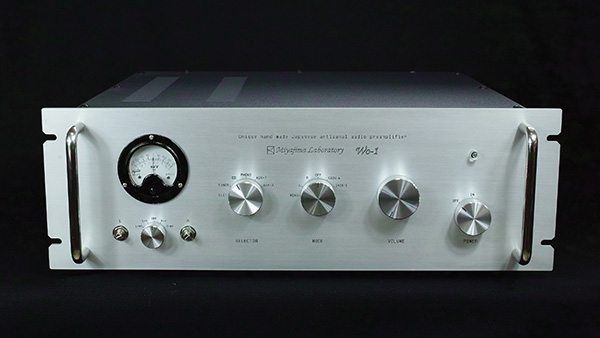
Miyajima Lab Wo-1 preamplifier

A phenomenon formerly unique to Japan, which in recent years has been emulated in cities around the world, is the jazz café (known as jazz kissa in Japan), where salarymen can find respite from their hectic lives, loosen their ties, and enjoy hi-fi jazz over coffee or a drink. Jazz kissaten are typically charming, smaller shops, traditionally furnished and paneled in beautiful wood, which serve superb artisan coffee in artful ceramic cups.


Such respect for artistry, craftsmanship, and attention to detail—the Japanese word is shokunin—is reflected in many aspects of Japanese life. This is where you find double handrails to accommodate people of different heights, intricate, ornately designed manhole covers, and bento lunch boxes with hand-carved vegetable figurines. While upholding strict conformity to societal norms, the Japanese highly value creative individualism. This shokunin mindset underlies their reverence for artisanal expression—and their love for jazz.


Japanese audio, much like jazz kissaten, reflects the shokunin mindset: craftsmanship pursued with both pride and humility.

Antipodes Oladra server/streamer/reclocker

Servers, servers, servers. How we who embrace digital hi-fi love them for their potential to make files and streams sound better (more alive, vital, streams sound better (more alive, vital, musical, moving, transparent) than music served from a computer. How we curse them when we experience the limitations of their software. How we despair when, shortly after ascending to Peak Digital Mastery, we download a software update that hurls us back into the Valley of Digital Unknowns.


I've climbed then slid down multiple hi-fi peaks as I've moved from computer to a Roon-equipped NUC, Roon Nucleus+, and Innuos Statement Next-Gen music servers. Along the way I've reviewed the original Innuos Statement from Portugal and the Antipodes Audio K50 from New Zealand. Now I'm exploring Antipodes's top-of-the-line server/streamer/reclocker, the Oladra ($25,000), which is designed for precise clocking, low noise, and high bandwidth.

Dan D'Agostino Momentum M400 MxV monoblock power amplifier

The Momentum M400 MxV Mono amplifier ($79,500/pair) is the latest iteration of Dan D'Agostino Master Audio Systems' debut amplifier of 2011, the Momentum Mono amplifier. Weighing 95lb, it is smaller and lighter than its entry-level sibling, the more powerful, 125lb Progression M550 Mono amplifier ($47,500/pair), and is veritably dwarfed by some other monoblocks, including the flagship D'Agostino Relentless Epic 1600 (570lb) and the Karan Acoustics POWERa mono (231lb), which I reviewed in May 2023. But if the M400 MxV's rock-solid look and feel and its exquisite aesthetics—a sleek amalgam of silver and copper fronted by a power meter that glows green and radiates Rolex quality—are any indication, a helluva lot is going on beneath its showy exterior.
Advertisement
Advertisement
Advertisement