Phono Cartridge Reviews

Sort By: Post DateTitle Publish Date

Soundsmith Strain Gauge SG-200 phono cartridge system
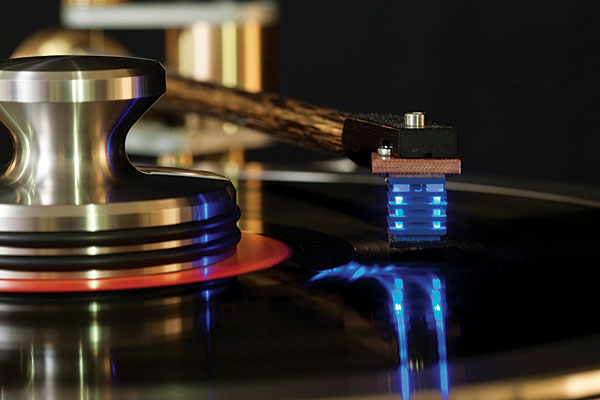
Strain-gauge phono cartridges are rarely made and seldom heard; for most vinyl fans, they are more myth than fact. Panasonic once made one, as did Sao Win, but those were decades ago. I've heard about those two models for years but have never seen, much less heard one.


As if he's not got enough to do building his extensive lines of moving-iron cartridges, preamplifiers, amplifiers, and speakers, Soundsmith's Peter Ledermann also makes a full line of strain-gauge cartridge systems available with a choice of six user-replaceable stylus profiles. I believe the Soundsmith is the only strain-gauge cartridge currently made anywhere in the world. Ledermann says it takes him a full day to build one.
Grado Prestige Gold1 phono cartridge

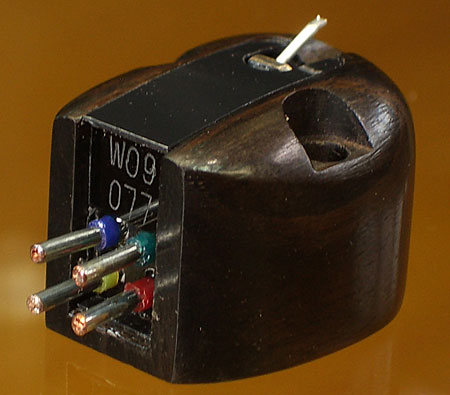
In the early to mid-1980s, I read every high-end hi-fi magazine I could get my hands on. Among the consequences was my discovery that the Grado Signature Seven phono cartridge—which was better and cheaper than the Signatures One through Six—was the cartridge that God wanted me to have. So I cut back on all manner of luxuries, saved every dollar I could save, and a few months later brought a walletful of cash to Harvey Sound in midtown Manhattan, where an unpleasant man with a bad comb-over handed me a little pill bottle of a plastic tube.


Listening #72

I'm old enough to remember when "Made in Japan" was an insult. As a child, I saw that phrase on only the cheapest or craziest toys—some stamped out of tin and cupped together by a tab with a fiendish edge, some molded from a distinctively smooth, brittle plastic. The latter included a wind-up bunny on wheels that my father brought home one day: my favorite toy, ever. (It came with a double-barreled dart gun that I seldom used, partly because I loved the bunny too much to shoot it, and partly because the suction-cup darts didn't stick to that kind of plastic in the first place.)


Soundsmith SMMC1 moving-iron phono cartridge

The audio industry may have lost a legend and a prolific innovator in Henry">http://www.stereophile.com/news/11260">Henry Kloss a few years back, but it still has another affable, creative eccentric in Peter">http://blog.stereophile.com/ces2008/011008smith/">Peter Ledermann. In the mid-1970s, Ledermann was director of engineering at Bozakhttp://www.stereophile.com/historical/1005bozak">Bozak;, where, with Rudy Bozak, he helped develop a miniature bookshelf speaker and a miniature powered subwoofer. Before that, Ledermann was a design engineer at RAM Audio Systems, working with Richard Majestic on the designs of everything from high-power, minimal-feedback power amplifiers and preamplifiers to phono cartridge systems. He was also an award-winning senior research engineer at IBM, and the primary inventor of 11 IBM patents.


Zu Audio DL-103 MC phono cartridge

In 1962, when tennis rackets were made of wood, newspeople were known for challenging the government, and the off-Broadway musical The Fantasticks was in its second year (the show closed in 2002), Nippon Columbia's Denki Onkyo (or Den-On) division introduced to the professional audio world a brand-new moving-coil phono cartridge. Developed in cooperation with the Japan Broadcasting Corporation, the DL-103 was one of the first attempts at making a truly wide-bandwidth stereo cartridge that nonetheless could withstand the rigors of back-cueing. The DL-103 was a nearly instant success with broadcasters, and its popularity spilled over into the world of domestic audio.


Benz-Micro MC20E2-L MC phono cartridge

The ceiling remains, but the floor has changed: Benz-Micro continues to offer a selection of rather expensive phono cartridges, including their well-established LP Ebony ($4700) and Ruby 3 ($3000) models. But in recent years, my attention has been drawn by the succession of budget Benzes: first, the Gliders ($795), then the ACEs ($550), and now the MC20E2-L ($199).


Advertisement
Advertisement
Advertisement