Powerline Accessory Reviews

Sort By: Post DateTitle Publish Date

PS Audio PerfectWave P10 Power Plant AC Regenerator

Stereophile hasn't reviewed a PS Audio power regenerator since February 2009, when Robert Deutsch tried the company's then-flagship, the Power Plant Premier ($2195). But earlier this year, as I prepared to write my review of PS Audio's NuWave DSD DAC (published in the May 2016 issue), a perfect opportunity to revisit the line came about: I read, in the owner's manual for the PSA DAC, that "power conditioners and the quality of the AC power can make a significant difference in sound quality." Eager to help the NuWave DSD put its best foot forward, I asked PS Audio to assist me in dealing with my AC power, which is marginal here in crowded New York City. They sent me their PerfectWave P10 Power Plant AC Regenerator ($4999)—and John Atkinson asked me to spill some ink on this most recent of the company's clean-power flagships.
Analog #246: AudioQuest Niagara 7000 Low-Z Power Noise-Dissipation System

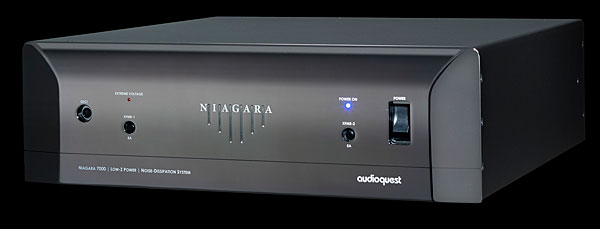
Are you old enough to remember when the wires connecting speakers to even the most expensive and sophisticated electronics were 16-gauge, multistrand lamp cord, and the terminals on speakers and amplifiers were just little screws? Sometimes those screws wouldn't even secure all of the wires' strands, but as long as loose strands from one screw didn't touch loose strands from the other, it was good enough . . . and back against the wall went your bookshelf speakers.

AudioQuest 3 US Power Strip

There never seem to be enough AC outlets, and when there are, they're not always easily accessible. I have two dedicated 15A duplex outlets at the power-amp end of my room, but a subwoofer and multiple power amps (up to three at a time) exhaust those facilities. What happens when I need to add a second subwoofer or other EQ? What do I do when I want to keep more than three amps cooking for quick comparisons?

Listening #96

When you play recorded music, you have before you a work of art with almost no physical existence at all; reconstituting it requires electricity, which will itself imitate the musical continuum represented by the bumps in the groove or the zeros in the datastream. When you listen to recorded music, you are listening to your household AC, and better AC equals better playback. That sounds obvious to me and you, even as it sends the technocodgers into paroxysms of puritanical indignation.

PS Audio Quintet Power Center

PS">http://www.stereophile.com/powerlineaccessories/ps_audio_power_plant_pr… Audio's Power Plant Premier is a high-end product that takes the regeneration approach in providing audio/video gear with the cleanest AC possible. But not everyone can afford to spend $2195 on such a product, and although the new amplifier design that forms the basis of the Premier is relatively efficient, it does use power, and concern about conservation of the planet's energy resources might lead one to prefer a passive approach to power-line treatment. PS Audio's line of Power Centers provides such an alternative. The model I had for review was the Quintet Power Center, which differs from the Duet Power Center only in having five pairs of receptacles to the Duet's two.


PS Audio Power Plant Premier AC Regenerator

Determining whether an idea is brilliant or off the wall is often a matter of perspective—and of looking at the results that follow from the idea. Take the notion of AC regeneration. AC is what comes from the wall socket, courtesy a network of power-generation plants, and it's specified as having a certain voltage and frequency, with the amount of current limited by fuses or circuit breakers in the electrical panel of the house or apartment. Audio components—other than those powered by batteries—are designed to convert this alternating current (AC) to direct current (DC), then produce variable AC that drives the speakers to produce a facsimile of that signal. In short, AC provides the raw material used by audio components to do their job.


Torus Power RM20 Audio/Video Power-Isolation Transformer

When I arranged to review the Bryston 28B-SST monoblock power amplifier, I wanted to be certain that the 1kW amplifier wouldn't be starved for current. Bryston advised me that Plitron, who manufacture the 28B-SST's toroidal transformer, also make Power Isolation Units (PIUs), under the brand name Torus Power. Torus explained that its PIUs combine surge suppression with massive toroidal transformers to provide AC power conditioning and protection from voltage surges.

HIFI-Tuning Fuses

Tweaks come and go. When a new one creates a buzz in audiophile circles, I generally prefer to wait and see if it's still around after the initial excitement has subsided. I'd heard about "audiophile" fuses some time ago, and although the likelihood of them making a significant difference didn't seem as farfetched as such tweaks as the "intelligent chip" or the "clever little clock," I didn't feel inclined to try them. I was persuaded otherwise by the confluence of two separate influences: a report by Michael Fremer, in the February 2007 Stereophile, that the HiFi-Tuning fuses produced a "subtle but noticeable" improvement in the sound of his Musical Fidelity kWP preamplifier; and an encounter at the 2007 Consumer Electronics Show with Robert Stein of importer Ultra Systems (the HiFi-Tuning fuses are made in Germany), who said that they produced a big improvement and offered to send me some samples.


Advertisement
Advertisement
Advertisement