Jason Victor Serinus
Lindemann’s New Cable Line
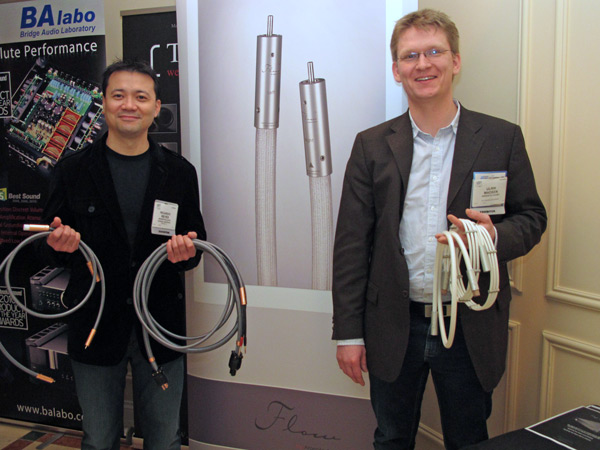
Soon to be distributed by Jonathan Josephs of One World Audio (smilingly showing off his babies), and so new that the US price has not been set, Lindemann’s Kind of Blue cable line includes power cables, speaker cable, and interconnects. All are cryo-treated.
Power cables, which come either shielded or unshielded, contain up to 14 separate “twisted pair” conductors composed of high-purity copper. Insulation is “Teflon-like,” there are neither ferromagnetic materials nor magnetic screws, shielding (when used) is a conductive Gore-Tex coasted with carbon. Interconnects come single-ended or balanced, the latter with a special XLR connector that is completely free of steel and includes gold-plated contacts.
Organic Cables
Ulrik Madsen (right), who designs the cables and owns the company, was on hand to discuss his products. All Organic Audio cables are derived from Argento Audio’s entry-level Argento Serenity. “I wanted to take advantage of the connectors I developed for Argento,” Madsen explain. “We make all our Organic Audio connectors ourselves from the same metal as the conductors in the cables, which is OFC 99.997% copper. (The more expensive Argento cabling uses silver). There are no solder points; all attachments are made by applying set-screws to accomplish compression.
MIT’s New Matrix Line
The new speaker cable comes in three flavors: Oracle Matrix HD 90 ($9999/8ft pair), Oracle Matrix HD 100 ($14,999/8ft pair), and Oracle Matrix HD 120 ($21,999/8 ft pair). There is one interconnect, Matrix 50 ($4999/1m pair, $5999/1m balanced pair). For digital cabling, one needs to go up one step in the reference line to Oracle MA-X digital ($3495/1m RCA or BNC, $3995/1m AES/EBU)
These new cables use MIT’s multi-pole technology. “We talk about poles of articulation,” said Holt. “There are electronics inside our boxes on the cables to provide wider bandwith coverage to power, so that sounds at either end of the spectrum won’t be rolled off as quickly.” The Matrix cables also employ a new technology called F.A.T. (Fractional Articulation Technology) that helps maintain the harmonic structure of audio signals.
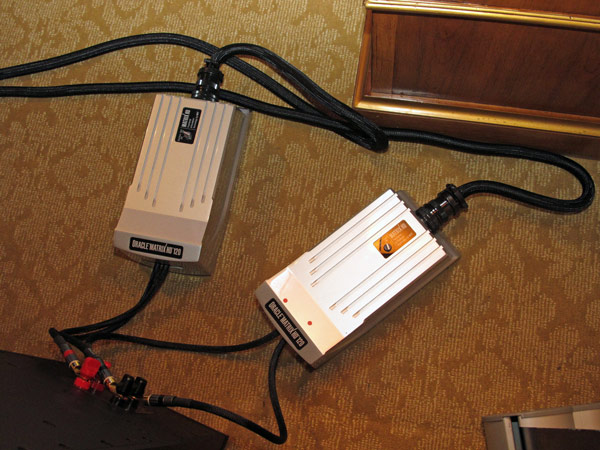
In the Magico room where they were displayed, the new Magico Q3, Soulution amplifiers, and files from Paul Stubblebine’s Tape Project made wonderful music through Oracle Matrix HD 120 speaker cable and the Oracle MA-X interconnects (start at $8495/1m pair). You can see the Oracle Matrix HD 120 boxes in the above photo, which was taken behind one of the Magico speakers. If other rooms hadn’t called, I would have dropped everything then and there and stayed for hours.
Stage III Concepts Cables
On display were the Zyklop power cord ($6000/1.5m), Gryphon interconnect ($5800/1m pair RCA, $6300/1m pair XLR), and Mantikor speaker cable ($13,200/2m pair). Besides digital and phono cables and speaker jumpers, the company sells hook-up wire for components in a variety of gauges. The least expensive, 22 AWG ($66/1.5m) is followed by 17 and 15 AWG ($280/1.5m).
Asked about the cable’s sonic properties, Ackerman replied, “It has no sound at all. It’s probably the closest thing I’ve heard to having no wire. It’s virtually invisible, like a direct connection.”
Gutwire's Good Cables
“We find copper is more natural and musical-sounding,” Herbert explained.
The photo shows the newest additions to Gutwire’s cable line. The power cable is the SP Crystal Edition AC cable ($1800/6ft), which lies in the middle of their price spread. Also shown are the EON-Z interconnect ($1600/1m pair) and UNO-S interconnect ($2500/1m pair). By way of comparison, the prices of the company’s top-of-the-line are as follows: the SP-18.1 AC cable ($7500/6ft), Uno-S interconnects ($2500/1m pair), and digital SD-3-SE ($1150/1m).
The terminations on Gutwire’s novel top-of-the-line SP cabling contain Bincho-Tan (white charcoal). Bincho-Tan emits negative ions, absorbs RF and EMI. Herbert first discovered the substance in his water purifier. Intrigued, he began to research it on the net, and learned about its other properties.
Gutwire also manufactures two 4 and 6 outlet power conditioners, the 4 Bar and 6 Bar ($1100$2600, depending upon the model). Each contains a passive filter, and the top of each is milled from a block of solid aluminum.
In a brief demo, I was struck by Gutwire’s ability to transmit a lovely smooth midrange on the classic recording of Harry Belafonte at Carnegie Hall.

Torus Power from Plitron
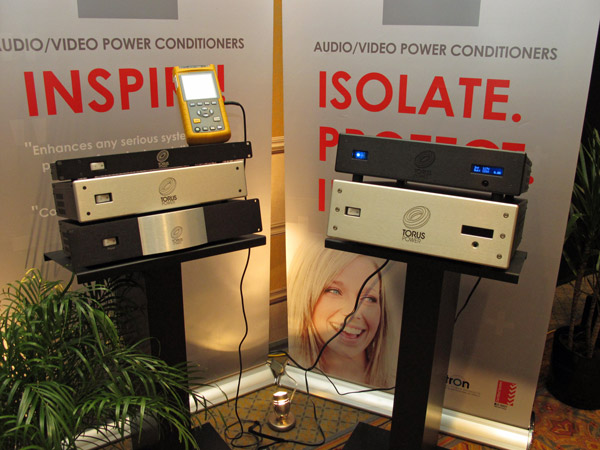
Arthur Kelm, formerly chief engineer in a number of recording studios including Record One, the Record Plant, and Skywalker, designed the Torus Power Ground One power conditioner panel that uses Plitron transformers. “I have known that power is the foundation of every audio/video system,” he explained. “It’s also the most misunderstood application you have. People just don’t understand power and its importance.
“The major advantage of using an isolation transformer is that you now have a very low impedance to plug into, and you can rebond neutral and ground which is where 90% of your noise comes from in electrical systems.”
The complete Torus Power line includes units from 2.5 amps up to 300400 amps. The lowest priced unit, the RM 2.5 ($999), handles 2.5A. The company’s most popular units, ideal for dedicated audio systems, are the RM 15 ($2000) and RM 20 ($3000). There is also a custom installation series with 60A and 100A units, plus Ground One panels for use in all-home AV and theatres. Some models include automatic voltage regulation.
TM Systems: New Name; Familiar Face
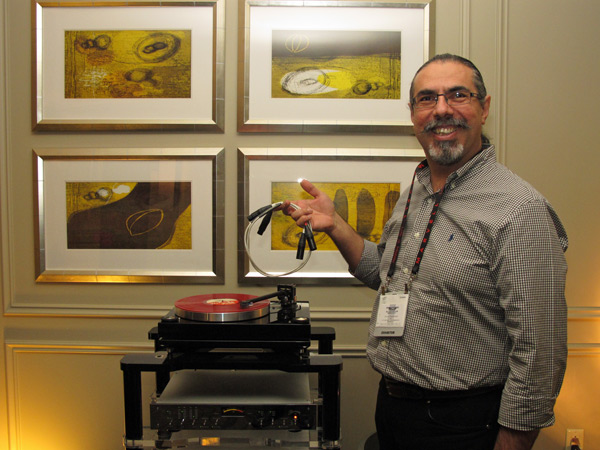
Not yet distributed in the US, Moghaddam’s handmade interconnects ($8000$9000/1.1m pair) will be followed in February or March by the machine-made Pulse R interconnects ($4000$5,000), which include special proprietary connectors made of copper alloy. Below them, Pulse B and Pulse C entry-level interconnects are in the works.
Veteran audiophiles will recognize Moghaddam as the 25-year veteran designer of Roksan turntables and loudspeakers. He began designing and manufacturing Pulse cables three years ago after he discovered that some Roksan ‘tables were being used with incompatible cables.
Gary Koh of Genesis, who had invited Moghaddam to exhibit his cables in the Genesis room, noted that they both attended the same college in England 25 years ago. “And now, 25 years later, we discover that we are both making our own cables because of similar concerns, such as their incorrect use by some people as tone controls,” he said.
Westlake Audio’s Cable Muffs
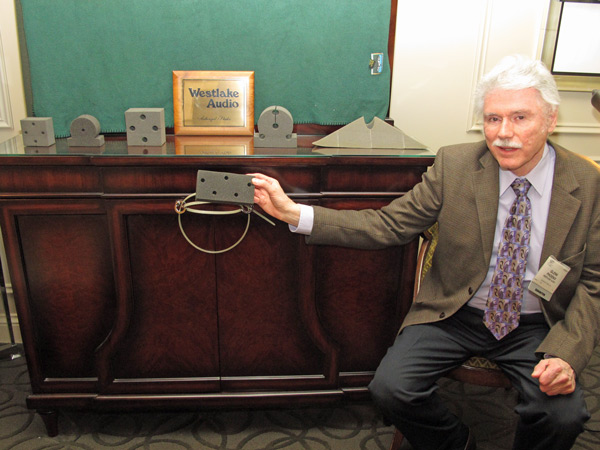
“We have a rule in the company to keep cables between 2” and 4” apart,” he said. “Putting left and right channels too close together can increase crosstalk, while positioning them too far apart may lead them to generate and pick up interference.” I hope I got that right.
Westlake Audio manufactures cable muffs with a number of different size holes and slots to accommodate a wide assortment of cables other than the extremely thick variety. Prices range between $59.50 and $88/set.
Absolute Fidelity Interfaces
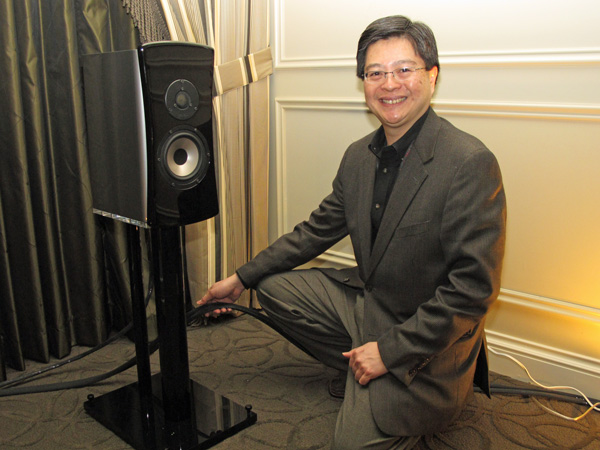
“To me, a cable should not function as a component; it should be an interface between two components,” said Koh. “Since every component is different, and draws power differently, I’ve designed different cables to interface between different components.”
The Absolute Fidelity Interface line currently includes the Loudspeaker Interface ($3000/2m pair); Turntable Power interface, Amplifier Power interface, and Component Power interface (each $1800/1m pair); and Component Interface (for use between source components, $1800/0.6m pair).
Koh explained that, a few years back, when he could not find a cable sufficiently transparent to do full justice to his Genesis 1.2 loudspeaker, he began rolling his own. Steve McCormack and a few other designers he works with were so impressed with the cable that they urged him to market it.
“I didn’t really launch them,” Koh said with a smile. “They just started selling. You can call this the official launch.”