Herb Reichert

Gramophone Dreams #89: Road Trip, Rare Audio Systems, and the First Watt SIT-4

Throughout my hundred years, I've told everyone who'd listen: If it's adventure you seek, the best way to find it is to stand on the right corner at the right time wearing the right hat, and when the limo pulls up and the driver says, "Get in," do not ask where it is going.

This strategy has served my life story well. It has placed me without striving in countless cinema-worthy locations, hanging with all types of legend-worthy characters.

Lately, that corner where I stand wearing the right hat is in front of the Polish newsstand at the intersection of Manhattan and Greenpoint Avenues in Brooklyn.
Continue Reading »

Musical Fidelity A1 integrated amplifier

In 1989, I bought my second pair of Rogers LS3/5a's from a guy on Staten Island who had them hooked up to a Musical Fidelity A1 integrated amplifier. After playing the speakers for me, he began removing his zip-cord speaker cables and paused to show me how, at the amplifier end, his red-plastic Pomona Electronics banana plugs had partially melted from the A1's heat. We both laughed.

After it first appeared in 1985, the A1 quickly became famous for its hot top plate. The top plate got as hot as it did because it was used as a heatsink for the output transistors, which were biased highly into class-A. The A1's hot top made tabloid headlines, but for me it was its bold, sinewy, un-transistory sound and timeless, sharply drawn styling that distinguished it from cooler running Brit-fi competitors such as Audiolab's 8000A, Creek's 4040, A&R Cambridge's A60, and NAD's 3020.

Now it's back, priced at $1779, looking and feeling cooler than before.

Continue Reading »

Gramophone Dreams #88: TEAC VRDS-701T CD transport

It's the late 1980s, and I'm soldering tube amplifiers on a plywood bench. I decide on a whim that it's time to break down and buy a CD player to supplement the Dynaco tuner and Dual cassette deck in my workroom music system.

I was a slow starter with digital because of my early take on CD sound: It was emotionally drained with grumbling distortions in the bass and an off-timbre midrange, crowned by a thin, artificial treble, and penetrated by an eerie, unnatural silence whenever the musicians stopped playing. I thought cassettes had higher fidelity and that CDs would be a passing fad, but I kept browsing CDs at Tower Records, and the itch to buy some was getting pretty strong.

One of my friends said, "Maybe it's not the conversion principle that's to blame but something else, like an imperfect CD player?" That interesting thought had not occurred to me, and it obviously occurred to lots of engineers, because they are still trying to improve the quality of CD playback by adjusting the mechanism.

Continue Reading »

Gramophone Dreams #87: Deejay Coolosities, AudioQuest Yosemite tonearm cable, Nagaoka MP-110 phono cartridge

SME’s Kathryn "Kat" Ourlian deejays a turntable shootout. Photo by Michael Trei.

One August night in 1965, I parked in the driveway of my best friend Derf Marko's house and let myself in the back door. As I entered, I could see to the bottom of the basement stairs, where I observed a loud pulsing darkness with plumes of agreeably acrid smoke floating up through the stairwell. Back in the darkness, I heard Derf/Fred and another person making declarative statements in loud unintelligible bursts. When I reached the bottom of the stairs, Marko's basement rec room looked like a trashed-out tiki bar illuminated by a single red Christmas light hanging just above a Dual turntable. The room was dark to a point where it was impossible to walk without stepping on records or to make out who was there and what was going on. I slouched on a couch, closed my eyes, and let my mind follow the sounds of rock drummers wailing like angry cats.

Soon it was obvious: Marko was frantically playing one drum solo after another while some crazy old dude kept hollering for the next solo before the last one finished. The revved-up stranger kept slapping his knees, muttering, and drumming along with each different drummer. Stacks of unsleeved LPs littered the linoleum floor and pink wool couch I was slumping on. But unbelievably, Marko adeptly—without cursing, fumbling, or hesitation—located every solo he wanted.

I found out later that the crazed "old guy" was Ginger Baker!

Continue Reading »

Linear Tube Audio Aero D/A processor

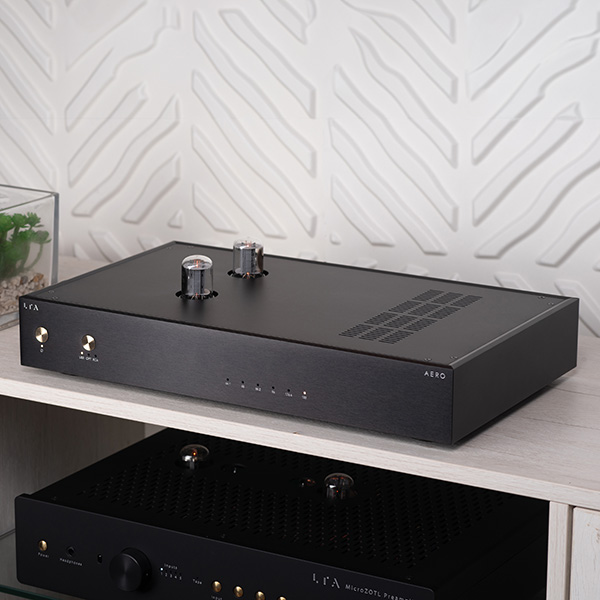
This paragraph from Linear Tube Audio's website description of their new Aero DAC sets the tone for the story I'm about to tell. "After trying various options, we chose the Analog Devices AD1865 R2R DAC chip, which is sometimes called the 'vinyl DAC,' for its organic sound. It is a non-oversampling DAC, with no digital filters. The AD1865 is much-loved by audiophiles and is used by at least one hi-fi company in a flagship DAC costing over $150,000."

Check the forums and you find that the AD1865 chip is also a heavy DIY favorite. Home brewers are attracted to this discontinued, "obsolete" 18-bit chip for its easy implementation and unprocessed, music-friendly sound.

Continue Reading »

Gramophone Dreams #86: Harbeth P3ESR XD loudspeaker and Nelson subwoofer/stand

After lifelike timbres and speed-train momentum, how a loudspeaker projects its energy into my room is the main thing that determines how my sound system feels as I listen to it. When I review loudspeakers, I try to notice the unique tone and force of their "voice" as they speak into my room. Do they stand too close, stick out their chests, and brag loudly in third harmonics? Or do they have small voices that force me to lean in to make out what they're saying?

With a miniature box speaker like my reference Falcon Gold Badge LS3/5as or the similarly sized Harbeth P3ESR XDs, which I'm auditioning this month, I have to sit very close to experience any of their direct, "off-the-cone" energy. If my listening position gets too far away or the speakers are positioned too far apart or too far from the wall behind them, the sound thins and loses body.

I didn't need to sit close to those 1947 Altec A5 Voice of the Theatre horns I used to use.

Continue Reading »

June 2024 Classical/International Record Reviews

Será Una Noche: Otra Noche; Bela Fleck: Rhapsody in Blue; Mahler: Symphony No.3 & R. Strauss: Death and Transfiguration; Maya Beiser × Terry Riley: In C; Schubert: String Quartet No.15 in G major D887 • String Quartet No.8 in B flat major D112; Stravinsky: Pétrouchka & Debussy: Jeux, Prélude à l'après-midi d'un faune.
Continue Reading »

Fern & Roby Amp No. 2 integrated amplifier

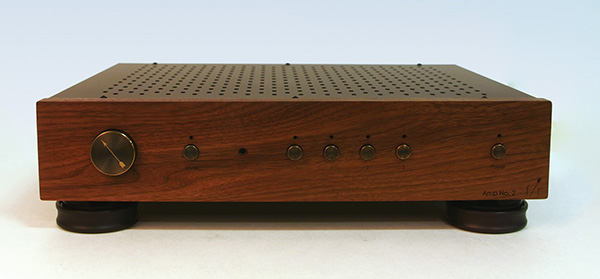
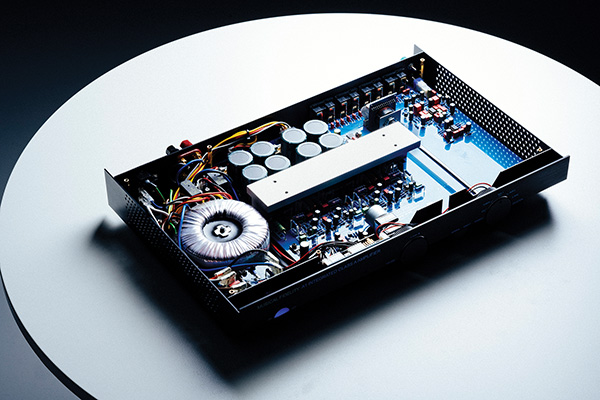
I know from experience that the manner in which a sound system occupies its environment affects every listening session, its feel and its quality. Which is what first attracted my attention to Fern & Roby products: This is serious, quality audio gear that looks elegant and unpretentious. The component I'm about to describe, Fern & Roby's new, $8500 Amp No. 2 integrated amplifier, is bureau friendly. It looks more stylish than tech-savvy, and it is not big or heavy, but its sound quality would put the sound of many amp farms to shame. A system consisting of an Amp No. 2, a pair of Raven speakers, and a Montrose turntable exemplifies owner-founder Christopher Hildebrand's materials-based, simple-is-better, form-follows-function design ethic.
Continue Reading »

Gramophone Dreams #85: Let the Right Brain In; the Hagerman Audio Labs Piccolo Zero head amp

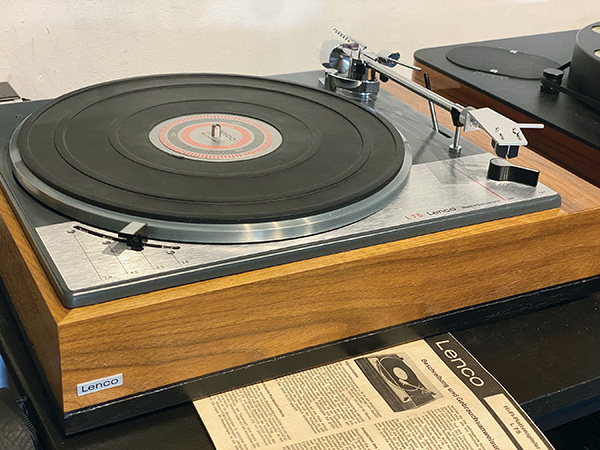
In the months since I told my Lenco story in Gramophone Dreams #79, two of my friends have bought L75s, and now they're enjoying them more than their shiny movie-star decks. One told me he has put more than $2000 into a Lenco L75 he bought online for $350. When I asked how his hot-rodded Lenco compared to his fancy belt drive, he replied, "You can feel it. The Lenco's motor pulls like a team of Clydesdales. It makes my belt drive feel like a pony pulling a child's cart."

When I asked him what he thought his rebuilt Clydesdale deck, with its new bearing, Jelco tonearm, and Grado Prestige Gold cartridge, was doing that his well-regarded belt drive was not, he replied, in a low, serious voice, "I think it gets more of the first part of a note."

Continue Reading »

Gramophone Dreams #84: dCS Lina D/A processor and Lina Master Clock

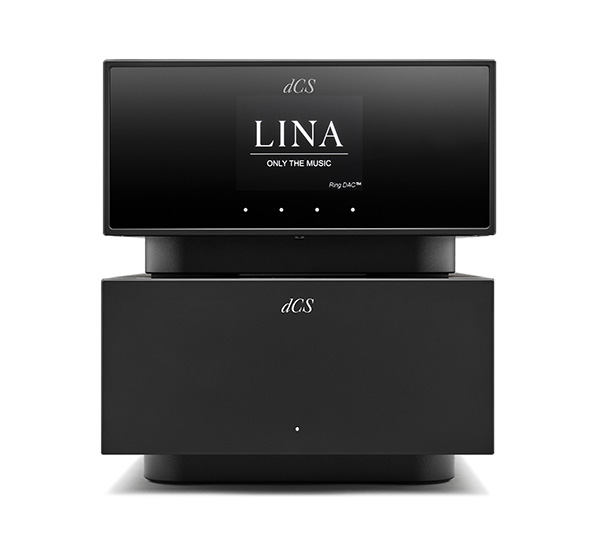
I was at least 40' away when I spied my first dCS Lina stack at CanJam. It was black, sitting conspicuously on a table emitting a strong Space Odyssey Monolith vibe. I can't remember which headphones I used, but I do remember how good it felt to face the stack and experience its startling clarity, showing off the bass end of a piano keyboard with a force I could feel in my shoulders. That impactful piano bass plus the stack's matte-finish, neo-Brutalist façade, and feels-like-cashmere volume control, made a strong first impression.

We all know everything sounds like what it looks like—right? It also sounds like what it's made of, who made it, and how much it costs. Well, the $13,500 Lina D/A converter could hardly look more different or feel or cost more different than the $46,500 dCS Vivaldi. The Lina is dCS's lowest priced streaming DAC, so it has to sound less good than my long-term reference Bartók, or the Bartók Apex I reviewed in Gramophone Dreams #75. That's just logical, right?

Continue Reading »
Advertisement
Advertisement
Advertisement