Tom Fine
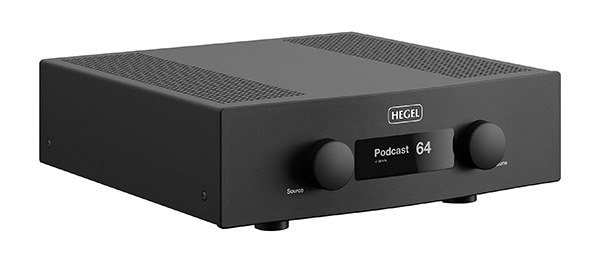
Hegel H400 streaming integrated amplifier
The Hegel H400 combines the functions of an integrated amplifier, DAC, and streamer.
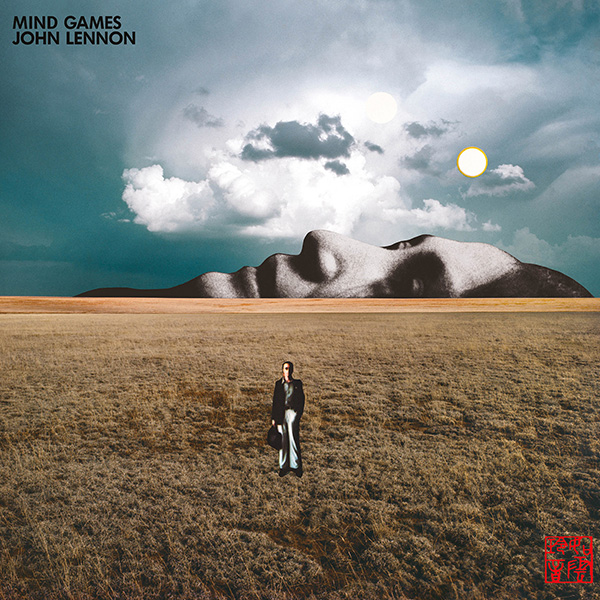
Rabbit Holes #11: Chasing John Lennon's Mind Games
By summer 1973, when Lennon's fourth album, Mind Games, was recorded at New York's Record Plant Studios, the turbulence of Lennon's life seas was at gale force. He was separating from Yoko Ono and starting a 16-month relationship (consummated at Ono's suggestion) with their shared administrative assistant, May Pang. The Nixon Administration was targeting Lennon and Ono for deportation because of their left-wing political activities, mostly focused on the Vietnam War.
T+A R 2500 R multisource receiver
It might be nice if the receiver can connect to a modern TV, which will have either TosLink or HDMI-ARC output, or both. For those of us who still own a bunch of CDs, we might as well include a robust DACand maybe even a built-in CD transport. Throw in FM analog and digital tuners, and voilà, you have the R 2500 R, the "21st Century Receiver" from T+A Elektroakustik of Herford, Germany, southwest of Hanover.
It Isn't Just the Music
When the CD is gone, and it will be soon, we'll miss it. New CD releases are winding down (footnote 1). In the classical world, the era of big, bargain-priced boxes of CDsa somewhat recent developmentis ending because, after a long, slow descent, retail sales have fallen off a cliff in the past year or so. In pop and rock, if you discover a new band you like, you may or may not be able to buy a CD. Perhaps they'll self-publish a few to sell at concerts; there's a better chance they'll have LPs, assuming they can get time at a vinyl-mastering studio and a pressing plant, both of which are booked to the max. CDs, though, are an afterthought if they're even that.
Vinyl records will likely stay around indefinitely as a collector's artifact, but new CDs are fading fast. This is momentous. CD will be remembered as the last mainstream physical music format. Its passing marks the death of physical music media.
Rediscoveries #7: Harold Land's The Fox from Craft Recordings and Acoustic Sounds
Read the back notes on the beautifully packaged new reissue from Craft Recordings and Acoustic Sounds and clarity emerges. The Fox wasn't born in Contemporary's studio/shipping room. Instead, it was laid to tape at Radio Recorders, Studio B, Los Angeles, in August 1959. It was the first record produced by David Axelrod, who would become a fixture at Capitol Records. It was released by short-lived label Hifijazz. Contemporary reissued it in 1969, and it has rarely been out of print since.
Revinylization #55: An American Beauty Unblemished
The tunes seem to roll like a Sunday drive on a country road, in and out of dark hollows and up and down hills. Three of its 10 songs have become folk-rock standards: "Friend of the Devil," "Sugar Magnolia," and "Truckin'."
WiiM Amp streaming D/A integrated amplifier
I think choice overload may scare some audiophiles away from the glorious world of streaming, where the bulk and finite scope of a physical music-media collection can be traded for (or augmented by) many more listening choices. If you're willing to explore and choose, you can hear as deep and wide as most musical rabbit holes are likely to go, and then return to your favorite songs with a couple of finger-pecks on your phone.
For some people, all that choice is intimidating, paralyzing, overwhelming, highly stressful. That's no way to enjoy music! I sympathize. I'm not ready to leave physical media behind. But I am very happy in the streaming present. In fact, I urge the hesitant: Cast aside your fears and trepidations, sign up for a free month of Qobuz, Spotify, Tidal, Apple Music, you decidethen take it slow. At first, avoid browsingjust search for the music you want to hear. Try something new each day. Over time, you'll adjust to the overwhelming abundance. By the end of the month, especially with a full-resolution service like Qobuz, Tidal, or Apple Music+HD, you may not want to give it up. The future-present beckons loudly.
The Forever Half-Life of Quadraphonics
That story is mostly true, though the format thrived for a while in Japan and Germany, and it never fully died. Now, modern tech has made possible rereleases of 1970s quad albums on relatively common formats: multichannel SACD and Blu-ray discs (BD). No more "meh" LP formats, no more fussy 1970s-tech decoders.
Cambridge Audio MXN10 streamerD/A processor
But facts is facts: Streaming is now the only mass medium for listening to recorded musicthe primary carrier for musicand has been for a few years now. According to RIAA statistics, the crossover year was 2016. That's when, in revenue terms, streaming outpaced physical formats. By 2022, the latest full year tabulated, streaming accounted for 84% of US recorded-music revenue.
So what's a long-time audiophile, born into the analog world, with strong roots in physical media, supposed to do?