
Fine Tunes

Sort By:  Post Date TitlePublish Date

Fine Tunes #8

Bill Gates would have you believe we live in a plug'n'play world. Apple has proselytized same since day one. But I'm here to tell you it just isn't so for high-end audio. The orientation of a component's AC plug—even the quality of the wall receptacle itself—affects the sound! Oh no, Mr. Bill, not something else to futz with! Will it never end?
Fine Tunes #7

Let's talk cable dressing. Make mine vinaigrette! (And you thought I'd go for French . . . ) Cable dressing is actually a rather delicate issue that requires a certain leap of faith. The concept is so simple that even I can explain the science to you. But the leap occurs when you realize how the positioning of cables and interconnect can make a real difference in the sound of your system. In spite of this, I've seen power cords and interconnects tangled up in a hopeless mess at the back of some pretty serious components.

Fine Tunes #6

One audio maintenance chore I dislike is getting down on all fours and cleaning the system's connectors—interconnects, speaker cables, and power cords. It's tedious, but the results can be spectacular. If you live in a relatively clean, dry environment, you might consider doing it every six months or so.

Fine Tunes #5

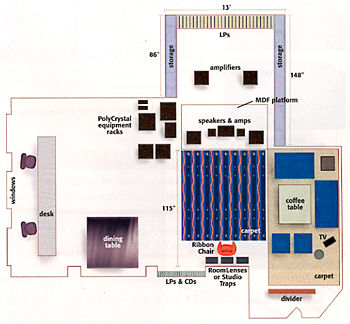
I've touched on loudspeaker placement in irregularly shaped rooms several times in the last few "Fine Tunes," but reader Peter Machare (Peter.MACHARE@usda.gov) wants more information about setting up L-shaped and other nonstandard listening areas. Here's how he describes his layout: "I have an L-shaped room. The speakers are at the bottom of the L and point up the long part of the L. Not all of us are perfect rectangles, you know."

Fine Tunes #4

In the September 1998 installment of "Fine Tunes," I wrote about the benefits of using nearfield listening to minimize your room's effect on the sound of your system. What you hear at the listening position should be first-arrival sounds from the speakers rather than chaotic reflections—in-phase and out—from the room. Allen Perkins of Immedia, importer of Audio Physic speakers, has written a white paper entitled "Principles and Techniques of Speaker Placement." It's provided to all purchasers of Audio Physic speakers. Essentially, it's a primer on nearfield loudspeaker placement (footnote 1).

Fine Tunes #3

So where did we leave off? I think you were wandering around the listening room clapping your hands. You were, I hope, listening to the slap echo and noting how it changed as you meandered about. That's probably just when someone near and dear bumped suddenly into the room and gave you that peculiar look we audiophiles know so well. Try to explain what you're doing.

Fine Tunes #2

In last month's edition of this new column, I wrote about those of us whose systems are out in the breeze in the Family Room, at the mercy of wives, Significant Others, curious children, cats'n'dogs, and nonaudiophiles who, for the life of them, can't figure out what it's all about. I met a chap the other day whose wife said to me, "Oh, you suffer from the same audiophile disease." I hastened to inform her that I am the disease, and suggested that her husband was pursuing a noble path for the love of music—no bad thing, in my view. She remained unconvinced.

Fine Tunes #1

John Atkinson recently forwarded me an e-mail from reader Daniel Sandmeier. Eight full months after moving into a new home, Mr. Sandmeier had finally experimented with speaker placement. He was flabbergasted by the result.

Advertisement
Advertisement
Advertisement