Floor Loudspeaker Reviews

Sort By:  Post Date TitlePublish Date

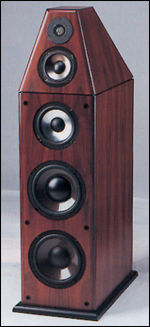
NHT 2.9 loudspeaker

Hard to believe it's been more than six years since NHT launched its flagship 3.3 loudspeaker (footnote 1). At the time, the floorstanding 3.3 was a revolutionary product for the company, whose product line until then had been aimed squarely at the customer who wanted good sound, but wanted it in a small, affordable package. While the 3.3 didn't change NHT's dedication to its roots, it did signal to audiophiles that the manufacturer could play ball with the big boys.
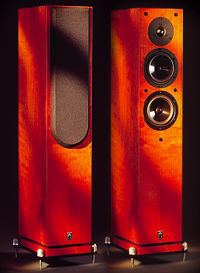
Snell XA90ps loudspeaker

The patter of the snare drum began softly and I leaned forward in my seat. Avery Fisher Hall fell silent as Riccardo Muti led the New York Philharmonic in Ravel's Boléro. Ravel once described this masterpiece as "lasting 17 minutes and consisting wholly of orchestral texture without music—of one long, very gradual crescendo." Though the hall was silent and expectant, the stage was packed with musicians waiting for...what? To gradually join in, one by one and layer by layer, to drive that gentle but relentlessly mounting crescendo. Ravel accomplished this by "having solo instruments play the melody...[then progressing] to groups" and finally "arranging the scoring so that the dynamics are self-regulating" (footnote 1). When the final, thunderous E-major chord stopped the piece by locking "all its harmonic gears," the hall erupted in ecstatic applause, and we all leapt to our feet.

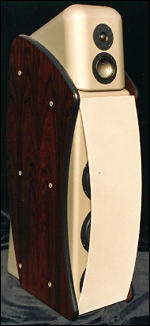
Sonus Faber Amati Homage loudspeaker

After establishing a reputation for building small, magnificent-looking, very expensive, stand-mounted loudspeakers, the Italian manufacturer Sonus Faber has hit the ground running. First came the moderately priced ($3500/pair) floorstanding Concerto Grand Pianos, and now the company's "statement" loudspeaker, the Amati Homage--a $20,000/pair visual stunner that earns its keep almost by looks and touch alone.

Genesis Technologies 500 loudspeaker

In Stereophile's "Recommended Components," most full-range Class A speakers—and even some in Class B—are behemoths. Some are tall, some are wide, some are deep, and some are just plain big. Most of us would find such no-compromise devices physically imposing and visually distracting in our listening rooms. Putting aside the infamous "Spousal Acceptance Factor," how can you ignore such speakers' presence and concentrate on the music?

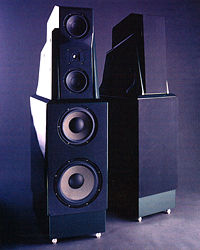
Wilson Audio Specialties MAXX loudspeaker

It's been five years since David Wilson's X-1/Grand SLAMM speaker system invaded our audio consciousness with its 500W power capacity and very high (95dB/W) sensitivity (footnote 1). Capable of an earsplitting 123dB at 1m, with a bandwidth to match, this was one speaker system that refused to be ignored. The X-1 has since evolved to $70,000/pair Mk.II form. It now provides some flexibility of tonal balance for different room acoustics, and is distinguished by greater subtlety in its differentiation of timbre. Beneath the X-1 in Wilson's range comes the WATT/Puppy ensemble, now in its 5.1 iteration (footnote 2). The WATT/Puppy has survived for over 10 years, and sets a benchmark for the Wilson line at its $17,270 system price.

Revel Salon loudspeaker

On a very special Saturday night in early September—late winter in Australia—I was deeply moved by hearing Brahms' Symphony 1 in the concert hall of the Sydney Opera House complex. Perhaps it was Marek Janowski's fiery, inspired conducting, but I keep recalling the hall itself. Earlier that day, I had photographed—first from my hotel room, later from a ferry—the huge, nesting sail-like roofs, covered with a million white ceramic tiles, that enclose an opera theater, concert hall, and restaurant. Twenty-five years in construction and costing over $107 million, the Sydney Opera House is described in my Fodor's '98 Australia guide as "the most widely recognized landmark of urban Australia." Attending the concert that night—all 2679 seats were occupied—I found the acoustics lovely, dark, and rich.

Pioneer Elite Reference Loudspeaker System (SGHT Review)

When Pioneer commissioned Allen Boothroyd, a British industrial designer best known for his work with Meridian Audio, to come up with a unique appearance for its new surround-sound speaker system, they apparently knew what they didn't want: another boring set of square boxes. Nor did they want a speaker system that would blend into Ethan Allen surroundings.

Advertisement
Advertisement