Headphone Reviews

Sort By:  Post Date TitlePublish Date

Phiaton Moderna MS 400 headphones

I once spoke to a blacksmith (named Smith, actually) about the wonderfully patterned bowie knives he made of Damascus steel. Struck by the contrast between the massive brutality of the knives themselves and the delicate beauty of the steel from which they were wrought, I asked Smith why he worked in Damascus, expecting him to extol its legendary temper or its aggressive cutting edge. After all, he was a pretty macho guy with a physique like, well, the village blacksmith's (Google it, young 'uns). He thought for a minute before responding, quietly, "Beauty is its own reward."
HeadRoom/Cardas Fat Pipe headphone cables

When Audio Advisor's Wayne Schuurman contacted me about reviewing the Vincent">http://www.stereophile.com/headphones/1108vincent">Vincent Audio KHV-1pre headphone amplifier, I felt confident that I had everything I needed to handle the task, owning, as I do, both the AKG">http://www.stereophile.com/headphones/806akg">AKG K701 and Sennheiser">http://www.stereophile.com/thefifthelement/605fifth/index1.html">Sennhe… HD-650 headphones, which have long been my references. That oughta get 'er done, I thought.

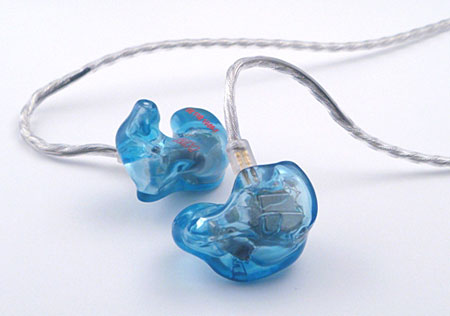
Shure E4 in-ear earphones

In New York and other major cities, I understand, bus accidents are a real problem. Buses turn right and failing to yield to pedestrians. Clueless pedestrians walk in front of buses. I haven't seen any statistics, but I'm guessing that in this era of cell phones and iPods, the problem has gotten worse: not only do such devices distract you, they make it harder to hear warning signs—such as the sound of a municipal bus bearing down on your ass.

Grado Laboratories SR 125 headphones

For many years I have used three sets of headphones, all from Grado Laboratories: the Reference">http://www.stereophile.com/headphones/796grado">Reference RS-1 ($695), the SR-125 ($125), and the SR-60http://www.stereophile.com/headphones/532">SR-60; ($60). I've always favored Grado headphones because the minimal-resonance design philosophy that I feel is responsible for the uncolored midrange of their moving-iron cartridges extends throughout their headphone range as well. Recently, however, I've achieved a new perspective regarding the SR-125 'phones that I felt would be of interest to Stereophile readers.

Melos SHA-Gold headphone amplifier

It's hard to know what to call the SHA-Gold. It is a superb headphone amplifier—maybe even the target all future headphone amps need to shoot at—but it's also a full-function preamplifier. At two grand, it's not exactly a unit you'd add to your current system just to get a headphone connection...Wait a minute! What am I saying? I'm sure that there are folks out there who would add this to their existing reference systems as casually as I'd buy the Audio">http://www.stereophile.com/headphones/796alchemy">Audio Alchemy headphone amplifier—but they'd be missing out on a great line stage.

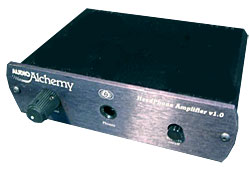
Audio Alchemy HPA v1.0 headphone amplifier

For headphone listeners, this is truly a golden age—we have multiple choices at many different price levels. During the course of this review, I had as many as five headphone amplifiers (and, in several cases, multiple power supplies) set up for comparison. Yet many people don't understand why we might want a headphone amp in the first place.

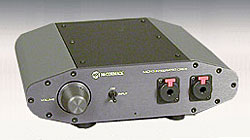
McCormack Micro Integrated Drive headphone amplifier

What, I hear you asking, is an integrated drive? The MID is part of McCormack's much lauded "Micro" series (see my review of their Micro Line Drive in Vol.18 No.6), which are designed to offer the same dedication to quality as McCormack's full-size components, but at a lower price (and in a smaller package). The MID was initially the Micro Headphone Drive, sporting two ½" stereo phone-jacks on the front panel, a two-position input switch, and a volume control. The rear boasted two inputs and an output (controlled by the volume pot). It was designed to be a high-quality headphone amp and a minimalist preamp. In this configuration, I ran into it at the 1995 WCES where—almost as a gag—Steve McCormack had made up a few ½" stereo phone-plug to 5-way binding post connectors. He could, he explained, run small speakers from the headphone outputs. There was a serious purpose behind the joke, of course. Showing that the MHD could drive speakers spoke volumes for its ability to drive headphones.

Sennheiser HDC 451 Noiseguard headphones

I was cruising at 36,000 feet, totally relaxed, listening to Richard Thompson. Looking down at my lap, I caught sight of a little box with a glowing green light. Switching off this light was like turning on the noise—the 767 was roaring like a locomotive and the ambient sound hit me like a fist. Thompson's crisp Celtic chordings turned mushy, undetailed, and dull. I felt weary. Whoa, I wouldn't do that again if I were you, laddie! I fumbled for the switch and reactivated the NoiseGuard circuitry on my Sennheiser HDC 451 noise-canceling headsets. Thompson's guitar rang out clearly, the airplane quieted to sound like an S-class Benz, and I relaxed into a calm reverie with only one worry clouding my contentment. But I patted my pocket: yup, still two cognacs left. Everything would be all right.

Advertisement
Advertisement
Advertisement