Phono Cartridge Reviews

Sort By:  Post Date TitlePublish Date

Benz-Micro MC20E2-L MC phono cartridge

The ceiling remains, but the floor has changed: Benz-Micro continues to offer a selection of rather expensive phono cartridges, including their well-established LP Ebony ($4700) and Ruby 3 ($3000) models. But in recent years, my attention has been drawn by the succession of budget Benzes: first, the Gliders ($795), then the ACEs ($550), and now the MC20E2-L ($199).
van den Hul Grasshopper IV phono cartridge

If you think I burned out cartridge-wise at the end of my and JE's It's A Mad Mad Mad Mad World cartridge survey at the beginning of the year (Vol.18 Nos.1 & 2), you're wrong. If you think I ought to burn out and give it a rest, you'll be disappointed. If you think analog doesn't matter anymore, you have my semi-sincere condolences. But if you think, as I do, that analog is enjoying a resurgence of epic proportions (twilight or no), and that LP playback has reached a new zenith of musical wonder, then hang on—here I go again!

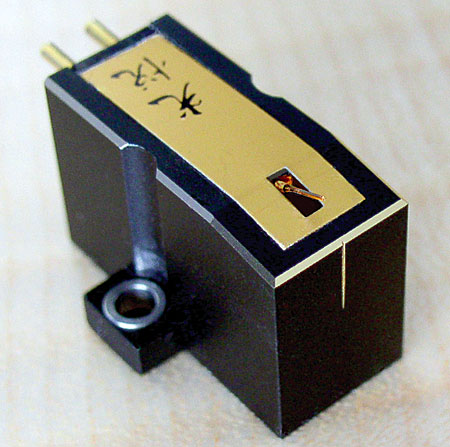
Koetsu Black MC phono cartridge

Every two or three years my family and I travel to Disney World in Orlando, Florida—one of those places I used to think I'd hate, but which I always enjoy in spite of myself. No such trip would be complete without visiting the Mitsukoshi department store at Epcot Center, which represents the pinnacle of Japanese consumer culture. At the Epcot Mitsukoshi store—the 430-year-old company's only US location—one can buy the finest of everything, including the rarest and most expensive writing papers and inks, the most exquisitely crafted pottery, and the loveliest freshwater pearls on Earth. Young shoppers are accommodated with the latest toys, trends, and technology—but there's nothing frantic or cheap about the manner in which they're offered. The watchword at Mitsukoshi is quality, and the presentation borders on being artistic.

van den Hul Black Beauty MC phono cartridge

A.J. van den Hul calls the Black Beauty a phono cartridge "just for friends." In a way, this Black Beauty was made specially for me—it's been tweaked for an undamped linear-tracking arm. Says so right here on the box: "Forsell Version." But before you explode, know that Mr. van den Hul will be pleased to do the same for you. He'll adjust the suspension of any Black Beauty– or Grasshopper-series cartridge for your arm and 'table. Or, should you specify, for "the preamp and load impedance, a particular brand of records to be played, the type of music generally played (jazz being more dynamic and classical more spacious and detailed), and other personal/sound preferences."

Lyra Skala moving-coil phono cartridge

Back in 2000, when Lyra introduced the Helikon moving-coil cartridge, which replaced the then six-year-old Clavis D.C., the company inexplicably retained the Clavis D.C.'s retail price of $2000. This was inexplicable because the Helikon's revolutionary design was new from the ground up, and because audiophiles—like most, if not all, consumers—perceive price to be a reflection of quality and performance.

Rega Apheta MC phono cartridge

I see a pattern taking shape: Roy Gandy's Rega Research offered their first CD player in 1996, which was 13 years after the medium was introduced to the public. Now, in 2006, some 50 years after Joe Grado designed and sold the first moving-coil phono cartridges, Rega has released one of those. The year 2016 may see the first Rega fluoroscope, or perhaps wire recorder. And it'll be a good one, I'm sure.

Ortofon MC-3000 MC phono cartridge

The Ortofon">http://www.stereophile.com/phonocartridges/ortofon_mc-2000_mc_phono_car… MC-2000 may just have been the most impractical cartridge to be unleashed upon the audio community for some years. With a high compliance (20cu) that made it ill-suited for most tonearms, it also had a preposterously low signal output of 50 microvolts, which gave new meaning to the terms hum and noise. Few MC preamps had enough gain to deliver adequate driving voltage to a system, and none of those that did had low enough noise to be usable with the 2000. If the problem wasn't hum, it was hiss; if hiss was acceptably low, there would be too much hum. At least Ortofon had the sense to be aware of the problem and to do something about it, in the form of their T-2000 step-up transformer, which is the only device I ever found that would allow the cartridge to be operated without a constant background of hum or hiss. Despite all this, I have used the MC-2000 as my reference cartridge for the last two years. Why? Because of all the cartridges I've tried, it is by far the most accurate.

Linn Troika MC phono cartridge

Some six or so years ago, the Linn Asak cartridge set new standards for imaging and soundstage reproduction. I can remember the first time I heard an Asak in a system using Quad">http://www.stereophile.com/floorloudspeakers/416">Quad ESL-63s—I had never experienced such depth of soundstage and solidity of imaging from any system, and that with Quad amplification! The Asak was relatively quickly overshadowed in this area, however, and in any case, soundstaging precision by itself didn't seem to be a high priority for the Linn design team, who were apparently more concerned with dynamics and a musical integration of the sound across the frequency range.

Advertisement
Advertisement
Advertisement