Phono Preamp Reviews

Sort By:  Post Date TitlePublish Date

Precision Transducer Engineering MMMC Phono Preamplifier
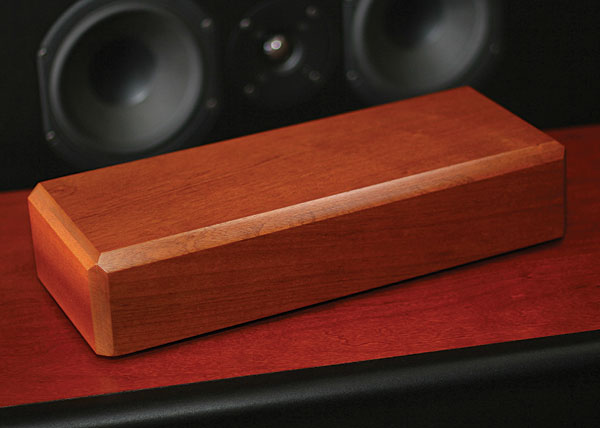
The phono preamplifiers reviewed this month are both affordable ($400–$1960) and highly accomplished, and the most expensive of them offers versatility that's unprecedented in my experience. Three of them are designed to be used only with moving-magnet, moving-iron, and high-output moving-coil cartridges, so I installed Shure's V15VxMR cartridge in VPI's Classic 3 turntable and listened in MM mode to all of them, beginning with the least expensive.
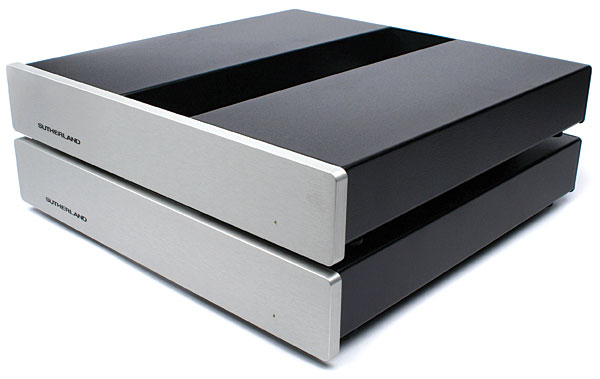
Sutherland Engineering Phono Block monoblock phono preamplifier

Saying that Sutherland Engineering builds a nice line of phono stages is like saying that the Porsche 911 Carrera is a nice line of sports car. The Sutherlands all share common design philosophies, features, and sonic attributes—but just as ramping up from Porsche's classic Carrera Coupe ($78,000) to the GT3 ($115,000) or the Turbo S Cabriolet ($172,000) increases the level of performance and distills the Porsche experience down to its essence, ascending the Sutherland line from the PH3D ($1000) to the 20/20 ($2200) to the Hubble ($3800) buys more of what Ron Sutherland is all about.

Leben RS-30EQ phono preamplifier

The Leben RS-30EQ phono preamplifier ($2695) incorporates a pair of common dual-triode tubes (12AT7) for phono gain, but breaks with tradition by using a CR-type equalization circuit rather than the more common negative-feedback type. Total gain is specified as 23.5dB, which is sufficient for moving-magnet pickups; an external transformer is recommended for use with moving-coil types. A silicon full-wave rectifier supplies heater voltage, while the rail is supplied by a 6X5GT rectifier tube.

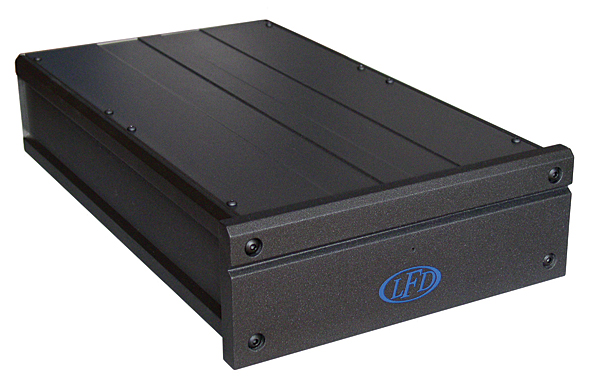
LFD Phonostage LE phono preamplifier

Far be it from me to surrender these column inches to the whims of a manufacturer.

That said, there's ample reason to break with tradition and offer the thoughts of an obscure English company called LFD, whose products may already have tripped your surveillance wires. In their "Charter to Product Commitment and Traditional Values"—which can be read in its entirety on Frohmusik's website and is signed by Bews and Hawksford (see below)—the people of LFD suggest, in so many words, that they will not manufacture goods outside of their native England; that their design work is guided by listening as much as by engineering theory; that they believe some component parts sound better than others of identical numeric value, depending on their specific role in an audio circuit; that their philosophy of circuit design is decidedly minimalist; and that they advocate the enjoyment of music on vinyl LP. That the principals of LFD have thus far avoided being burned alive as heretics is a source of wonder.

Sutherland Engineering 20/20 phono preamplifier

Why no batteries?

It seemed a simple and obvious question, but I couldn't get an answer out of Ron Sutherland. Why did his new 20/20 phono preamp use an AC power supply instead of batteries? I asked directly, I asked repeatedly, I tried framing the question in different ways, all to no avail. Did the AC supply make it sound better? Was it less expensive to build? Were potential customers turned off by having to replace batteries once every year or two?

NAD PP 3 digital phono preamplifier

Even Mikey Fremer is surprised at vinyl's current popularity. Some pundits postulate that eventually CDs will die out, and we'll be faced with the choice of LPs or downloads. (I hope not. I'm just getting used to CDs.) With abundant sources of new pop releases and a wide range of reissues on vinyl, and a variety of used LPs, every audiophile should own a turntable. And with the availability of affordable turntables such as the Pro-Ject Debut III, which I reviewedhttp://www.stereophile.com/turntables/pro-ject_debut_iii_record_player"…; in the February 2010 Stereophile, the cost of entry to VinylLand is not very dear. The problem is that so few entry-level integrated amplifiers and receivers available today include phono stages. (The Marantz PM5003, which I reviewedhttp://www.stereophile.com/integratedamps/marantz_pm5003_integrated_amp…; in the January 2010 issue, is a notable exception.)

Pure Vinyl LP recording & editing software

As long as you're spinning an LP for your listening pleasure, and if digitizing it at a resolution of 24-bit/192kHz is transparent to the analog source, why not record and store the LP on your computer at that high sampling rate for future convenient playback via iTunes or for iPod use, or for burning to CD-R? And, while you're at it, why not record the LP unequalized and apply the RIAA curve in the digital domain, where you're not dependent on capacitors and resistors that are imprecise to begin with, and can drift over time? With no drift of phase or value, the virtual filter's results should be better than with any analog filter. And in the digital domain, you can program in any curve known, and select it at the click of a mouse. Aside from the sweat equity invested in programming it in the first place, it wouldn't add a penny to the program's cost.

Advertisement
Advertisement
Advertisement