Reference

Sort By:  Post Date TitlePublish Date

The Essex Echo 1995: Electrical Signal Propagation & Cable Theory

Editor's Note: The matter of whether—and if so, how—speaker cables and interconnects can affect the sound of an audio system has vexed the audiophile community since Jean Hiraga, Robert Fulton, and others first made us aware of the subject in the mid-1970s. Most of the arguments since then have involved a great deal of heat but not much light. Back in August 1985, Professor Malcolm Omar Hawksford Ph.D (of the UK's University of Essex and a Fellow of the Audio Engineering Society) wrote an article for the British magazine Hi-Fi News & Record Review, of which I was then Editor, in which he examined AC signal transmission from first principles. Among his conclusions was the indication that there is an optimal conductor diameter for audio-signal transmission, something that I imagined might lead to something of a conciliation between the two sides in the debate. Or at least when a skeptic proclaimed that "The Laws of Physics" don't allow for cables to affect audio performance, it could be gently pointed out to him or her that "The Laws of Physics" predict exactly the opposite.
Time Dilation, Part 2

If you missed Part">http://www.stereophile.com/features/105kh">Part 1 of this article (Stereophile, January 2005), or it has faded in your memory, here's a résumé. (Readers who recall Part 1 with crystalline clarity, please skip to paragraph four.) The accurate measuring of loudspeakers requires that the measurements be taken in a reflection-free environment. Traditionally, this has meant that the speaker be placed atop a tall pole outdoors or in an anechoic chamber. Both of these options are hedged around with unwelcome implications of cost and practicality. To overcome these and allow quasi-anechoic measurements to be performed in normal, reverberant rooms, time-windowed measurement methods were developed that allow the user to analyze only that portion of the speaker's impulse response that arrives at the microphone ahead of the first room reflection. MLSSA from DRA">http://www.mlssa.com">DRA Labs is the best-known measurement system to work on this principle, and both John Atkinson and I use it in the course of preparing our loudspeaker reviews.

Red Shift: Doppler distortion in loudspeakers

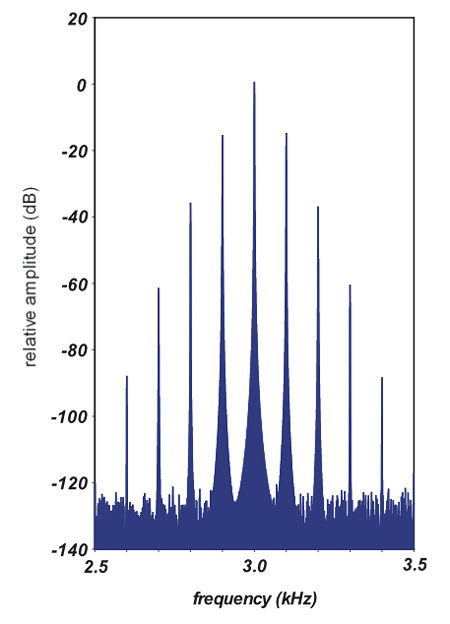
In the world of digital audio, jitter has been a focus of audiophile attention for well over a decade. It is blamed for many of the sonic ills of which CD and other digital media have been accused. But here's a puzzle: The major source of frequency intermodulation distortion in audio systems—the loudspeaker—has largely escaped such withering inquiry. Why?

Jitter & the Digital Interface

Until recently, all problems in digital audio systems were blamed on either the analog/digital converters (ADCs) used in mastering or the digital/analog converters (DACs) needed for playback (footnote 1). As the performance of both ADCs and DACs improved, however, a previously unrecognized mechanism for distortion was unmasked: jitter. As we shall see, jitter—or, more correctly, word-clock jitter—can be a significant limitation in the technical and sonic performance of digital audio systems (footnote 2).

Cutting Corners

If anyone ever thinks to compile a list of the 100 seminal audio papers that should be found in every tech-aware audiophile's filing cabinet, Harry Olson's "Direct Radiator Loudspeaker Enclosures" deserves to feature in it. Originally presented at the second Audio Engineering Society Convention, in October 1950, it was published in Audio Engineering in 1951. In 1969—in a rare and certain acknowledgement of its classic status—the AES republished it in its Journal (footnote 1).

Noise, Modulation, & Digital/Analog Conversion

At the February 1991 Audio Engineering Society Convention in Paris, Audio Precision's Dr. Richard Cabot (see my">http://www.stereophile.com/interviews/850">my interview in January 1991, Vol.14 No.1) proposed a new technique for measuring noise modulation in D/A converters (footnote 1). The method, based on psychoacoustic principles, attempts to predict the audible performance of D/A converters. Now that Stereophile has added digital-domain signal generation and analysis to our Audio Precision System One, we can employ Dr. Cabot's technique and see if there are any correlations with subjective performance.

CD: Jitter, Errors & Magic

The promise of "perfect sound forever," successfully foisted on an unwitting public by the Compact Disc's promoters, at first seemed to put an end to the audiophile's inexorable need to tweak a playback system's front end at the point of information retrieval. Several factors contributed to the demise of tweaking during the period when CD players began replacing turntables as the primary front-end signal source. First, the binary nature (ones and zeros) of digital audio would apparently preclude variations in playback sound quality due to imperfections in the recording medium. Second, if CD's sound was indeed "perfect," how could digital tweaking improve on perfection? Finally, CD players and discs presented an enigma to audiophiles accustomed to the more easily understood concept of a stylus wiggling in a phonograph groove. These conditions created a climate in which it was assumed that nothing in the optical and mechanical systems of a CD player could affect digital playback's musicality.

Jitter, Bits, & Sound Quality

Jitter is not what digital sound quality induces in the listener; rather it is the instability in the clock signal that controls exactly when the analog waveform is sampled in the original A/D conversion, or when the digital word input into a DAC results in an analog voltage being produced at the chip's output. "So what?" is the response of digital advocates, "As long as a digital one is recognized as a one and a digital zero as a zero, then how can there be any difference in sound?" goes their argument, normally culminating in a fervently expressed "Bits is bits!"

The Law of Averages

The Compact Disc clearly hasn't read the script. At a time when, in the autumn of its commercial life, the format is supposed to be stepping aside to allow younger blood to succeed it, CD has instead in recent years enjoyed something of a revival in audiophile opinion. While SACD and DVD-Audio, rather strutting and fretting their hour upon the stage, are doing more plain fretting than anything, the best in CD sound quality has improved sufficiently for some to question whether we need the new media at all.

Advertisement
Advertisement
Advertisement