Solid State Power Amp Reviews

Sort By:  Post Date TitlePublish Date

Audionet Max monoblock power amplifier
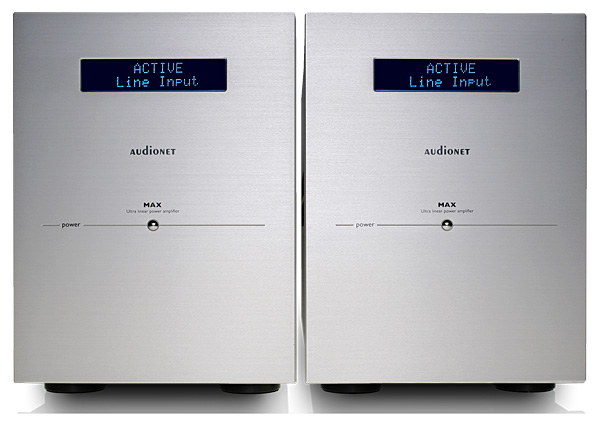
Three years ago, when I first heard Audionet's Max monoblock power amplifiers, I described their pairing with YG Acoustics Hailey loudspeakers "an absolute winner" and "definitely one of the finer systems at T.H.E. Show Newport Beach." At subsequent audio shows, no fewer than four other Stereophile Contributing Editors enthused about different pairings of YG loudspeakers with Audionet amplification. Herb Reichert, at the 2014 Rocky Mountain Audio Fest: "Everything had a kind of just right quality. Totally impressive!" Sasha Matson, at RMAF 2015: "Marvelous" on vocals, "rockin' and tight" on bass and drums. John Atkinson, at T.H.E. Show 2016: "Duke Ellington's classic Jazz Party in Stereo . . . was reproduced with terrific dynamics." Larry Greenhill at the 2017 Consumer Electronics Show on the sound in the YG Acoustics room, which included Audionet's Max monoblocks: "the sound on playback of Jake Shimabukuro's ukulele wizardry came closer to matching his live performance than in most rooms."

AVM Ovation MA8.2 monoblock power amplifier

I've known Peder Bäckman, international sales director for the German firm Audio Video Manufaktur GmbH (AVM), for many years, ever since he worked with Electrocompaniet. When I told him that I was looking for products to review in the reference system in my new 20' by 16' by 9' music room, he invited me to browse AVM's large catalog and see what tickled my fancy. In consultation with John Atkinson, it became clear that AVM's largest, most powerful monoblock amplifier, the Ovation MA8.2 ($29,990/pair), seemed a good fit.

Boulder Amplifiers 2150 monoblock power amplifier

"I'm a recording engineer, so I value accuracy," said a panelist in a discussion—titled "How to Read Between the Lines of Audio Advertising"—at last October's Rocky Mountain Audio Fest. I, too, was on the panel, which was moderated by Brent Butterworth, a writer for the SoundStage! Network of online audio magazines.

"Accuracy is overrated," I interjected from the other end of the dais. "Accurate to what? To your sonic tastes? To what you hear on your preferred loudspeakers? Other than one's personal preferences, I'm not sure the term accuracy has much meaning."

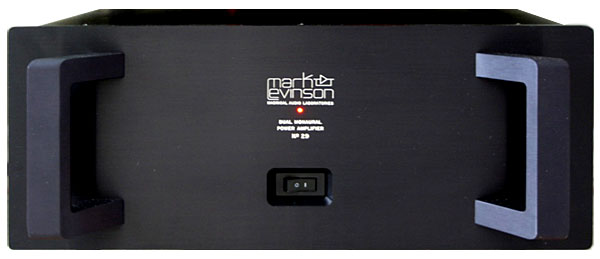
Mark Levinson No.29 power amplifier

I still remember reading about my first Mark Levinson product 14 or 15 years ago. It was a preamp. The model number escapes me, but it sold for over $2000. It was soon followed by the JC-2, designed by John Curl, which was a bit less pricey but still astonishingly expensive for a mid-'70s preamp. We've come a long way since then. The man, Mark Levinson, left the company that bore his name in the early 1980s and founded a new company, Cello. The company Mark Levinson became the core of Madrigal. It is a mark of their continued dedication to uncompromising high-end products that their bread-and-butter line remains the high-priced Mark Levinsons. They no longer have the Rolls-Royce of the audio market to themselves (in their early years, they made the never exactly inexpensive Audio Research products—ARC was certainly a contender for the same title—look like bargains), but they are certainly a leading player.

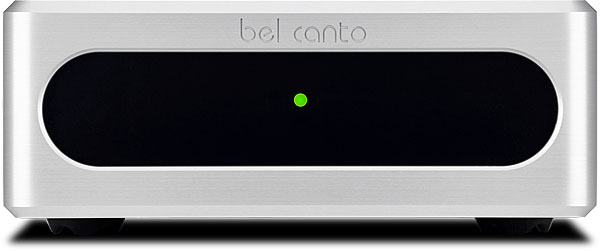
Bel Canto e.One Ref600M power amplifier

Has it really been more than seven years since I reviewed Bel Canto's REF1000M monoblock? According to the Bel Canto website, that model, based on Bang & Olufsen's ICEpower class-D modules, is no longer available. But now, like so many manufacturers, Bel Canto has adopted for its new models the NCore class-D module from Hypex—although the REF600M monoblock ($4990/pair) is not Bel Canto's first product to use it . . .

SAE 2HP-D power amplifier

In 1967, in Los Angeles, Morris Kessler, with Ted and Beth Winchester, founded Scientific Audio Electronics (SAE), which enjoyed a successful run of 21 years. In addition to Kessler, Sherwood Electronics cofounder Ed Miller, as well as the legendary James Bongiorno, contributed designs. (If you don't know Bongiorno's résumé, please do a web search.) Some SAE products, particularly their big-metered power amplifiers, became objects of desire for audiophiles on the West Coast and, especially, in Japan.

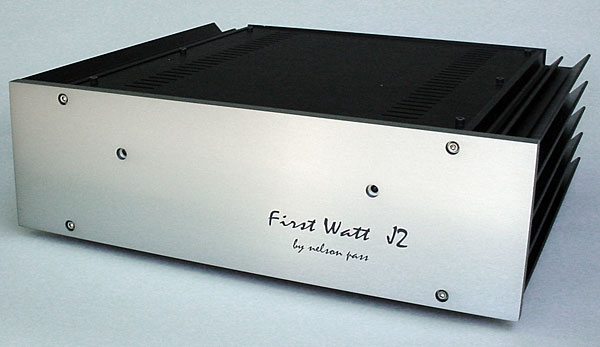
First Watt J2 power amplifier

Every time a new audio technology enters the marketplace, a debate begins about its relative merit. That debate never ceases, even decades after the technology first came (and sometimes went). Turntable platters driven by belts vs rims vs idlers vs directly by their motors. Analog vs digital. Tubes vs solid-state. Triodes vs pentodes, Single-ended vs push-pull. Objectivism vs subjectivism. The power and seriousness of each of these debates has splintered our global hobby into diverse tribes, cults, and subcults—and therein lies one of the chief joys of being an audiophile: participating in cult rivalries.

Audio Alchemy DPA-1M monoblock power amplifier

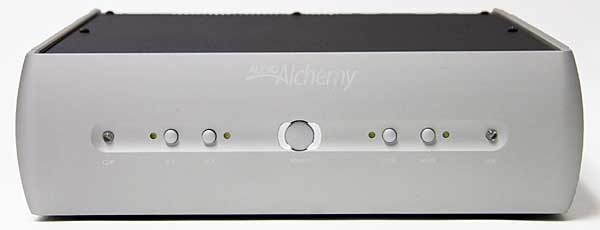
To those who were into audio in the late 1980s and early '90s, the name Audio Alchemy is a familiar one. I've owned DACs and jitter-reducing devices made by Audio Alchemy and Perpetual Technologies (the first successor to the original AA) and found them to provide excellent performance at modest prices. Indeed, at the time, many in the industry felt that the Audio Alchemy products were underpriced, leaving too little room for profit, and that this led to the company's demise. The new Audio Alchemy—led by its original designer, Peter Madnick, and having on staff other employees from the old AA—is what Madnick describes as a "grown-up" version of the original company, maintaining "the brand's original ethos of superior technology and value." And the prices, while quite reasonable for the performance they seem to offer, appear high enough to allow the new AA to survive.

Hafler Transnova 9500 power amplifier

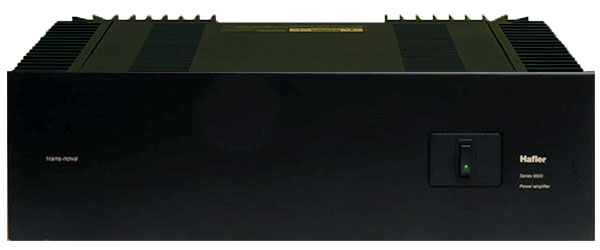
Boy, do we ever get letters. From readers angry that we review too many expensive products. From readers depressed that we review too many affordable products. From readers bemoaning our digital coverage. From readers asking when we're going to get with the 21st century and stop gushing over analog. From readers wanting more coverage of tube products. From readers wanting more coverage of MOSFET amplifiers designed for high voltage gain on the output stage.
Advertisement
Advertisement
Advertisement