Stand Loudspeaker Reviews

Sort By:  Post Date TitlePublish Date

JBL 18Ti loudspeaker

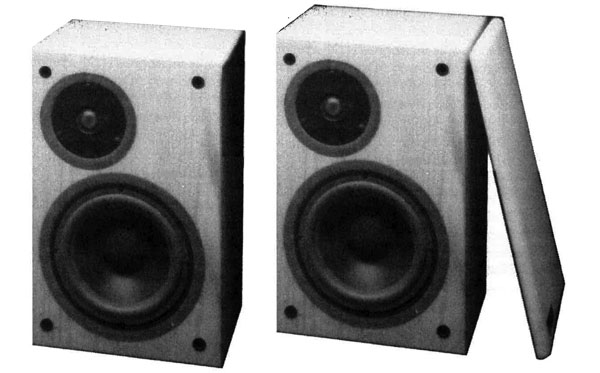
Introduced in 1985 as the smallest model in JBL's "Ti" range, the 18Ti ($590/pair) shares with its larger siblings, like the JBL 250ti (recently reviewed by J. Gordon Holt), a high-tech tweeter that uses a one-piece ribbed titanium-foil dome/surround just 25µm thick. This is both rigid and of very low mass, pushing its first-breakup mode up to the region of 30kHz. The tweeter is mounted above the polypropylene-cone woofer, offset a little to one side to make room for the 45mm diameter port (though the speakers are not supplied as a handed pair). The 10-liter internal volume box is well-constructed from 20mm chipboard, covered in real-wood veneer.

Kii Audio Three loudspeaker

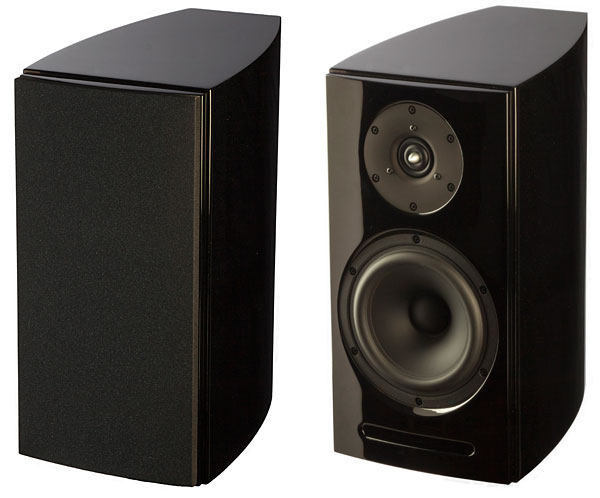
At the risk of offending nearly every designer and manufacturer of loudspeakers, I think we have not seen anything really new in a long time. Casting a gimlet eye at Stereophile's "Recommended Components" reveals some electrostatic and planar-magnetic models, a few horns, and lots and lots of cones and domes in boxes. Those cones and domes have voice-coils inductively driven by permanent magnets, and overwhelmingly use passive crossovers. Innovation in speakers mostly takes the form of advancements in materials science and, to a much lesser degree, cabinet shape. All helpful, but not revolutionary.

Monitor Audio R300/MD loudspeaker

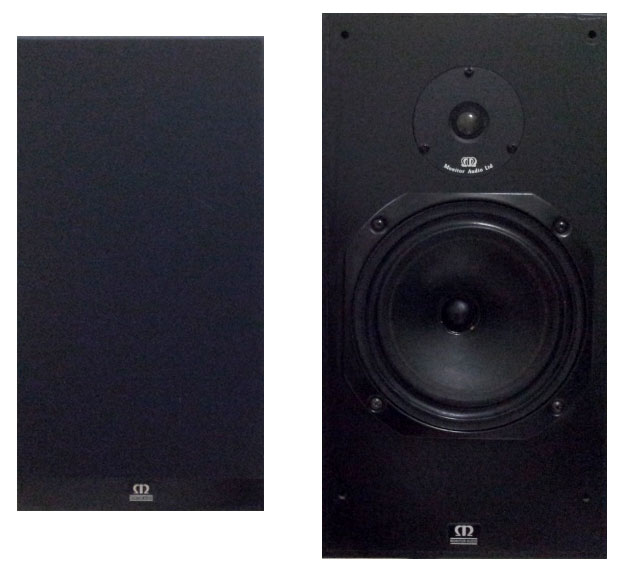
The Monitor Audio R300/MD ($669/pair) debuted at the 1988 SCES in Chicago. English company Monitor Audio is one of the pioneers in spreading the use of metal-dome tweeters in relatively low-cost loudspeaker systems. The tweeters they have designed in conjunction with SEAS and British manufacturer Elac may have now found their ways into a number of designs from competing manufacturers, but there is no doubt that Monitor leads the way. The new R300/MD features a new ¾" version of the SEAS 1" aluminum-dome unit Monitor introduced with their R652/MD (reviewed in Vol.10 No.5), in conjunction with an 8" doped paper-cone woofer.

Amrita AMRIT-MiniMonitor loudspeaker

"Amrita" is Sanskrit for "nectar," and indeed, the Amrita owner's manual states that they are confident their speakers "will provide Nectar For Your Ears." Although this Iowa-based manufacturer offers a large range of loudspeakers, I decided that Stereophile should review their small AMRIT-MiniMonitor ($875/pair) after Martin Colloms mentioned in his report from the 1987 SCES in Vol.10 No.5 that it sounded "pleasantly balanced on both rock and classical material." We received a pair for review in the summer of 1988, but it turned out that only one was working, the other having a very restricted low-frequency response below 100Hz. After repeated requests for replacements, Amrita's John Andre personally delivered a pair to Santa Fe in the Spring of 1989. This time, both worked out of the box!

Dynaco A-25 loudspeaker

Everyone knows that a lot of serious music listeners—that is, those who listen to music instead of using it as a conversational background—have neither the space nor the money for a pair of typical floor-standing speakers, and must make do with bookshelf-type systems that are actually small enough to put in a bookshelf. But while the typical audio perfectionist will freely admit that there is a place in the audio sun for these dinky little speakers, he cannot really take them seriously, particularly when they're priced significantly under $100 each.

DeVore Fidelity Gibbon 3XL loudspeaker

Forty years ago, when I first had money enough to buy serious [ahem] consumer audio, there were a few good turntables available, from Thorens, Garrard, Ariston, some others. Today is the golden age of turntables: ask Mikey, if not antiquarian Artie. And loudspeakers! In 1970, models were few, and most were mediocre. Today, you can have a great loudspeaker for a song.

Dynaudio Contour 20 loudspeaker

The soul of a loudspeaker cannot be exclusively characterized by such unmeasurable, reviewer-friendly declarations as "lush tonality," "gossamer textures," "clear-water transparency," "microdetail," or "pacey dynamic rhythmic expression." Neither can it be fully described by such measurable characteristics as anechoic frequency response, dynamic impedance, or step response. More than anything else, a loudspeaker expresses its full character in how and where it directs the listener's attention. What a loudspeaker emphasizes—what it reveals, what it obscures, what it forces the listener to notice and think about—that is a loudspeaker's soul.

Ohm Acoustics CAM 16 loudspeaker

I like Brooklyn. I even got married under the shadow of the Brooklyn Bridge! (Almost the exact spot where Cher's grandfather let his dogs howl at the moon in Moonstruck. And if you're ever in the Park Slope area, check out McFeeley's for brunch.) I could be forgiven, therefore, for having a soft spot for any Brooklyn manufacturer, including Ohm Acoustics. Except that the only Ohm model I have heard was the omnidirectional Ohm Walsh 5 (favorably reviewed by Dick Olsher in Stereophile in 1987, Vol.10 No.4, and 1988, Vol.11 No.8), and the omni principle is something that I have never found to work, or at least to give me what I feel necessary in reproduced sound. The Ohm Model 16, however, is one of three more conventional Coherent Audio Monitor (CAM) speakers intended to offer good sound at an affordable price: $300/pair

Wharfedale Diamond 225 loudspeaker

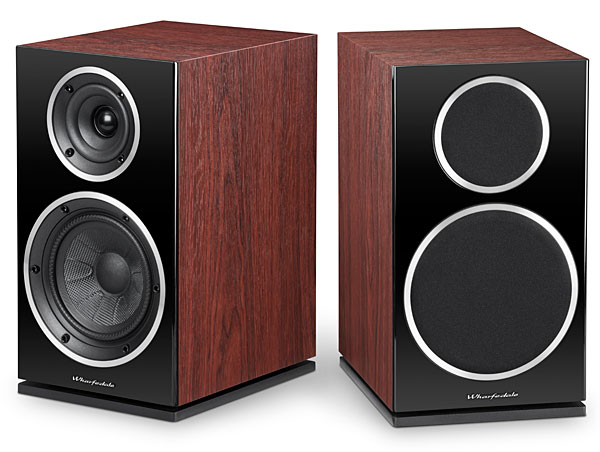
In the United Kingdom, the first seeds of perfectionism in audio separates were sown by Goodmans Industries, founded in 1925. Then, in 1930, Garrard (est. 1722) produced its first commercial gramophone. Shortly thereafter, England experienced the Great Slump, the British name for the worldwide catastrophe known in the US as the Great Depression. Near the beginning of this economic downturn, in 1932, Gilbert Briggs founded Wharfedale Wireless Works—and the first British "high-fidelity" audio amplifiers began being manufactured by H.J. Leak & Co. Ltd., founded by Harold Joseph Leak in 1934.

Aerial Acoustics 5T loudspeaker

Long-lived loudspeaker models are rare. So it's surprising that the two-way, stand-mounted Model 5, the smallest speaker made by Massachusetts-based Aerial Acoustics, was revised just once between 2015 and April 1997, when Robert Harley favorably reviewed it and it cost $1800/pair. The revised 5B was equally favorably reviewed by John Marks in July 2009. This kept the original's 1" titanium-dome tweeter and sealed-box woofer loading but replaced the 7" polypropylene-cone woofer with a 7.1" laminated-fiber–cone woofer. Despite more than a decade's worth of inflation, the price rose only slightly, to $2400/pair.
Advertisement
Advertisement
Advertisement