
Subwoofer Reviews

Sort By:  Post Date TitlePublish Date

Revel Ultima Rhythm2 powered subwoofer

Powerful, massive, and expensive, Revel's Ultima Rhythm2 subwoofer ($10,000) swept me off my feet when I first saw it in Harman International's suite at the 2013 Consumer Electronics Show. It outsizes, by 49 lbs and 2.6 cubic feet, Revel's previous flagship model, the Ultima Sub30, which I reviewed in the November 2004 issue. Its specs read like no other sub's: 196 lbs; 18" cast-frame woofer; dual 4" voice-coils; 4kW peak power from twin internal amplifiers that generate 1kW RMS; 115dB peak acoustic output; a fully configurable, high-resolution, 10-band parametric equalizer (PEQ); an internal crossover with high- and low-pass outputs; and PC-based setup via USB. The Rhythm2's patent-pending design is said to let just enough air move in and out of the cabinet to prevent any distortion-inducing pressure due to heating of the voice-coils. And its veneer, shape, beveled top edges, and bottom plinth exude the quality found in Revel's top-of-the-line floorstanding speaker, the Ultima Salon2, with which I was familiar.
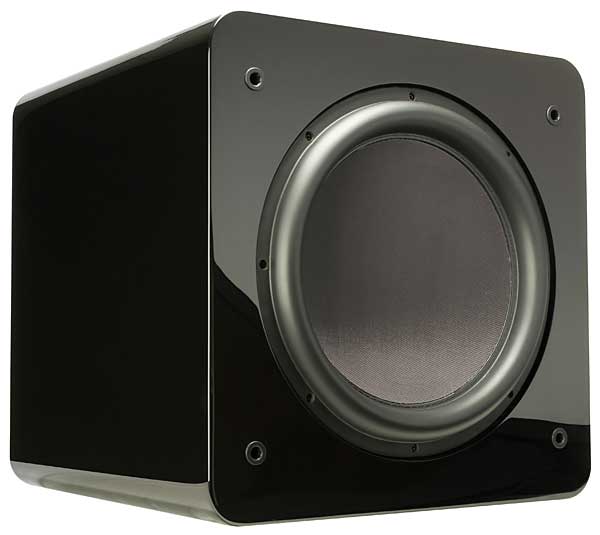
SVS SB13-Ultra powered subwoofer

As an audiophile, I've come to associate the size, weight, and price of a subwoofer as quick'n'dirty indicators of its quality. The subwoofers that have worked best in my large listening room—the Velodyne ULD-18 and DD-18+, Muse Model 18, REL Studio III, JL Audio Fathom f113, and Revel Sub30—each weigh more than 130 lbs and cost more than $2500. With some of my reference recordings, all of them have achieved what Robert Harley described in the April 1991 issue of Stereophile as the goals of a quality subwoofer: "seamless integration, quickness, no bloat, and unbelievable bass extension." Yet are back-busting weight, unmanageable size, and nosebleed cost essential to achieving those goals?

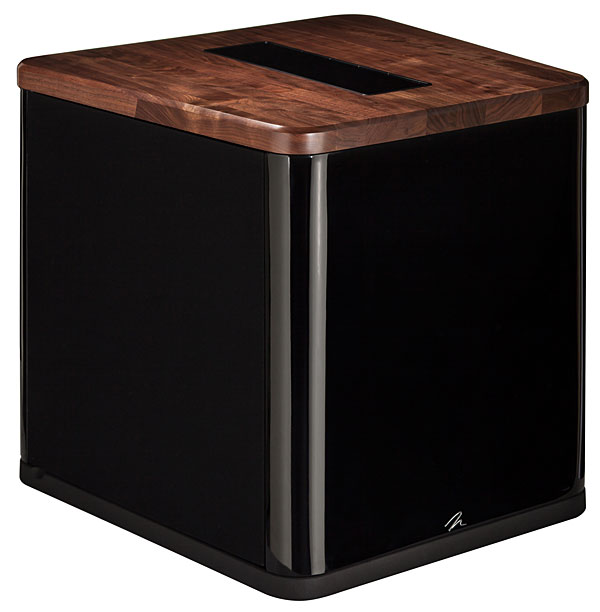
MartinLogan BalancedForce 212 subwoofer

I like big bass, but I cannot lie
Tubby thumpers need not apply
And when a speaker drops in with itty-bitty bass
It puts a frown upon my face
I get bummed . . .

—Sir BassaLot, first audiophile rapper, 1992

Some folks put a pair of bookshelf speakers on stands in their room and are happy as clams. I imagine that they imagine the missing bass and never give it another thought. Not me, and perhaps not you. Some of us want to hear it and feel it, just as we would real instruments. We want sex in the room.

Nelson-Reed 1204 subwoofer

I was so impressed by the Nelson-Reed 8-04/B loudspeaker's low-end range that I seriously doubted the add-on subwoofers could add enough of significance to be cost-effective.

I was wrong.

Two of the subwoofers were provided, along with the necessary electronic crossover unit. Each 1204 unit contains four 12" woofers in a very solid sealed enclosure, with two facing to the front and two facing the rear. The electronic crossover has three controls, besides the AC power switch: a hardwire (footnote 1) bypass switch, a stereo/mono switch, and a subwoofer level control. In the stereo mode, the low frequencies are kept separate, left from right; in mono mode, they are blended together for feeding to a single subwoofer. I will not resurrect the question of whether or not it is important to maintain stereo separation into the LF range, except to echo N-R's observation that there is no LF separation on analog discs to begin with; the lows are mixed together, to limit vertical excursions of the cutting stylus that could cause it to rise above the disc surface or, worse, dig into the aluminum base of the master disc.

Sumo Samson subwoofer & Delilah crossover

Welcome back, Ladies and Gentlemen, to the continuing saga of the Englishman's Search for True Bass. In the previous episode (footnote 1), you witnessed Our Hero tussling with the problems of ported vs sealed-box woofer loading for full-range speaker systems. His conclusion? That ported designs may offer low-frequency quantity but it always seems to be at the expense of quality. If it's bass quality you want, you are better off with well-tuned sealed boxes, which explains why he is an unashamed fan of relatively small speakers with fast, tight upper bass. In this month's thrilling installment, JA—stiff upper lip thrust forward—wrestles with the problems of extending the bass response of his preferred speakers with a subwoofer from the Californian company of Sumo! Now read on . . .

Bowers & Wilkins DB1 subwoofer

Although many high-end audio products are described as revolutionary and as breakthroughs in design when new, most audiophile components now on the market have not changed our way of relating to such products in the way the iPad has done. Once in a while, a new audio product does move in that direction by enabling the audiophile to do install a product and optimize its performance in a different way.

Muse Model 18 subwoofer

I should begin this review by confessing that I've never been a fan of subwoofers. Most subwoofer systems I've heard have been plagued by a familiar litany of sonic horrors: poor integration between subwoofer and main speakers, boom, bloat, tubbiness, slowness, excessive LF output, and an overall presentation that constantly reminds the listener he is hearing a big cone moving. To me, subwoofers often sound detached from the music, providing an accompanying thump that bears little relationship to the sound from the main speakers. Rather than revealing the music's harmonic underpinnings, subwoofers often obscure them in a thick morass of featureless boom. In addition, adding a subwoofer often destroys the qualities of the main speakers that made you buy them in the first place—just to name a few of my observations (footnote 1).

Other than that, I like subwoofers.

Gradient SW-57 subwoofer

There are two kinds of audiophiles: those who own original Quad ESL speakers and those who don't (footnote 1). This review is for the former, although the latter may find it of some interest. The Gradient SW-57 subwoofer attempts to do for the original Quad (footnote 2) what Gradient's SW-63 (footnote 3) does for the Quad ESL-63: supply the bottom octave while relieving the ESLs of the strain of reproducing low bass.

Velodyne ULD-18 & ULD-15 subwoofers

Velodyne introduced their series II subwoofer line in the fall of 1988, and it seems timely to review their largest, most powerful unit, the ULD-18. As the line's flagship, this Velodyne subwoofer represents the most sophisticated and expensive system offered by the company. It is sold as a system, complete with driver, enclosure, amplifier, control unit, electronic crossover, and servo cable and circuitry. Velodyne's unique servo circuitry, manufacturing techniques, and aggressive sales technique emanate from the company's designer, David Hall.
Advertisement
Advertisement
Advertisement