
As We See It

Sort By:  Post Date TitlePublish Date

Drunk on Vinyl

It was a simple little thing that turned into so much more. Michael Lavorgna started it. Out of the blue and as sudden as spring, he sent an e-mail to me and speaker designer John DeVore: "Let's plan a trip to the Princeton Record Exchange!" And, just in case 60,000 beautiful LPs wouldn't be enough of a lure, Michael put a cherry on top: "The Triumph Brewing Company is right next door!"
A Bad Idea That Would Make a Worse Law

As the May issue was being put to bed, the Internet was all aflutter over a proposal by digital strategy consultant Jim Griffin to have Internet Service Providers (ISPs) levy a $5 surcharge—a "network licensing model"—on all broadband users. Under this model, Griffin proposes that ISPs collect the fee, which would then be paid into a pool to "compensate music-copyright holders." Griffin says that consumers who do not download digital music files would not be forced to pay the surcharge, but that he anticipates "70–80% would pay" for all the content they could download.

Feeling As One

A few nights ago, I listened to mezzo-soprano Lorraine Hunt Lieberson's recording of J.S. Bach's great solo cantata, "Ich habe genug" (It is enough), BWV 82 (Nonesuch 79692-2). Hunt Lieberson was one of those rare mezzos, like Janet Baker and Kathleen Ferrier before her, whose voice conveyed an innately spiritual sense of connection with something greater than the individual self. Especially when she sang softly, she was able to imbue her tone with a hallowed reverence that is easier to feel than describe in words. To the extent that anyone can communicate the "tender mercies" and sacred intimacies of life, love, and spirit, Lorraine Hunt Lieberson proved herself a master.

Inhumanly Perfect Performances?

"Modern recordings, for all their glory . . . have conditioned audiences to expect an inhuman degree of performance accuracy, comparable to what a recording studio's editing team can produce by patching together the best moments from multiple takes."—James F. Penrose, Wall Street Journal, January 25, 2008

Music Served

I'm writing these words on the flight home from the 2008 Consumer Electronics Show, held January 7–10 in Las Vegas. I wasn't sure what to expect at this year's CES. Though the official stats show that the US economy has grown for the fourth straight year, audio retailers I spoke with before the Show feel that that economic growth has not resulted in any increase in consumers' disposable incomes. In fact, with the drying up of credit, retailers are concerned that 2008 may well be a step back from 2007 in overall sales, and that high-end audio—a niche category within a niche category—will be adversely affected by the relative impoverishment of the middle class.

Is Ambisonics the Future of Sound Reproduction?

Scene the First. You are sitting in a concert hall, dead center, row M; the cellist walks on to the stage, sits down and starts to play the prelude to the first of Bach's">http://www.stereophile.com/musicrecordings/1192yoyoma">Bach's solo cello suites, that intricate unfolding of a rhapsodic melodic line within the tight framework of an implied chordal structure. Melody, harmony, rhythm—none exist at any one point of time in this most exquisite of Bach's solo instrumental writing, yet the skill of the composer, coupled with the artistry of the musician, allow you to perceive the abstract as reality.

Is It Real? Or Is It...

Enid Lumley accosted me in the corridors of Santa Monica's BayView Plaza Hotel in March: "That doesn't sound like a real piano!" I was taken aback. The sound to which the redoubtable Ms. Lumley was referring emanated from a 7' Steinway we had hired for James">http://www.performancerecordings.com/">James Boyk to play at the Stereophile show. Jim was conducting a series of tutorials on how the sound of a real piano is constituted, so Enid's criticism, on the face of things, seemed absurd. As my face obviously showed this conclusion, she hastily explained that, of course it was a real piano, but the fact that it overloaded the 40-seat room in which it was being played caused it to sound different from the sound of a real piano played in a concert hall. To lead visitors to the show to expect piano records to sound similar to what Jim was producing was dishonest.

Measurements, Maps & Precision

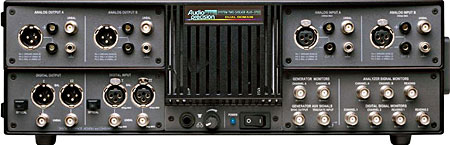
As I wrote in this space last month, test-equipment manufacturer Audio Precision has loaned Stereophile a sample of their top-of-the-line SYS2722 system, which has both significantly greater resolution and greater bandwidth than the Audio Precision System One Dual Domain we have been using since 1989. The reviews you can read in this issue include the first measurements I have performed with this impressive piece of gear, though there are still a number of graphs I produced using our System One. In fact, with the equipment I tested using the SYS2722, I performed duplicate sets of measurements using both the System One and the Miller Audio Research QC Suite in order to get a handle on how close the three systems agreed. (They did on the tests where the SYS2722's improved resolution was not a factor.)
Advertisement
Advertisement
Advertisement