

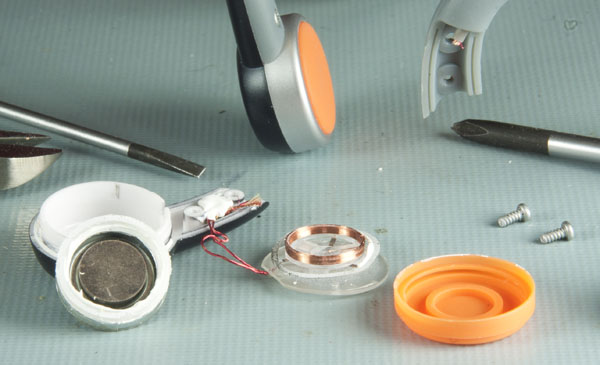
TEAC Filltune HP-F100
Going in, I thought there was no way I was going to hear any high frequency performance from either of these bone conduction headphones. I was wrong. These magnetostrictive transducers actually deliver surprisingly good uppermids and low-to-mid treble performance. No way they're anywhere near transparent, but they are surprisingly articulate and inteligible. From around 600Hz and below however, they really drop off, and the bass is virtually non-existant. I can see why tactical teams use them though, understanding poor quality whispered speech would be quite easy with these headphones. None the less, the fidelity of the HP-F100 headphone is miserable overall, and I can see why TEAC discontinued them. It's a really cool party trick, but that's about as far as it goes. I'm tempted to see if TEAC would let me hold on to them for meets and shows because headphone enthusiasts would get a kick out of having the experience. But I'd never use them around the house. AfterShokz ($59.95)
These are marketed primarily for runners who wish to listen to music while outside to retain their situational awareness to prevent accidents. Because these cans don't cover your ears, you are able to hear your surroundings unimpeded. But the problem is more complicated than that.
I get news feeds about headphones, and I can tell you that the number of people killed by trains while wearing headphones is simply unbelievable. I reckon I read reports of this type of tragic accident two or three times a month! And pedestrians getting tangled up with cars is way worse. (USA Today article about headphone accidents.) PEOPLE! PAY ATTENTION!!!
I'm all for improved safety, but the problem is more than just not being able to hear with headphones on. The problem is inattentional blindness. If you're paying attention to the music, it's extremely easy not to pay attention to something else, even if it's in plain view or earshot. Yes, loud music on headphones and sealed headphones will absolutely get in the way of you not hearing things. But music played at modest levels in an open, earpad type headphone (the Koss Porta Pro for example only attenuate outside noise 1dB---a barely detectable amount of isolation) will still allow you to retain most situational awareness. The key is PAYING ATTENTION to what's going on around you.
Now, if the Aftershokz delivered good sound, I'd be all for them, but they don't. The audio quality is abysmal. Unlike the magnitostrictive drivers, these cans try to make bone conducted sound by mechanically vibrating along with the music, and driving the vibrations through the skin and into the bone. These headphones simple aren't able to make strong enough contact with the bone of your cheek and drive the signal hard enough to sound good. Highs are virtually non-existant, and as you drive up the lows you start to feel the vibrations of the skin on your cheek rather than hear it in your ears. Push the bass harder, and it feels like butterflys are wrestling in front of your ears. Additionally, since the Aftershokz are vibrating significantly in front of your ears, you do hear sound from them through your ears in the normal manner, and it's quite distracting.
I found that if you plug your ears they get much louder due to the occlusion effect. Though almost tolerable in terms of sound quality if you put ear-plugs in, it completely defeats the intended purpose of these cans for situational awareness. Besides, if you're going to use them like this, why not just get some in-ear monitors.
Summary
While bone conducted audio makes all sorts of sense for applications in hearing assistance, under water listening, and tactical military and law enforcement, it just doesn't pan out for recreational music listening. It sounds like crap. People who want to be safer running outdoors in urban areas should use open, earpad type headphones and play the music at low levels. Or better yet, just leave the music at home and enjoy the run.
The Aftershokz just seems to me like a solution in search of a problem, and they certainly haven't found it here. Definitely not recommended.
No measurements this time ... my dummy has calibrated ears, but it's cheek is stone deaf.
Resources
USA Today article about pedestrian headphone accidents.
Aftershokz product page.
TEAC Filltune HP-F100 product pdf.
Similar to the Aftershokz is the Audiobone.
Some tactical headset info.
Amphicom underwater guided tour products.
Underwater music player SwimMP3 product page.
Wikis on: bone conduction audio; bone conduction auditory brain stem response; bone anchored hearing aids; MRI; and magnitostriction.
Going in, I thought there was no way I was going to hear any high frequency performance from either of these bone conduction headphones. I was wrong. These magnetostrictive transducers actually deliver surprisingly good uppermids and low-to-mid treble performance. No way they're anywhere near transparent, but they are surprisingly articulate and inteligible. From around 600Hz and below however, they really drop off, and the bass is virtually non-existant. I can see why tactical teams use them though, understanding poor quality whispered speech would be quite easy with these headphones. None the less, the fidelity of the HP-F100 headphone is miserable overall, and I can see why TEAC discontinued them. It's a really cool party trick, but that's about as far as it goes. I'm tempted to see if TEAC would let me hold on to them for meets and shows because headphone enthusiasts would get a kick out of having the experience. But I'd never use them around the house. AfterShokz ($59.95)
These are marketed primarily for runners who wish to listen to music while outside to retain their situational awareness to prevent accidents. Because these cans don't cover your ears, you are able to hear your surroundings unimpeded. But the problem is more complicated than that.
While bone conducted audio makes all sorts of sense for applications in hearing assistance, under water listening, and tactical military and law enforcement, it just doesn't pan out for recreational music listening. It sounds like crap. People who want to be safer running outdoors in urban areas should use open, earpad type headphones and play the music at low levels. Or better yet, just leave the music at home and enjoy the run.
USA Today article about pedestrian headphone accidents.
Aftershokz product page.
TEAC Filltune HP-F100 product pdf.
Similar to the Aftershokz is the Audiobone.
Some tactical headset info.
Amphicom underwater guided tour products.
Underwater music player SwimMP3 product page.
Wikis on: bone conduction audio; bone conduction auditory brain stem response; bone anchored hearing aids; MRI; and magnitostriction.















